
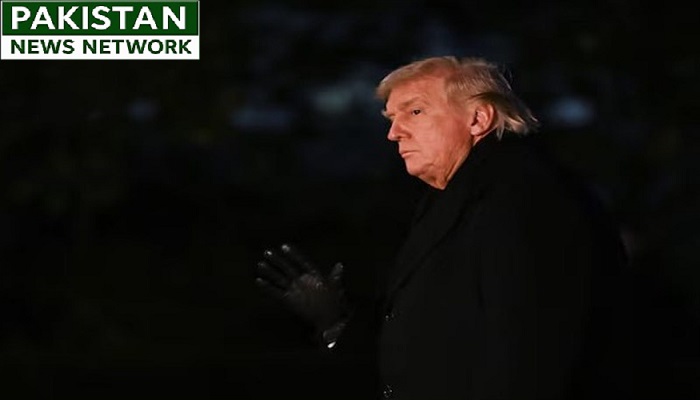
PNN – A British media outlet has reported that Trump is trapped in a quagmire regarding Iran—caught between two options, one bad and the other worse—with no apparent way out.
According to the report of Pakistan News Network and amidst ongoing analysis by Western and American media circles regarding the regional conflict and the crisis facing the U.S. and its allies, the British magazine The Economist has examined the complex options facing the United States vis-à-vis Iran in an article titled “Trump’s Iran Quagmire: Neither Decisive War nor Lasting Peace.” A summary of the article follows below.
The Entire Region in a State of Tension and Instability
An interim peace agreement between the United States and Iran has failed to establish a lasting ceasefire or pave a clear path for negotiations. The Strait of Hormuz is effectively closed and exchanges of fire continue, even as Gulf States strive to reach a provisional agreement to reopen the waterway and avert further escalation.
A few days ago, U.S. President Donald Trump backed away from his threat of a “massive attack” on Iran, stating that negotiations were progressing; however, Tehran rejected the latest proposals. This contradiction highlights the fragility of existing understandings and the continued reliance of both sides on a combination of military pressure and limited diplomatic efforts.
The United States and Iran signed an interim peace agreement on June 17. Under this understanding, the two countries were supposed to move closer to a comprehensive agreement, but instead, they soon returned to wrangling over the Strait of Hormuz. Even if diplomats manage to reach a solution—which seems unlikely—it might amount to nothing more than a stopgap measure for an agreement that was fragile from the start.
This understanding began to unravel on July 6, with an exchange of fire between the two sides at sea over the Strait of Hormuz; the US subsequently launched about two weeks of sustained airstrikes against Iran—targeting primarily infrastructure in the country’s south—while Tehran retaliated with intense missile and drone attacks on US bases in Persian Gulf nations and added Jordan to its list of targets.
However, on July 24, Trump abruptly halted the bombing campaign against Iran, with US officials stating they were keen to give diplomacy a chance. Privately, the Americans also expressed concern over dwindling stocks of air-defense interceptor missiles and voiced doubts regarding the effectiveness of limited airstrikes.
Iran Insists on Full Control of the Strait of Hormuz
For its part, Iran has halted attacks on commercial vessels; however, the Strait of Hormuz remains closed, and the number of countries utilizing its southern passage has dropped to virtually zero. Amidst this situation, a delegation of Omani officials traveled to Tehran last weekend for talks. While Iran does not negotiate directly with the United States, Oman acts as an intermediary between the two sides.
In this context, Muscat presented a proposal to Tehran that includes a formal ten-day ceasefire and a plan to reopen the Strait of Hormuz. Under this plan, Iran and the Persian Gulf states would jointly manage the waterway through a shared mechanism.
Under the proposed framework, ships would not pay mandatory transit fees; however, a joint consortium could collect “voluntary contributions” to fund navigational aids, environmental services, and other amenities—a model similar to the arrangements currently in place for the Strait of Malacca in Southeast Asia.
Tehran, however, rejected the proposal, insisting that any agreement must grant Iran full control over shipping in the Strait of Hormuz. Subsequently, on the night of July 29, Iran targeted a U.S. base in Jordan with a missile, and the United States launched a new round of airstrikes against Iran in the early hours of July 30.
Thus, less than a month after the signing of the memorandum of understanding between Iran and the United States, it appears that a significant portion of the agreement has lost its effectiveness. The first clause stipulated that the United States and Iran had agreed to end the war “permanently,” yet hostilities resumed less than three weeks later.
Trump’s bad and worse Options in the Quagmire of War with Iran
In this situation, Trump faces difficult choices. Escalating the conflict carries significant risks, while accepting Iran’s control over the Strait of Hormuz would be embarrassing for him domestically and alarming for his Persian Gulf allies.
Against this backdrop, it appears Trump is playing for time. He ramped up military pressure and threats—pushing the price of Brent crude above $100 a barrel on July 23—before backing off and causing prices to plummet.
Trump had hoped to further pressure Iran’s economy by blockading its ports and keep the conflict in a state of equilibrium; however, Iran’s attacks on Jordan demonstrated that the United States does not have sole control over the pace of this war.
Amidst this, U.S. allies in the region are feeling anxious and confused. Israeli Prime Minister Benjamin Netanyahu met with Trump at the White House on July 28, but the meeting was unusually low-key; Netanyahu entered through a side entrance, while Trump bypassed the customary briefing with reporters in the Oval Office. The following day, Saudi Defense Minister Khalid bin Salman made a brief visit to Washington.
With the continuation of attacks and the absence of serious negotiations regarding the nuclear issue, sanctions, and maritime arrangements, the possibility of a renewed escalation of tensions persists. Furthermore, the ambiguous text of the Islamabad Memorandum has failed to resolve any of the fundamental issues between the parties, and there are no strong indications that a new agreement—if reached—would be capable of addressing the root causes of the dispute.