
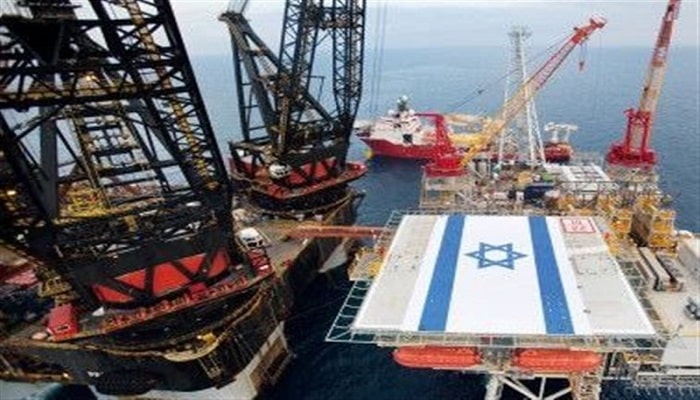
PNN – A Zionist media outlet revealed that the war with Iran created a major crisis in Israel’s energy sector, especially exports.
According to the report of Pakistan News Network, following the major energy crisis in the region and the world that emerged following the US and Zionist regime’s war against Iran and our country’s crushing response to the aggressors at various levels, Israeli reports revealed the increasing pressure from Egypt and Jordan on Israel and the United States to resume gas supplies from the Tamar platform, amid concerns about the collapse of the power grid.
The Strategic Importance of the Tamar Gas Platform, Within Iran’s Reach
The Hebrew newspaper Yedioth Ahronoth examined the Zionist regime’s energy crisis as a result of the war with Iran and how this war threatened the supply of gas to Egypt from Israel’s Tamar gas platform in an article, which is explained below.
Today, the energy sector in Tel Aviv is struggling to recover from the aftermath of 40 days of war under a constant barrage of rocket fire. The Leviathan and Karish platforms were shut down for fear of a direct hit, a move that cost the Israeli economy billions of dollars, while the Tamar platform alone remained in the field.
Israeli journalists who visited the Tamar gas platform heard about the intense tension at sea and spoke to workers who were forced to stay there despite the danger.
The Tamar platform, built at a cost of about $3 billion and commissioned in 2013, became the centerpiece of Israel’s energy sector during this period, single-handedly supplying all of Israel’s gas consumption during the war, thus preventing a blackout scenario.
The platform is operated by American energy giant Chevron and is manned by a trained team of about 40 people, including American and Israeli engineers, technicians, and system operators.
A worker at the Tamar gas platform confirmed that when a drone approaches, we know it is directed to hit the platform, and in this case, the emergency system is immediately activated, stopping the flow of gas and disconnecting the pipes within seconds.
This operation is carried out through automatic valves located on the platform and on the seabed, whose task is to lock the gas in the tank and subsea pipes, preventing a massive leak of flammable gas that could lead to a major explosion and unprecedented damage, even if the platform itself suffers physical damage.
This capability allows the Department of Energy and Chevron to make quick preemptive shutdown decisions whenever there is doubt about a missile launch toward the platform, as happened several times during the recent battle.
But logistical challenges, such as getting people in and out and bringing in outside contractors, are costly, and convincing workers and contractors that the Tamar platform is safe is also a major challenge.
Chevron operates in over 100 countries around the world and has very strong relationships with global contractors, yet many foreign contractors were reluctant to come to Israel (Occupied Palestine) since October 7, and eventually, due to Chevron’s reputation as a reliable company, they agreed to come and install a 150-kilometer pipeline during the war, which allowed them to reach peak production at Tamar.
Israel’s Energy Sector’s Big Problem in the War with Iran
Israel’s energy sector became a central target for Iran during the recent war, during which Iran attempted to cause widespread power outages in Israel by targeting strategic facilities. Tehran is well aware of Israel’s growing dependence on natural gas, which accounts for about 70 percent of its electricity generation, and knows that damaging offshore gas platforms could cripple Israel’s economic activity.
This situation has also turned Israel’s energy abundance into a major weakness. The Haifa refinery complex was hit by a direct Iranian bombardment last month, and at the same time, drones and missiles were fired at gas platforms in Israel’s exclusive economic zone.
This situation presented Israel’s security apparatus with a complex dilemma, because while there is a huge risk of damaging an active platform, a complete shutdown of gas platforms could lead to immediate damage to electricity supplies and the need to use expensive and polluting fuel.
Ultimately, despite the land and sea defense system for the platforms in which billions of shekels (Israeli currency) had been invested, it was decided to shut down the Leviathan and Karish platforms before the war began, while the Tamar platform remained active under heavy protection to provide the minimum energy needed by the market.
Israel suffers severe economic damage as gas platforms shut down over fears of Iranian attacks
The decision to shut down two of Israel’s three gas platforms for an extended period has come at a huge economic cost and left unanswered questions about Israel’s energy readiness for future conflicts.
The gas shutdown has cost the Israeli market about 1.5 billion shekels in just four weeks, according to a report by consulting firm BDO, prepared by Chen Herzog, a senior Israeli economist, due to a roughly 22 percent increase in electricity costs caused by a shift to more expensive and polluting fuels such as coal and diesel.
The report also cited a loss of about 400 million shekels in government revenue from royalties and taxes, in addition to a damage of about half a billion shekels to GDP from reduced profits for gas companies.
Most of the gas produced from the Tamar platform is directed to the Israeli market, while a large portion of the gas stored on the Leviathan platform is intended for export to Egypt and Jordan, and these two neighboring countries are very dependent on Israeli gas.
Energy Export Crisis to Egypt and Jordan
Egypt is currently grappling with a severe energy crisis, including planned power outages, and during the war, the Egyptians and Jordanians, fearing a collapse in power supplies and popular protests, put great pressure on Israel and the United States to resume gas supplies to them.
The Tamar platform operates as a floating plant, consisting of a complex network of tanks and refining towers that separate sand and liquids from the gas, and below, a remotely operated technological highway.
The gas is extracted from geological formations about 5 kilometers below the sea surface, where enormous pressures and high temperatures prevail, and from there it travels to a submarine system of wells on the seabed at a depth of 1,700 meters, beginning its 150-kilometer journey in giant pipes laid on the seabed to reach the processing platform off the coast of Ashkelon.
In the meantime, the old Mary Bay platform can be seen directly in front of us, which once supplied gas from the Yam Tethys reservoir and was decommissioned in 2013. Although it is no longer producing gas, it remains an important logistical asset for Chevron, serving as a housing and storage facility for crews who are transferred to the Tamar platform.
The Tamar platform is a huge profit engine for Chevron, feeding the domestic market and export agreements with Egypt and Jordan, while also providing the Israeli government with a measure of American immunity from security threats.
The Leviathan platform, also operated by Chevron, only returned to operation on March 24, about a month after the war began, while the Karassh platform, operated by the British company Energian, remained inactive until the ceasefire took effect on April 8.
Israeli security apparatus confused over strategy to protect energy platforms in war
Meanwhile, developments and decisions raise questions about stability and certainty in the gas sector, and while central industrial facilities such as the Haifa refinery continued to operate, decisions to completely shut down gas platforms were sometimes made without detailed explanations or clear criteria.
Despite this, a huge sum of around 3 billion shekels has been invested in defending the platforms, including the purchase of defense ships from Germany and various technological tools, but the gap in operational decisions remains a matter of debate.
While the Israeli cabinet attributes this to security and energy continuity considerations, some market sectors point to the identity of the operators as a determining factor, implying that platforms operated by the American company Chevron have priority over those operated by the British company Energian.
A crisis of confidence for foreign investors in Israel’s energy sector
The Israeli Energy Ministry initially focused on the flow of gas to the Israeli market, but the fact that other platforms have been shut down for weeks is also affecting the cabinet’s ability to attract new investment. It is also sending a signal of regulatory instability as it seeks to encourage international companies to enter drilling activities in economic waters.
For foreign investors, such uncertainty could be seen as a significant risk and damage the attractiveness of the local market.
The Challenge of Paying Compensation to Gas Companies
Everyone knows that a complete shutdown of a platform has far-reaching economic and operational consequences, and yet gas companies have received no answers about financial compensation for the estimated financial damage of hundreds of millions of shekels.
In addition, questions are raised about whether the decision to close the platforms will be reversed every time the missile threat returns, and whether the billions of shekels invested in defending them may not be enough to continue operations even in a time of war.
Energy officials have received compensation requests from the companies, and it is a legal matter that they will review and decide on whether to pay them compensation.
It is worth noting that Egypt and Israel signed an agreement in 2018 to export Israeli gas from the Leviathan field to Egypt for $15 billion over 10 years. Egypt’s East Mediterranean Gas Company (EMG) receives the Israeli gas and processes it at Adco facilities to export it as liquefied natural gas to Europe and Asia. Jordan also imports Israeli gas from the Tamar field for power generation.
These agreements, despite their political sensitivities, are a pillar of regional economic cooperation. Egypt depends on Israeli gas to fill the gap between growing domestic demand and surplus exports, while this dependence raises security concerns in the face of rising regional tensions.