
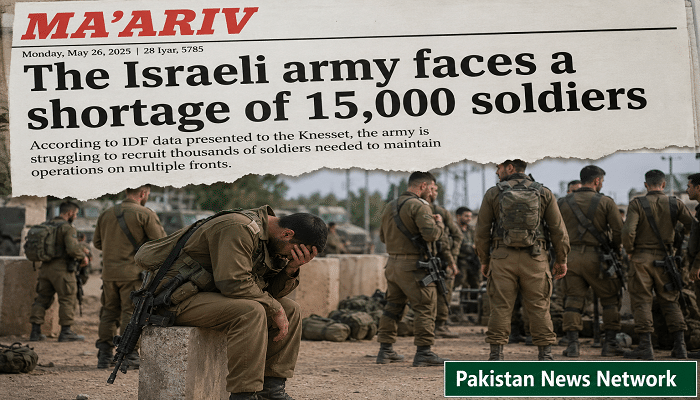
PNN – The Zionist newspaper Ma’ariv reported on the worsening manpower crisis in the Israeli army, writing that the ongoing war on several fronts since Operation “Al-Aqsa Storm” has depleted the reserve forces, and estimates indicate a shortage of about 15,000 soldiers; a situation that has even raised the issue of recruiting foreign forces with high salaries.
According to the report of Pakistan News Network; The Zionist newspaper Ma’ariv reported on Saturday that there is growing concern among Zionists about the “growing crisis of shortage of soldiers.” The newspaper noted that the pressure on the regime’s army reserves has multiplied due to the ongoing war on several fronts since the start of Operation Storming Al-Aqsa, and acknowledged that the “people’s army” model is not working in the occupied territories.
Ma’ariv says that the reason for this is that the desire to serve in the military in the Zionist regime has decreased and the crisis of recruiting “ultra-Orthodox” Jews into the regime’s army remains as strong as ever.
The newspaper, noting that the Israeli army is currently “suffering from unprecedented attrition,” continued by writing that Eyal Zamir, the Israeli army’s chief of staff, estimated a shortage of 15,000 soldiers for May 2026, which is a dangerous operational vacuum and threatens the army’s ability to continue the war.
Ma’ariv proposed that the Israeli army should recruit troops from foreign countries in exchange for high salaries to compensate for its shortage of troops, noting that this proposal is based on Ukraine’s experience in recruiting foreign troops during the war with Russia, in which tens of thousands of soldiers joined the Ukrainian army in exchange for financial incentives and high salaries.
According to the report, Israel currently has foreign currency reserves worth approximately $236 billion, some of which the regime could use to finance foreign troops. According to Ma’ariv, the cost of recruiting this number of troops for Israel is estimated at between $2.5 and $3 billion per year; therefore, the regime’s army could consider a salary of $10,000 for each foreign soldier.
These forces could be recruited from Eastern Europe, Latin America, and the United States. Experts emphasize that raising such issues is indicative of the manpower crisis that the Israeli army is facing after months of long war. In addition, the regime’s reserve forces are attritional and have experienced severe internal disagreements over the division of responsibility for the war.