
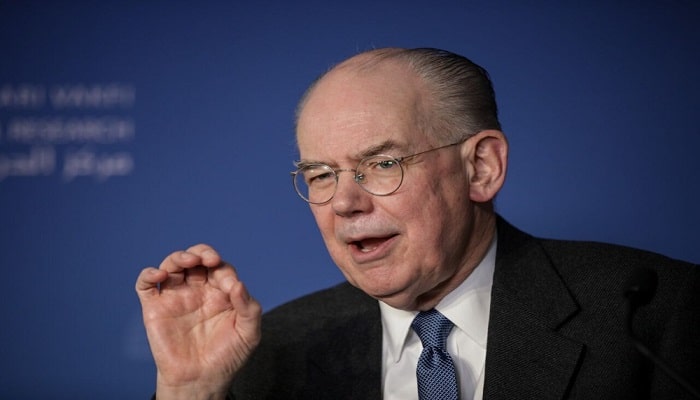
PNN – Emphasizing the deep nationalism of Iranians, the University of Chicago professor John Mearsheimer said that America does not have a strategy for victory and that an end to the crisis is only possible through a negotiated agreement.
According to the report of Pakistan News Network; John Mearsheimer, a professor of political science at the University of Chicago, referred to the ongoing war between the United States and Iran and emphasized that an end to this crisis is most likely only possible through a negotiated agreement, although reaching such an agreement will be very difficult.
At the beginning of this conversation with Piers Morgan, a prominent British presenter, he said, referring to the situation on the ground, that there is not even a sustainable ceasefire at the moment and that the situation has developed in such a way that tensions have increased once again. According to him, the US decision to continue the blockade of the Strait of Hormuz caused Iran to react and close the route again; an issue that has led to mutual conflicts, including the seizure of ships, and has halted negotiations.
Complexity of negotiations and wide differences
Mearsheimer, emphasizing the great distance between the two sides’ positions, noted that even if they return to the negotiating table, reaching an agreement would be very complicated. He explained that the nuclear issue is only one of the issues in dispute, and numerous issues are also on the agenda, including sanctions, compensation payments, control of the Strait of Hormuz, Iran’s relations with resistance movements, and the US military presence in the region.
He went on to point out the stated goals of the United States at the beginning of the war, saying that Washington initially sought to change the regime in Iran, but now has focused on preventing the development of the nuclear program. The American analyst admits that achieving this goal is also impossible for Washington, because Iran is unlikely to give up its enrichment capacity.
America’s Miscalculations and Strategic Deadlock
The university professor also pointed out the incorrect assessment of the US and the Israeli regime of the war situation, stating that US President Donald Trump and Israeli Prime Minister Benjamin Netanyahu thought they could achieve victory with a quick and decisive attack, but this calculation was wrong.
Mearsheimer went on to emphasize that even some senior American officials, including those at decision-making levels, were skeptical about the success of this strategy, but ultimately the decision was made to enter the war, a war that he acknowledged was “disastrous.”
In another part of the conversation, he referred to the economic consequences of the war, saying that the closure of the Strait of Hormuz could have serious consequences for the global economy. According to him, the increase in energy prices and disruption in the export of oil and basic goods could face the international economy in a serious crisis, and some analysts even speak of the risk of a recession similar to the 1930s.
“Iranians are nationalists to the core.”
The American analyst emphasized that these same concerns have led the US president to seek to reduce tensions and extend the ceasefire, as any renewed attack on Iran could lead to the complete closure of vital energy routes.
Referring to Iran’s military capabilities, Mearsheimer said that Tehran still has a high capacity to attack and can target the vital infrastructure of countries in the region, an issue that could have far-reaching consequences.
He concluded by stating that the United States has no strategy for winning this war, and emphasized that continuing the military path will not only fail, but will also entail greater costs, and that the best option is a quick end to the conflict through diplomatic solutions.