

PNN – A new poll shows that Netanyahu is lagging behind the opposition even in the index of the most suitable person to be prime minister.
According to the report of Pakistan News Network, the latest poll by the Hebrew-language newspaper Ma’ariv indicates a significant shift in Israeli public opinion, which, if sustained, will be the final blow to Benjamin Netanyahu’s undisputed position. According to the results of the poll, the two main opposition figures, Naftali Bennett and Gadi Eisenkot, have now surpassed Benjamin Netanyahu in the “most suitable person to serve as prime minister” index; an index that had become one of the most important political bastions of the Israeli Prime Minister in recent months, and now it seems that that same bastion is collapsing.
The index of the most suitable candidate for prime minister can be considered (with some leniency) Netanyahu’s impregnable fortress against the opposition. In this index, Netanyahu was able to regain his previous position about 6 months after October 7, 2023, and has been at the top of the list for most of the time since then.
With the exception of Benny Gantz, who was at the top of the list for the first 6 months after October 7, 2023, and also Naftali Bennett, who was ahead of Bibi for some time after his official return to politics in June 2025, Netanyahu has managed to remain at the top of the index for most of the time since October 7, 2023, and on a larger scale, for most of the time since the 2022 elections.
To sum up this development in one phrase, Bennett and Eisenkot have temporarily conquered Netanyahu’s last impregnable stronghold. This stronghold was not a parliamentary majority, nor the unity of the ruling coalition, nor even organizational superiority within the right-wing camp; but rather Netanyahu’s leadership in the individual index of suitability for prime ministership. In fact, even during periods when his cabinet was faced with security crises, internal protests, coalition disputes, and pressure from the aftermath of the war, Netanyahu tried to present himself, at least at the level of “personal image,” as the most suitable candidate to lead Israel.
The importance of this index is such that it is said that the stability of each individual in it has a great impact on the survival of his power and his popularity with public opinion in the occupied territories. Some of Netanyahu’s entourage even suggested to him at one point that, because he is still ahead of his rivals in this index, he submit a bill to the Knesset to restore direct elections for the prime minister, like the three periods held between 1996 and 2001, and approve it using a parliamentary majority.
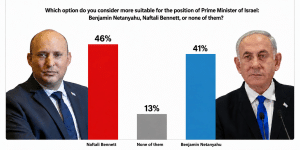
In the latest poll by the Ma’ariv newspaper in the race between Bennett and Netanyahu, Bennett won 46 percent of the votes, while Netanyahu received 41 percent. In addition, 13 percent of the participants stated that they had not yet made a clear decision on the matter.
The significance of this number becomes clearer when we compare it with the previous poll by the same newspaper on April 16, where Netanyahu was still ahead with 43 percent to Bennett’s 41 percent. Thus, in the space of about two weeks, the balance has completely changed, shifting the lead from Netanyahu to Bennett.
On the other hand, a similar situation is seen in the direct competition with Gadi Eisenkot, leader of the opposition Yashar party. According to the new poll, 44 percent of respondents considered Eisenkot more suitable for the post of prime minister than Bibi, while 42 percent chose Netanyahu and 14 percent answered “don’t know.”
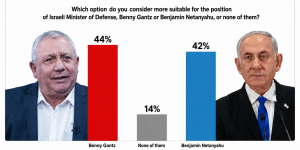
This result is also very significant compared to the previous poll, because at that point Netanyahu was leading with 45% to Eisenkot’s 38%. So the current Israeli prime minister is lagging behind not only one rival, but also both of the main alternative figures in this key indicator.
From this perspective, what has happened is not just a simple numerical decline, but could be a sign of the erosion of Netanyahu’s personal position in the public opinion of the residents of the occupied territories; a position that for years was considered one of his main sources of power. Netanyahu had always tried to present himself not only as the leader of a political camp, but also as the “only reliable option” to govern this regime in critical and complex security and regional conditions. If this image has been damaged in the minds of voters, the consequences will not be limited to a poll and could lead to a broader rearrangement of the political scene of the occupied territories.
At the same time, the results of the same poll show that Netanyahu’s definitive successor has not yet been established in the public mind. When Bennett and Eisenkot were compared in a direct competition, 33 percent considered Eisenkot more suitable and 32 percent preferred Bennett, while 35 percent said they had not yet decided. This high level of uncertainty shows that although Netanyahu’s position has been damaged, the Israeli opposition has not yet reached a consensus on a single figure and the intra-camp competition among his alternatives is still open.
In this context, the political polarization of the poll is also significant. According to the published data, Eisenkot has a stronger base among voters of some of Netanyahu’s opposition parties, while Bennett has the upper hand among another segment of the opposition. This suggests that the Netanyahu crisis does not necessarily mean the immediate formation of an undisputed successor, but rather that Israeli politics is entering a phase of transition, uncertainty, and competition over the post-Netanyahu legacy.
However, the key question is whether Netanyahu’s decline in the personal competence index is a temporary fluctuation or the beginning of a sustainable trend. Political experience in occupied Palestine has shown that public opinion can shift rapidly during periods of war, crisis, and coalition struggles. Therefore, it is too early to make a final judgment about Netanyahu’s permanent decline. But what is clear is that he now faces a serious challenge even in the area that until recently was one of his most important sources of superiority.