
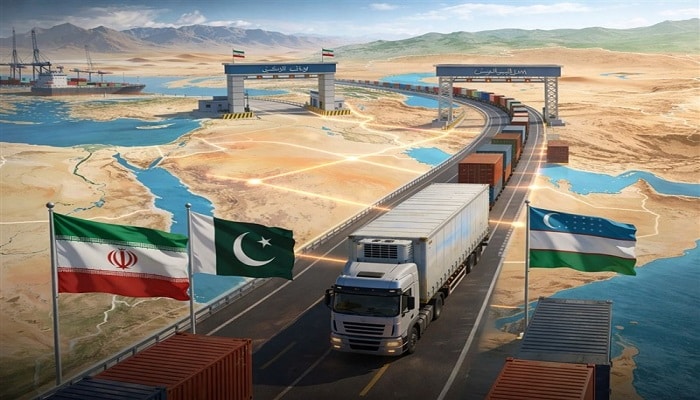
PNN – Pakistan began a new chapter in regional trade by sending its first export shipment to Uzbekistan via Iran.
According to the report of Pakistan News Network, in a strategic and important move, Pakistan officially launched its trade and transit operations within the framework of the “Pakistan-Iran Transit Corridor”. According to reports published by customs authorities and quoted by the Pakistan Today newspaper, the country’s first export shipment has been successfully sent via Iranian soil to Tashkent, the capital of Uzbekistan. This important event indicates the serious will of the countries of the region to benefit from Iran’s transit and geopolitical capacities.
According to reports, this inaugural and historic shipment consisted of frozen meat products, which were loaded and shipped using refrigerated trucks equipped with refrigeration equipment and in full compliance with international road transport standards.
The commercial cargo’s route began in Pakistan and, after passing through the strategic port of Gwadar, entered Iranian territory, eventually passing through Iran’s secure and extensive road network, reaching landlocked countries in Central Asia, specifically Uzbekistan.
Senior government officials in Islamabad emphasize that the main goal of activating this transit corridor is to facilitate and expedite land trade and create a safe, economical, and efficient alternative to long and costly sea routes, which are facing numerous challenges these days.
TIR International System; Catalyst for Regional Trade
Sanaullah Abro, Director General of Customs, Transit and Trade, Pakistan, while explaining the technical and operational details of this transit route, announced that the said corridor has been operationalized and activated under the TIR International System (TIR – Convention on International Road Transport).
This advanced customs system allows commercial cargo and freight trucks to cross the borders of several countries with minimal border inspections and customs formalities, thus significantly reducing the time and cost of transit of goods.
He continued his speech by adding that key border crossings and points, including the borders of Taftan (near Mirjaveh, Iran), Rimdan, Sost and the port of Gwadar, have been fully activated for transit under the TIR Convention procedure.
In this regard, administrative and customs procedures have also been optimized and facilitated to fully support and support the faster and smoother movement of cargo along this vital transit route.
Deeper Ties with Central Asia; Crossing Maritime Restrictions
At the official inauguration and commissioning ceremony of this transit corridor, Sanaullah Abro, along with Muhammad Rashid, Director of Transit at Pakistan Customs, symbolically and officially issued the order for the movement of the first shipment.
Senior officials present at the event described the initiative as an important part of the Pakistani government’s broader efforts to strengthen trade and economic ties with Central Asian countries and also significantly reduce exorbitant logistics costs.
Informed sources and economic experts quoted by Pakistan Today said that the new route will provide a much more cost-effective and economical option to exporters and traders.
This alternative route is also expected to significantly reduce the transit time of goods and greatly reduce the additional pressure on maritime trade routes, which have been disrupted due to global developments and high insurance costs.
This land transit corridor will not only reduce dependence on traditional routes, but can also increase the volume of cargo and trade traffic through Pakistan’s strategic ports, ultimately acting as a powerful driver for the country’s export growth.
Islamabad-Tashkent $2 Billion Trade Prospects
This remarkable transformation and infrastructure development comes at a time when Pakistan is seriously seeking to expand and deepen its economic interactions with the countries of the Central Asian region, and at the forefront of them is the Republic of Uzbekistan. The volume of bilateral trade between Islamabad and Tashkent has grown significantly in the past year, approaching the $500 million mark, indicating the high potential of the two countries to develop relations.
Currently, about 230 Pakistani-invested commercial and manufacturing companies are operating in various sectors within the territory of Uzbekistan, which indicates the depth of economic influence and the strategic desire of both sides for long-term cooperation.
The scope of this bilateral cooperation covers diverse and key sectors of the economy, including the textile industry, the production of pharmaceutical and medical products, the agricultural sector, as well as the chemical industry, each of which has high potential for foreign exchange and job creation.
Iran’s Key Role in the New Eurasian Trade Architecture
Both Pakistan and Uzbekistan, in their recent meetings and agreements, have agreed on a plan to increase the volume of bilateral trade to an impressive $2 billion in the near future.
To achieve this ambitious goal, several measures and actions are being discussed and considered, the most important of which is the expansion of the list of goods covered by the “Preferential Trade Agreement” (PTA), which facilitates trade between the two countries. In addition, easing and reducing the strictness of phytosanitary requirements and regulations (agricultural quarantine) as well as strengthening the basic infrastructure of trade, including the establishment and operation of Uzbek trade houses in important economic cities of Pakistan such as “Lahore” and “Karachi”, are on the serious agenda of the authorities of the two countries.
Meanwhile, Iran’s unique and undeniable role as a secure, stable, and expansive bridge between South Asia and the heart of Eurasia is becoming more and more apparent. Iran’s privileged geopolitical position and its extensive road and rail infrastructure have made it the safest and shortest transit route for connecting the region’s emerging economies.
The opening of this new transit corridor from Pakistan to Central Asia will not only bring immense economic benefits to Islamabad and Tashkent, but will also solidify Iran’s undisputed position as the region’s transit hub. These developments clearly demonstrate that land routes through the heart of Iran are the golden key to developing regional trade and neutralizing any trans-regional restrictions.