
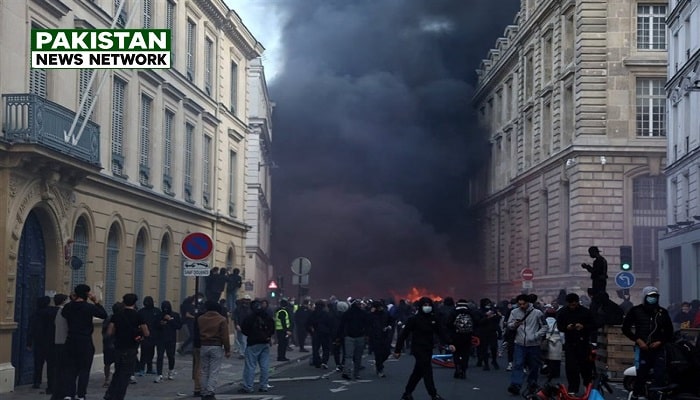
PNN – Hundreds of thousands of people in France have taken to the streets, marking the most extensive political and social protests seen in recent years.
According to the report of Pakistan News Network; France is facing a serious crisis following some of the most widespread unrest in recent years. Demonstrations against the government of Emmanuel Macron have resulted in damage across the country—a development that has once again brought the debate surrounding France’s political and social situation to the forefront of public attention.
The French government has labeled the demonstrators as “rioters” and “looters,” prompting a harsh crackdown by the police.
On Sunday, political leaders blamed one another for the unrest, while citizens looked on in disbelief at streets littered with broken glass and the charred remains of vehicles.
Three distinct groups converged during these protests: student movements demanding better classroom conditions, a nationwide movement protesting the rising cost of living, and groups that used the demonstrations to damage public property.
The protests have intensified a sense of financial and social crisis in France, the European Union’s second-largest economy. The government is attempting to pass an unpopular austerity budget; meanwhile, public discontent has bolstered the position of far-right leader Marine Le Pen, establishing her as a major contender ahead of next spring’s presidential election.
What happened?
According to the French Interior Ministry, more than half a million people took part in about 110 marches across the country on Saturday. This marked the largest day of protest since the demonstrations began about a month ago. However, the General Confederation of Labour (CGT)—one of France’s major trade unions—reported a higher turnout, stating that 800,000 people had taken to the streets.
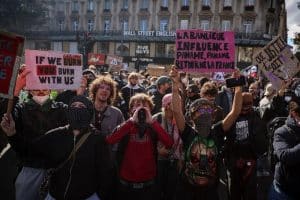
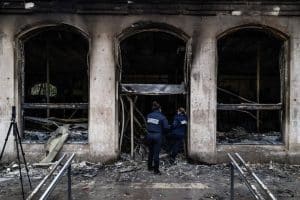
Alongside peaceful demonstrations, groups of protesters destroyed approximately 1,500 shops and a number of symbols of the French state. In the wake of these events, around 2,000 people were arrested.
In the city of Limoges, in central France, a fire almost completely destroyed the town hall. In Marseille, the country’s second-largest city, masked individuals entered a government building and toppled a bust of “Marianne”—a symbol of the French Republic.
Why Are Students Protesting?
Student protests began last month, driven by dissatisfaction with the state of schools.
Students are complaining about dilapidated school infrastructure, overcrowded classrooms, heavy curricula, a shortage of teachers and staff, and insufficient funding. Many are also calling for fundamental reforms to the state-run university admissions systems—systems they believe operate in a selective and unfair manner.
Students have blocked hundreds of schools so far. According to the government, at least 24 schools have been set on fire or damaged. Since September, thousands of people have been detained and more than 1,000 individuals—including police officers, students, and school staff—have sustained injuries.
The heavy-handed police response has further fueled the students’ anger. Prosecutors and the police oversight body are currently investigating at least 34 cases involving allegations of unlawful conduct by officers during the protests.
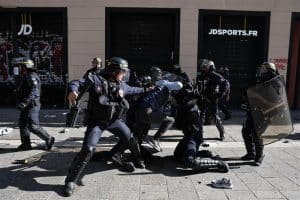
These cases include two instances of severe injury to adolescents: according to authorities, a 15-year-old boy’s left hand was likely severed from his body by the explosion of a police sound-and-blast grenade. Additionally, a 14-year-old boy sustained severe injuries and a permanent disability after being struck by a tear gas canister fired by an officer at close range.
Why did other groups join the student protests?
Throughout the month of October, labor unions and other protest groups gradually joined the student gatherings. By organizing larger marches, they expressed their solidarity with the students while simultaneously challenging a broader range of issues.
Some of the protesters are angered by rising living costs and increased fuel prices—a hike exacerbated, in part, by the war with Iran. Farmers have also joined the protests, citing the rising costs of agricultural production.
Social media accounts linked to the “Yellow Vests” movement have likewise called on people to take part in the demonstrations. Nearly a decade ago, this movement—sparked by opposition to rising gasoline prices and other issues—triggered a wave of street rallies and protests across France.
Left-wing parties have also supported these protests, viewing them as part of a broader wave of discontent directed at French President Emmanuel Macron. Macron, who is ineligible to serve more than two terms, is nearing the end of his presidency.
Social unrest and street protests have a long history in France. The student protests of 1968, for instance, brought the government to the brink of collapse and led to sweeping changes within French society.
What are the political consequences of the protests?
On Sunday, far-right leaders and the French government blamed far-left groups for the unrest. Specifically, they accused “La France Insoumise” (France Unbowed)—a major left-wing party—of playing a role in the emergence of the disturbances.
Sébastien Lecornu, a French government minister, accused the party’s leaders of fueling tensions by fostering distrust toward the police among protesting students. He also stated that some of the individuals who participated in the unrest belong to the “far-left” movement.
“La France Insoumise” has rejected these accusations. In response, the party’s leader, Jean-Luc Mélenchon, held the government responsible for actions that he claims set the stage for the unrest.