
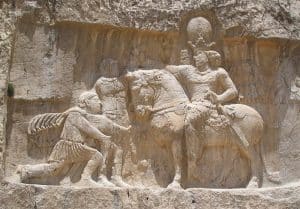
PNN – Rubio ought to know that part of Rome’s civilizational legacy is a fate similar to that of Valerian, who was brought to his knees by the Iranians.
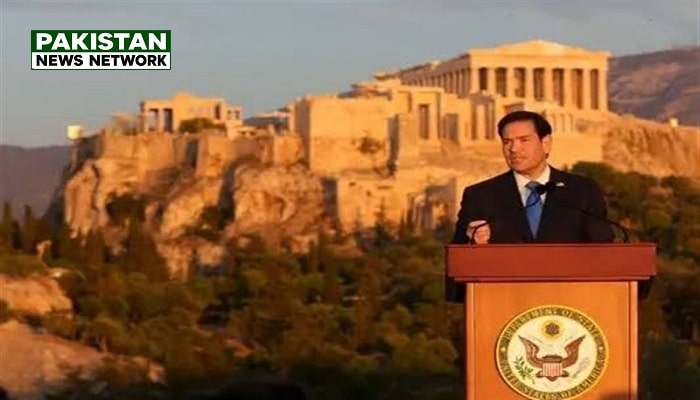
According to the report of Pakistan News Network; while U.S. President Donald Trump has repeatedly threatened to destroy Iranian civilization over the past seven months, U.S. Secretary of State Marco Rubio—during a recent visit to Athens—likened the current U.S. conflict with Iran to the war between Xerxes and the Spartans in an unusual and lengthy speech delivered in front of the Acropolis. In this address, Rubio characterized Iranians as plunderers, linked Western civilization—specifically that of ancient Greece and Rome—to the United States, and portrayed the U.S. as the heir to that civilization. Notably, this anti-Iranian stance taken by the Secretary of State of the terrorist U.S. administration is considered so significant by the West that even Elon Musk has shared the full video of Rubio’s anti-Iran remarks.
In part of his inflammatory speech, Rubio says: I stand here today as the foreign minister of that republic—and as a descendant of immigrants who traveled from Spain to the New World—to speak of a debt that neither the passage of time nor the distance of space can erase. He then describes American history as bearing the fingerprints of antiquity, noting that Greece is literally etched into the architecture of the American government—in the soaring columns, domes, and monuments throughout the capital. This framing articulates a claim of identity in which the United States is portrayed not merely as a global power, but as the heir and guardian of Western civilization. Rubio even describes himself as a “descendant of immigrants from Spain” who has inherited this legacy. Such a narrative elevates the conflict with Iran from a geopolitical dispute to a “clash of civilizations.”
Rubio then leaps across a span of 2,500 years, identifying Xerxes’ troops—who set fire to the Acropolis—as the direct ancestors of modern-day Iran. He states: Ultimately, they were defeated. The Iranians looted the temples, torched the sanctuaries, and razed the Acropolis to the ground. In Rubio’s framing, Iran is portrayed as an enemy—not merely a “regime,” but a “hostile civilization”—that has maintained a singular identity from the Achaemenid era to the present day.
In Athens, Rubio spoke of the debt owed to Western civilization and hailed the United States as the heir to Greece and Rome. Yet, the legacy of Rome encompasses more than just columns, the Senate, and Roman law. Rome also had a ruler like Valerian, who knelt before the Sassanid King Shapur I and was taken prisoner. Thus, if one is to claim the mantle of Rome’s heir, part of that legacy is the fate of Valerian—marked by the moment the preeminent symbol of Western civilization knelt before Iran.
Rubio begins his remarks by recalling the ancient Iranian attack on Athens and the plundering of its temples; he then contrasts the leaders of modern-day Iran with Western moral values and emphasizes the necessity of defending Western civilization. At one point in the speech, he states: And now, today, we stand at a crossroads. For the coming decade—and the decisions we make—will write the story of the next century. The path we choose will determine whether the West retains its position at the pinnacle of global power or resigns itself to a future of erosion, servitude, and decline… We must decide to act now, or we will lose the choice to act forever.
This particular remark from Rubio’s ecstatic pronouncements indicates that the conflict is no longer merely a simple, conventional, or even strictly inter-state war. Contrary to the propaganda of hostile networks—which portray the US-Iran conflict as a war between two states—Rubio’s statements reveal a far broader and more expansive perspective on the conflict. The issue is not limited to nuclear energy, oil, the Strait of Hormuz, or a handful of security dossiers; the pivotal turning point of this war is the acceptance of the Western-envisioned order. In effect, a country like Iran has no right to alter the rules of the global game led by the United States; instead, it is expected to abide solely by the structures and rules established by Western nations—with the U.S. at the helm—particularly in the post-World War II era. Otherwise, you are branded with labels such as “terrorist,” “anti-democratic,” or “fundamentalist,” and subjected to sanctions, blockades, and military attacks until you accept the order they desire.
To interpret the conflict as a simple, ordinary, or merely state-level affair—as the enemy’s propaganda would have it—is a view that borders on treason or, at best, naivety. The clearest examples of this are cases like Venezuela and Syria. In Venezuela, the abduction of Maduro by US military commandos resulted in no structural change to the government; the same individuals remained in power. The incumbent leaders simply chose to surrender their oil to the US to appease Trump. Consequently, the pressure and threats of military action ceased. The US government even stopped backing the opposition leader, María Corina Machado, in her bid for power.
In the case of Syria, too, Al-Julani—who was previously labeled a terrorist and the leader of the terrorist group Al-Nusra Front, and for whose capture a $10 million bounty had been set—has become a U.S. partner after rising to power. Despite the Zionist regime’s attack on the Syrian presidential palace, its occupation of Syrian territory, and its abduction of Syrian citizens, Al-Julani offers no significant reaction; he is content simply to enjoy the protection of the U.S. umbrella. This shift in labeling is entirely functional: anyone who accepts the U.S. order becomes a “partner,” whereas anyone who challenges it remains a “terrorist.”
Conclusion
Rubio’s speech serves as a civilizational declaration, positioning the United States as the heir to Greece and Rome, while casting Iran as the heir to that civilization’s historic adversary. Within this framework, any nation that rejects the American order is branded “terrorist,” “anti-democratic,” and a “civilizational threat,” thereby legitimizing sanctions, blockades, and military strikes against it. The United States must realize that if it aspires to inherit the legacy of ancient Rome, that heritage includes a fate akin to that of Valerian—who, after years of warfare, was ultimately brought to his knees by the Iranians.