

PNN – The revelation of details regarding Netanyahu’s trip to Abu Dhabi points to behind-the-scenes schemes involving Arab states of the Persian Gulf and Tel Aviv.
According to the report of Pakistan News Network; on the night of Sunday, September 27, 2026, Hebrew-language media reported a significant, secret visit by Benjamin Netanyahu, the Prime Minister of the Zionist regime, to Abu Dhabi, the capital of the United Arab Emirates. This visit is particularly significant given that ongoing negotiations between the Islamic Republic of Iran and the United States have reached an impasse—driven by the Trump administration’s “excessive demands” and “miscalculation” of the situation on the ground—leaving observers with little hope for an agreement between the two sides.
Meanwhile, Abu Dhabi’s ambitious rulers—rather than exercising foresight or considering the consequences of aligning and partnering with CENTCOM and the Zionist regime in the event of a potential war with Iran—have made their choice, effectively turning the country’s future economic development into a dangerous gamble. In this context, Israel’s Channel 14 claimed last night that during his visit to Abu Dhabi, Netanyahu did not meet solely with Emirati officials; representatives from Saudi Arabia, Qatar, Jordan, and several other nations were also present at the meeting. Assuming the accuracy of reports published by media outlets close to the Zionist regime and the UAE, the fundamental question is: has a new plot against the Islamic Republic of Iran been hatched in Abu Dhabi? If the answer is affirmative, what consequences will this new situation have for the future of the conflict between Iran, the US, and Israel, as well as for the security of the region’s countries?
Countries on the southern shores of the Persian Gulf and certain regional states are seeking to “beg for security” from Israel, even though the experience of the “Ramadan War” clearly exposed the limitations, vulnerabilities, and struggles of the world’s most powerful military in countering missile and drone attacks by the Armed Forces of the Islamic Republic of Iran. This comes at a time when Tehran—despite evidence confirming the involvement of regional Arab states in the aggression against Islamic Iran—had extended a hand of reconciliation and coexistence toward them; yet, instead of participating in the “Muscat” coordination meeting or aligning with the recent agreement between Iran and the Sultanate of Oman, these Arab governments chose to travel to Abu Dhabi and welcome Israel’s criminal prime minister.

A fundamental question facing strategists in Arab nations is how they intend to utilize Israel’s defense systems, given that the regime’s military would be unable to provide them with significant assistance in the event of war. Perhaps a more precise answer is that “Bibi”—at a time when CENTCOM is occupied with repairing war damage and restoring its defensive capabilities following Iran’s devastating, crushing blows—aims to bolster the primary radar and air-defense layer against attacks from Iran and the Axis of Resistance, thereby effectively enlisting Arab states to adopt Israel’s defense systems.
The history of international relations abounds with documented evidence of the devastation wrought by war at the height of conflicts between political entities. Although Britain, France, and Russia are counted among the victors of the Second World War, surviving films, photographs, and written records from that era reveal the immense human, industrial, and military losses they sustained on the path to defeating Nazi Germany.
Although the prospect of an “infrastructure war” between Iran and the US-Israeli axis is undesirable, there is a possibility that Israel’s current prime minister—in a bid to secure re-election to the Knesset and retain power—might drive the entire region to the brink of the abyss, effectively opening Pandora’s box. Should a “zero-sum game” ensue, while Iran’s economic and military infrastructure would certainly be imperiled, the economic infrastructure of the US, European nations, and—naturally—Arab states would also be exposed to direct Iranian strikes. Even though Iran’s armed forces have devised and prepared to execute a new plan targeting critical infrastructure within Israel, the accomplices of this aggressor regime would not emerge unscathed from such a conflict.
Cooperation with Israel: A Historic Mistake by the Arab States of the Persian Gulf
Relying on modern weaponry and its so-called “smart” security system—the efficacy of which was exposed during the “Al-Aqsa Flood” operation on October 7, 2023—Benjamin Netanyahu seeks to convince Arab nations that, given the shift in U.S. policy regarding its continued presence in the Middle East and its growing focus on China’s periphery, Israel is the actor best positioned to serve as Washington’s primary defense and security partner. He aims to portray Israel as capable of establishing a new security umbrella for Arab states through frameworks such as the Abraham Accords and potential defense pacts like a “Middle East NATO.”
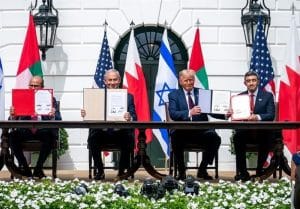
At the same time, Tel Aviv aims—by constructing and solidifying this manufactured image—to position itself as the architect of a new regional security order that safeguards emerging value supply chains, such as IMEC, the Development Road, and even the Middle Corridor. Netanyahu has repeatedly presented this vision to regional nations at the UN General Assembly, seeking to impose a regional order upon Arab states based not on consensus, shared interests and security, or mutual cooperation, but rather on a strategy of Israeli hegemonic ambition. On the other side of the coin, however, the bitter reality for the region’s nations is that the Islamic Republic of Iran possesses a serious resolve to respond to warmongering states and their partners; the defensive actions of Iran’s armed forces could cast a shadow of uncertainty over the survival of the political regimes and the future development of countries that have betrayed the Islamic Ummah.
All in all, it appears that a combination of Donald Trump’s fear of a miscalculation by the US National Security Council regarding the current realities of the Iran dossier and Netanyahu’s drive to ignite a regional war has set the countdown in motion for a new round of conflict between the “Axis of Resistance” and the US-Israeli axis. In this arena, the wisest course for Arab nations might be to help avert a war between Iran and the US, diversify their defense alliances, and—drawing lessons from the Ramadan War—move toward expanding ties with Tehran; yet, the Abu Dhabi summit demonstrated that at least some Arab states have already made their choice and must, naturally, face the consequences with full accountability.