
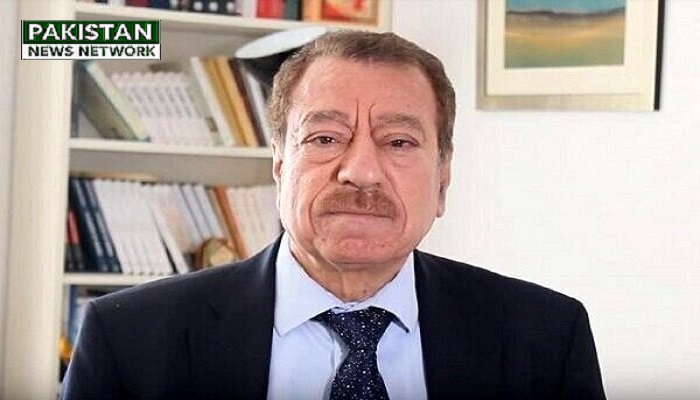
PNN – Highlighting the upcoming key meeting in Oman, an Arab analyst stated that the gathering scheduled for Monday in Salalah, Oman, has a high chance of success for six reasons.
According to the report of Pakistan News Network; citing Rai al-Youm, Arab analyst Abdel Bari Atwan wrote: The meeting scheduled for Monday in Salalah, Oman—involving Iran and six Arab states of the Persian Gulf—is considered a corrective step in the negotiation process and holds a strong prospect of success for the following reasons:
First: These negotiations—the first of their kind and long delayed—are being conducted face-to-face between the foreign ministers of the Gulf Cooperation Council (GCC) states and Iran, free from US interference or threats. The United States is an aggressor nation that seeks to sow the seeds of sectarian and political discord and to extort the Arab states of the Persian Gulf under the guise of ensuring security.
Second: It has been conclusively proven that the United States has failed to achieve its objectives—specifically, the overthrow of the Iranian regime and the destruction of Iran’s nuclear program. This failure stems from Iran’s steadfastness on the battlefield and its refusal to back down from its positions or make concessions, despite U.S. pressure on both the military and economic fronts.
Third: The Arab states of the Persian Gulf have been the biggest losers in this war, which has now entered its sixth month. Most of these nations have not seen a single dollar enter their treasuries, as they are unable to export their oil and gas due to Iran’s closure of the Strait of Hormuz and its insistence on specific demands—particularly the lifting of the naval and economic blockade and the release of frozen assets. Prior to the conflict, Gulf states exported 20 million barrels of oil daily through the Strait of Hormuz, and all American aircraft carriers and warships failed to reopen the waterway, whether through force or negotiation. To cover budget deficits, some Gulf states have resorted to borrowing hundreds of billions of dollars and have halted numerous infrastructure projects.
Fourth: Some intermediaries were intimidated by Trump. They acted as messengers, conveying U.S. demands and pressures to Iran; in other words, they were not neutral.
Fifth: Oman has provided a more suitable avenue for negotiation due to its standing among regional nations and its ties to all parties. As part of the Persian Gulf region, dialogue between Iran and the Arab states of the area facilitated by Oman is viewed as a form of “intra-family dialogue.”
The author also points to Oman’s role in previous negotiations between Iran and the United States in Geneva and Muscat, arguing that Omani mediation could have led to an agreement acceptable to both sides, yet the process stalled. Israel played a role in the failure of those efforts, as it did not desire an agreement between Iran and the U.S. or an end to the conflict, preferring instead for the hostilities to continue.
Sixth: The Persian Gulf states have awakened from their slumber and realized that neither the United States nor even Israel can protect them. They have also come to understand that the American bases located there—most of which have been completely neutralized, particularly in Bahrain (which announced it would not participate in Monday’s meeting in Salalah) and Kuwait—serve merely as instruments for financial extortion. Evidence of this is Trump’s return from his inaugural visit to three Persian Gulf states in May 2025 with over $5 trillion, alongside hundreds of millions of dollars in gifts for himself and his wife—most notably a $400 million presidential jet.
He further noted that Haitham bin Tariq, the Sultan of Oman, succeeded in achieving this goal not only due to his good relations with all parties but also thanks to his wisdom, prudence, diplomacy, and consultations with most Gulf capitals.
Atwan added: We reiterate that the Gulf States—which have suffered the most from the conflict involving Iran, the US, and Israel—could emerge as the biggest winners, particularly if this meeting leads to an agreement to reopen the Strait of Hormuz, even temporarily, as this would allow the flow of oil to global markets to resume.
He continued: We had hoped that Egypt and Jordan would be invited to participate in this meeting, even though we acknowledge that neither country has a direct connection to the Strait of Hormuz. We hope to soon witness another historic reconciliation meeting that includes them, the Arab states of the Persian Gulf, and Iran.
Atwan wrote: Ultimately, we hope that Yemen—and the ongoing war there—will be at the top of the agenda for the Salalah meeting. We reiterate that the Sultanate of Oman enjoys the trust of all conflicting parties. We hope this meeting fosters reconciliation and rapprochement between Arab nations and Iran, while shutting the door on the sowing of discord and on interventions by the United States and Israel.