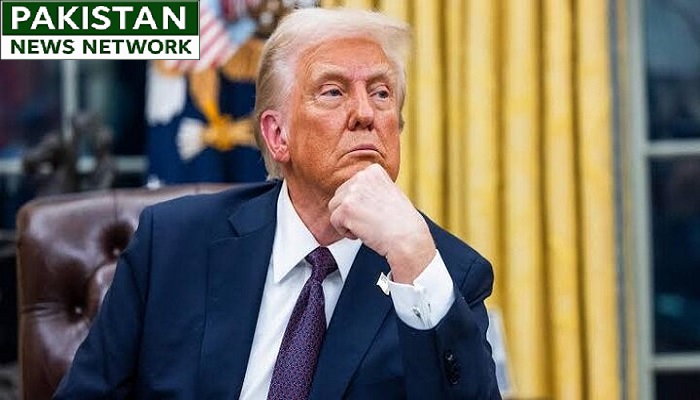
PNN – A senior editor at The Australian newspaper criticized the management of the U.S. war against Iran, stating that the longer the conflict has dragged on, the more Iran’s position has strengthened and the U.S. position has weakened. He emphasized that Donald Trump’s frequent shifts in stance are not a sign of flexibility, but rather an indication of desperation, a lack of strategy, and an inability to lead the war effort.
According to the report of Pakistan News Network; Paul Kelly, editor-in-chief of The Australian newspaper, speaking about the U.S. war against Iran, stated that Donald Trump is facing two simultaneous crises: a strategic crisis on the battlefield and a domestic political crisis ahead of the U.S. midterm elections.
He remarked: Trump cannot win this war, yet he dreads defeat. He needs to exit the conflict and reach an agreement with the Iranians, but his position has weakened to such an extent that he is unable to sign an acceptable strategic deal—one that would allow the U.S. to withdraw with a sense of pride and enable Trump to claim he has not been humiliated.
Kelly added that Trump is compelled to end the war and frame the resulting agreement as a victory, yet convincing public opinion of such a claim would prove extremely difficult.
According to him, the longer the war drags on, the more Iran’s position strengthens and the U.S. position weakens. Trump realizes he must bring this situation to an end but does not know how to do so; the longer he waits, the more precarious his strategic standing in the war and his political position at home will become.
The Australian analyst described Trump’s situation as a truly painful dilemma with no clear way out.
The war’s objectives were ludicrous and unrealistic from the start.
Responding to the possibility of renewed bombing of Iran—advocated by American neoconservative and pro-war factions—Kelly stated that the fundamental problem with this war, from the outset, was the vast gap between available means and stated objectives.
Noting that the war was entered into with false confidence and arrogance—and without setting realistic goals—he pointed out that the U.S. President initially spoke of regime change in Iran and inciting the Iranian people; these were “ludicrous” objectives that had no chance of realization.
He stated that the limitations of a military strike and an air campaign were clear from the start, yet Trump dismissively ignored the possibility that Iran might close the Strait of Hormuz. According to Kelly, the issue of the Strait of Hormuz was raised during Security Council meetings and pre-war discussions, but Trump brushed it aside and failed to take it seriously.
Trump Lacks Wartime Leadership Capability
Paul Kelly stated that as the conflict dragged on, it became clear that Trump is neither a strategic leader in the role of president nor capable of providing wartime leadership.
He identified Trump’s constantly shifting positions as the primary issue, noting that through this behavior, the U.S. president has demonstrated to the world—and to Iran—that he lacks a firm objective or resolve regarding the conflict; he appears confused and unsure of what course of action to take.
Kelly added that sending such a message to an adversary is highly damaging.
He identified Trump’s domestic political weakness as the second problem, stating that the U.S. president is unable to mobilize public opinion in support of a more coherent military strategy against Iran.
According to him, this weakness has become apparent to Iran, Russia, China, and the entire world.
Kelly stated that the United States’ most important global objective today should be maintaining the credibility of its deterrence—particularly in East Asia and vis-à-vis China—but that Trump’s behavior has undermined this credibility.
Trump’s shifting stances signal desperation
Responding to the claim that Trump’s changing positions reflect “unconventional diplomacy” and “tactical flexibility,” Kelly stated that the evidence does not support this view, as the handling of the conflict shows no signs of strategic acumen on Trump’s part.
According to him, the U.S. President’s constantly shifting positions signal desperation and a lack of strategy rather than flexibility. Kelly noted that Trump lacks a firm grasp of the situation and has failed to devise an exit strategy for the conflict.
Observing that Iran believes it possesses sufficient domestic capacity to sustain a conflict with the U.S., Kelly added that time is not on the U.S. President’s side and that he faces immense pressure to find a way out.
Trump’s Damage to the US Exceeds That of Bush
Comparing the Iran situation to the Iraq War, a senior editor at The Australian newspaper noted that George W. Bush’s invasion of Iraq imposed heavy costs on the US in terms of credibility, casualties, wealth, influence, and legitimacy, and that Washington’s overall response to the 9/11 attacks was deeply flawed.
However, he argued that the damage Trump is inflicting on the US likely surpasses the harm caused during the Bush era.
He cited the erosion of America’s global standing compared to 25 years ago as the primary reason, noting that China’s power and the challenges it poses are far greater today than in that earlier period, and that the global order has become more dangerous and chaotic. In his view, Trump’s response to these circumstances has been highly ineffective.
Kelly added that Trump treats U.S. allies with disdain, even though those allies—despite their shortcomings—have consistently been a source of Washington’s strength. He noted that Trump initiated a conflict with Iran without informing U.S. allies, essentially because he attached no importance to their views or standing.
Kelly emphasized that this behavior has severely damaged U.S. relations with its allies and undermined the concept of Washington’s strategic global leadership.
He also cited Trump’s economic and tariff policies—and their incompatibility with U.S. strategic interests—as further factors weakening the country.