
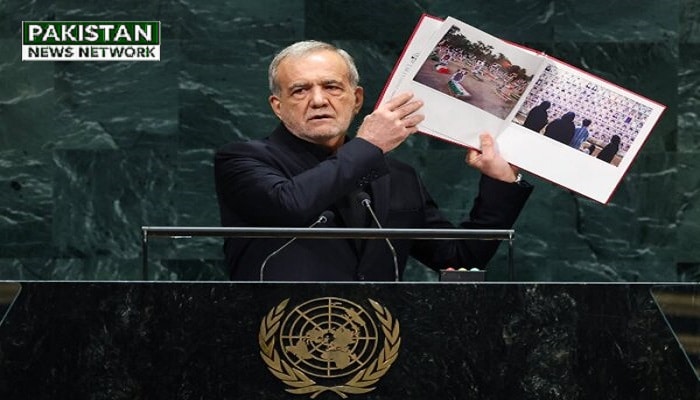
PNN – Beyond Tehran’s official stances, Pezeshkian’s speech at the 81st session of the UN General Assembly drew varied interpretations from foreign media and officials regarding the war, diplomacy, and regional security.
For Masoud Pezeshkian, the President of the Islamic Republic of Iran, the UN General Assembly served as a unique platform during his third appearance there; it was not merely a venue for articulating Tehran’s official positions, but a stage where the rhetoric from both sides of the Iran-US conflict was presented to global public opinion—even before being analyzed in their respective capitals.
Pezeshkian took the podium yesterday evening—Wednesday, September 23—at a time when war, negotiations, sanctions, regional security, and the future of the international order were all simultaneously commanding attention. Consequently, the significance of his address extends beyond the words he actually spoke; what matters more is how the world perceived his remarks and which aspects of his message were highlighted by foreign media and officials.
An examination of these very reactions reveals that Pezeshkian’s speech cannot be viewed merely as an official stance taken by Tehran; his remarks conveyed messages regarding war and peace, Iran’s relationship with the world, and the image the Islamic Republic of Iran seeks to project amidst one of the region’s most volatile periods.
Read more:
What message did the world receive from Pezeshkian’s remarks?
Foreign media’s initial interpretation of Pezeshkian’s speech was that it combined a stance of steadfastness with a readiness for diplomacy; in other words, Tehran rejects U.S. threats while simultaneously keeping the door to negotiations open. In its report on the president’s address, Reuters highlighted these dual aspects, noting that Pezeshkian declared Iran would not yield to U.S. pressure yet remained prepared for diplomacy to end the conflict. Al Jazeera’s assessment underscored the same point, characterizing the speech as a blend of fierce criticism regarding Trump’s approach and an emphasis on the possibility of negotiations. Thus, the initial foreign reading interpreted Tehran’s message not as a rejection of negotiations, but rather as a call for talks conducted without capitulation or acceptance of the language of threats.
A more significant interpretation, however, concerns the reasons behind the simultaneous adoption of a harsh tone by Tehran and the continuation of diplomacy. Andreas Krieg, a professor of defense studies at King’s College London, views this apparent contradiction as part of the “war of narratives” between Tehran and Washington. According to this analyst, the U.S. seeks to portray any potential agreement as the outcome of its pressure on Iran, whereas Tehran needs to demonstrate that it has withstood that pressure and entered negotiations while retaining its leverage; from this perspective, Pezeshkian’s speech is not merely a stance aimed at a foreign audience but an attempt to shape a narrative in which negotiation is not equated with capitulation. This external perspective reveals one of the most crucial layers of Pezeshkian’s remarks: his deliberate decision not to draw a conflict between “resistance” and “diplomacy.”
In another aspect of foreign analysis, the focus has shifted from the relationship between Tehran and Washington to the issue of regional security and the Strait of Hormuz. Al Jazeera has reported that while emphasizing diplomacy, Pezeshkian also placed the issues of the maritime blockade and the Strait of Hormuz at the center of Iran’s stance; meanwhile, reports regarding the New York negotiations indicate that the Strait of Hormuz is a key point of contention between the two sides. Tehran seeks the lifting of economic pressures and the blockade, whereas Washington insists on freedom of navigation in the waterway.
Thus, when Pezeshkian states, “We will either build security together or endure insecurity together,” the remark can be viewed in the context of a core issue currently highlighted in foreign analyses as a central knot of the crisis: Should Persian Gulf security be defined by the presence and pressure of foreign powers, or by arrangements in which regional states play the primary role?
Even prior to the speech, regional and Western media had taken note of this aspect of Tehran’s message. The National reported that, coinciding with Pezeshkian’s visit, Iranian security officials spoke of combining negotiation with military readiness; in this context, they raised the prospect of regional security arrangements involving Iran and the Persian Gulf states, rather than relying solely on Washington.
On the other hand, Al Jazeera had previously reported—amidst ongoing security concerns—that certain Gulf Cooperation Council (GCC) states are engaging in talks with Tehran to mend ties and forge new forms of cooperation. Consequently, Pezeshkian’s statement regarding the joint construction of security can be viewed as part of a broader message; in the eyes of some foreign media outlets, this message is directed not only at the United States but also at the Arab nations of the region.
One of the key international takeaways from Pezeshkian’s speech was that Tehran sought to avoid creating a conflict between resistance and diplomacy. In its analysis, The Guardian noted that while Pezeshkian repeatedly emphasized that Iran would not capitulate, he simultaneously declared Tehran’s readiness for dialogue and negotiation—provided the “language of force” was absent.
This interpretation gains added significance given that, just hours before the speech, the first direct contact between Iranian officials and U.S. envoys in months had taken place via intermediaries. Reuters also described these talks as a sign of potential progress, even though there was no apparent shift in the positions held by either side.
The Strait of Hormuz has also emerged in foreign media coverage as a key to understanding Pezeshkian’s message. Reuters reported that Hormuz is now a primary point of contention between Tehran and Washington; at the United Nations, Pezeshkian emphasized that one cannot expect everyone to benefit from this waterway while Iran remains deprived of shipping access.
The Guardian offered a similar assessment, claiming that while in New York, Pezeshkian sought to garner support from Iran’s Arab neighbors for Tehran’s proposals regarding the future of the Strait of Hormuz. Consequently, his statement—we will either build security together or endure insecurity together—can be interpreted by foreign media not merely as a stance on Iran’s own security, but as a message to the Arab states of the Persian Gulf concerning the future of regional security arrangements.
Why was reopening the Palestine file necessary?
One aspect of the foreign media’s coverage of Pezeshkian’s speech that stood out was the linking of Iran’s crisis to the Palestinian issue and the crisis of legitimacy facing the international order.
Pezeshkian did not frame the Palestinian issue merely as a separate matter within Iran’s foreign policy; rather, he cited it as an example of the failure of international mechanisms to prevent civilian suffering, emphasizing that one cannot speak of peace while ignoring Palestine. In its live coverage of the speech, The Guardian highlighted this point alongside Pezeshkian’s warning about the expansion of the war, reporting that he described the situation in Palestine as an “open wound” on the conscience of the international community and a symbol of the failure of international mechanisms to avert civilian suffering.
However, certain Zionist regime media outlets interpreted this specific part of Pezeshkian’s remarks differently. The Jerusalem Post focused particularly on his criticism of the double standards regarding the nuclear capabilities of Iran and Israel; at the UN, Pezeshkian stated that while Iran does not seek nuclear weapons, it will not relinquish its right to peaceful nuclear technology, simultaneously questioning why Israel possesses nuclear weapons while Iran faces pressure and sanctions. The Times of Israel also highlighted this aspect, noting that Pezeshkian emphasized the preservation of the right to enrichment and peaceful nuclear technology in his speech.
These reactions indicate that, in the view of Zionist media, the remarks regarding the nuclear issue constituted a key element of Pezeshkian’s message—a message in which Tehran seeks to draw a clear distinction between rejecting nuclear weapons and rejecting restrictions on its peaceful nuclear program.
Alongside this, US media outlets contextualized Pezeshkian’s remarks on Palestine within the broader scope of the regional crisis. The Associated Press reported that Middle East conflicts cast a shadow over the UN General Assembly, placing issues such as the potential for war between Iran and the US, the situation in Gaza, and the Israeli-Palestinian conflict at the center of UN discussions. The Los Angeles Times described Pezeshkian’s address as a wartime speech in which the Iranian president—while defending Tehran’s positions—warned against the continuation of hostilities, disruptions to maritime shipping, and the collapse of negotiations.
From this perspective, the way the Palestinian issue was raised in Pezeshkian’s speech cannot be viewed merely as a reiteration of a traditional stance; he sought to turn the question of Palestine into a litmus test for the international community’s claims regarding peace, international law, and the protection of civilians.
Overall, the international reaction to this part of the speech indicates that Pezeshkian aimed to advance his message on two simultaneous levels: first, defending Iran’s position regarding the war, its nuclear program, and the right to self-defense; and second, situating these issues within the broader context of the Palestinian crisis and the double standards applied in the enforcement of international law.
It is here that his statement—either we will build security together, or we will endure insecurity together—takes on a broader significance; for in Pezeshkian’s view, sustainable regional security is not merely a matter concerning Iran and the United States, and achieving lasting peace in West Asia is impossible without resolving the Palestinian issue and putting an end to what he terms the selective application of international rules.