
PNN – American and international sources have warned of a crisis involving a shortage of strategic weaponry—specifically U.S. air defense munitions—persisting through 2030.
According to the report of Pakistan News Network citing CBS News; U.S. sources indicate that the United States faces a serious challenge in replenishing its air-defense missile stockpiles. This comes amid rising consumption of munitions and declining production capacity, alongside warnings that shortages of strategic munitions are likely to continue until 2030.
Severe Shortage of Defensive Ammunition
In late December, General Randy George, the U.S. Army Chief of Staff, warned of a critical shortage of missile defense ammunition, emphasizing that addressing this shortfall could take five years.
According to U.S. officials who spoke with CBS News, this assessment was included in the Pentagon’s global force management and allocation plan—prior to the outbreak of a conflict involving the U.S., Israel, and Iran.
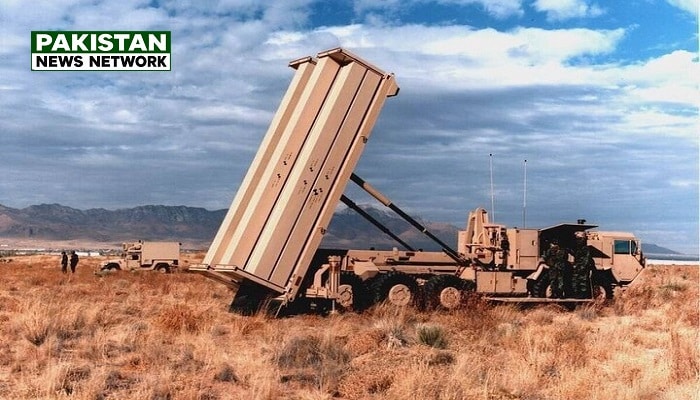
The assessment indicates that stockpiles for THAAD and Patriot missile systems will remain at a critically low level through 2030. This warning stems from the transfer of Patriot missiles to Ukraine following the outbreak of the Russia-Ukraine war in 2022, the depletion of munitions used to defend Israel, and the limited capacity of the defense industry to ramp up production.
Although the United States maintains vast stockpiles of certain offensive munitions—such as precision-guided bombs and Joint Direct Attack Munitions (JDAMs)—U.S. officials state that their primary concern lies with missile defense munitions. Citing security reasons, CBS News declined to report the exact percentage of these remaining stockpiles.
THAAD and Patriot: Depleted Stockpiles
The THAAD system is one of the United States’ most advanced missile defense systems, designed to intercept ballistic missiles during their terminal flight phase—whether inside or outside the atmosphere. According to a 2025 report by the Congressional Research Service, the U.S. Army possesses eight such systems, each comprising six launchers.
On the other hand, the Patriot system is used to protect troops, military installations, and critical infrastructure against ballistic missiles, cruise missiles, and enemy aircraft; it operates at lower altitudes than those covered by the THAAD system. The system’s interceptor missile, known as the PAC-3, is a critical, short-lifespan munition, as it relies on direct impact—”hit-to-kill”—to destroy incoming missiles.
Mark Cancian, a retired U.S. Marine Corps colonel and a senior defense and security advisor at the Center for Strategic and International Studies (CSIS), stated that the THAAD and Patriot systems are munitions that the U.S. military would employ extensively in any potential conflict with China.
According to an estimate published by CSIS in April, it currently takes four years and five months to fulfill new orders for THAAD interceptor missiles, while the average lead time for PAC-3 interceptors—used in the Patriot system—is three and a half years.
61% of Patriot Interceptor Stockpiles Depleted in War with Iran
The center estimated that, prior to a conflict with Iran, the United States would have entered the year 2026 with approximately 2,300 Patriot interceptor missiles in its arsenal; between 1,050 and 1,430 of these missiles would be expended during the war—accounting for roughly 61% of the pre-war inventory.
According to the center’s estimates, the THAAD system’s inventory prior to the war stood at approximately 355 interceptor missiles, of which between 190 and 290 have since been expended. The United States has placed orders for over 800 THAAD missiles for the 2027 fiscal year; however, ramping up production will not immediately resolve the shortfall.
Lockheed Martin and RTX—through its subsidiary, Raytheon—manufacture these systems and their essential components. Both companies have entered into agreements to accelerate production, and in January, Lockheed Martin announced a plan to quadruple its THAAD missile production capacity, increasing it from 96 to 400 missiles per year.
However, the depletion of munitions during the conflict with Iran is not the sole cause of the shortage; rather, the problem has been exacerbated by decades of spending decisions, the shrinking of the defense industrial base, and military operations that have outpaced the capacity of manufacturers to replenish stocks.
A U.S. official told CBS News that the United States would have to wait until 2030 to restore its stockpiles to December 2025 levels—and that is assuming it avoids any further use of THAAD and Patriot missiles in the context of Iran or other conflicts.