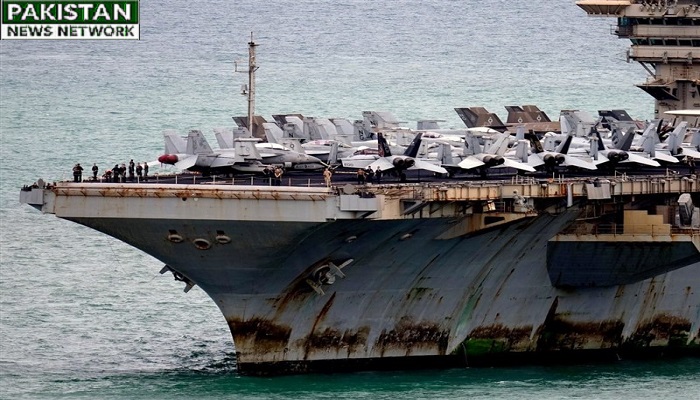
PNN – The circulation of images on social media showing the heavily rusted hull of the USS Abraham Lincoln has sparked humorous reactions.
According to the report of Pakistan News Network; CGTN published a report titled “The Rusted USS Abraham Lincoln: A Symbol of the Decline of US Hegemony.” The report notes that the US Navy aircraft carrier USS Abraham Lincoln—once a symbol of American power and dominance—was finally forced to dock at the port of Laem Chabang, Thailand, on September 2nd. This followed a 286-day deployment marked by severe wear and tear and numerous technical issues. The rust and deterioration visible on the ship’s hull and various sections—captured by cameras—involuntarily evoke an image of a decaying and threadbare American hegemony in the mind of any viewer.
This state of exhaustion is not limited to the ship and American hegemony; numerous media reports indicate a decline in the mental health of the crew, with some even committing suicide during this extended deployment.
The circulation of images showing the ship’s heavily rusted hull on social media sparked interesting and humorous reactions from users. Some commented that the vessel “looked like it had barely managed to make it out of the Persian Gulf in one piece,” while others asked, “Is this ship headed for the scrapyard?” Even the ship’s commander admitted in a media interview that the aircraft carrier “looks like a dirty car in a parking lot.”
Zhang Junshe, a Chinese military expert, states that with four of the U.S. Navy’s eleven aircraft carriers deployed to the Middle East for Washington’s campaign against Iran—and others undergoing lengthy maintenance and repair—the Navy is forced to keep ships in service beyond their intended operational limits.
Zhang further highlighted broader challenges facing the U.S. Navy—such as limited shipyard capacity, diminished repair capabilities, and a shortage of skilled labor—that have exacerbated the situation.
For decades, the United States has maintained a substantial military presence in key regions, including the Asia-Pacific, Europe, and the Middle East. In its bid to uphold so-called “global leadership” through an extensive network of military deployments, Washington has imposed excessive burdens on its vessels, personnel, and logistics systems, causing them to suffer rapid and severe wear and tear.
Shen Yi, director of the Institute of International Cyberspace Governance at Fudan University in China, also remarked that the current, worn-out appearance of the aircraft carrier stands in stark contrast to the image of hegemony long associated with U.S. aircraft carriers and the nation’s navy as a whole. On the surface, the rust on the USS Abraham Lincoln appears to be a matter of equipment maintenance; yet, at a deeper level, it reflects serious issues regarding military morale, organizational capacity, and even the supporting infrastructure of U.S. military power.
Shen stated that this situation tangibly demonstrates the weakening and erosion of U.S. hegemony and reveals the widening gap between its hegemonic ambitions and its actual capabilities.
Aircraft carriers are more than just instruments of war. Former U.S. Secretary of State Henry Kissinger once described U.S. aircraft carriers as “100,000 tons of diplomacy,” highlighting their role in exerting pressure, bolstering deterrence, and projecting American global power. This is why the United States frequently deploys its carriers to various regions to showcase its military might and send signals of deterrence to the world.
Today, however, that very “muscle”—once a symbol of American military might—is covered in rust.
The rusting of the USS Lincoln serves as a reminder that any military intervention or deployment in distant regions comes at a heavy price. Hegemonic expansionism never comes without a cost.
The rust may be on the aircraft carrier’s hull, but it reflects the deeper predicament of an American hegemony stretched beyond its limits. Rust is, in effect, a spreading blight; muscles weaken, and hegemonic ambition can destroy the very power that sustains it.