
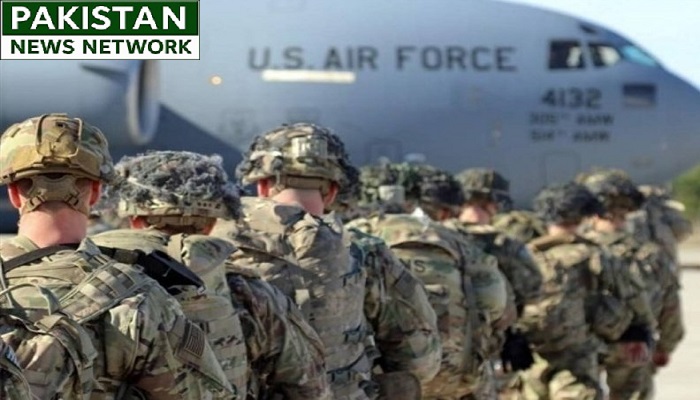
PNN – Confronting separatist groups and the US military withdrawal from the Kurdistan Region of Iraq stand as two strategic achievements of the “Ramadan War.”
According to the report of Pakistan News Network; one of the most significant opportunities arising from the Ramadan War and its subsequent developments emerged not on the direct battlefield against American and Zionist adversaries, but along the country’s western borders. The unprecedented confrontation with separatist and counter-revolutionary groups in northern Iraq—followed by the military withdrawal of the US “terrorist army” from the country, particularly the Kurdistan Region—represents two strategic achievements capable of enhancing the security of Iran’s borders for years to come.
These two events, resulting from the sustained and astute military pressure exerted by Iran’s armed forces, shifted the security dynamics in the country’s west in Tehran’s favor.
For years, the presence of separatist and counter-revolutionary groups in northern Iraq had remained a persistent and chronic threat to Iran’s national security. Operating under the covert and overt support of certain foreign actors—particularly the United States and the Zionist regime—these factions consistently sought to destabilize the region and sow insecurity along the border. Repeated negotiations and pledges by senior Iraqi officials to dismantle these groups never yielded a definitive outcome, and sporadic attacks had little impact on their operational capabilities. However, the “Ramadan War” altered the landscape, providing a unique opportunity for Iran’s armed forces to eliminate this long-standing threat once and for all.
The key and important question is: What were the strategic achievements of Iran’s recent operations in northern Iraq?
1) Unprecedented Ground Operations against Separatist Groups
With the outbreak of hostilities, Tehran explicitly warned the Kurdistan Region of Iraq that it would target the region’s facilities should separatist groups take any action against Iran’s borders. This warning—accompanied by a significant surge in drone and missile strikes on these groups’ headquarters—rapidly escalated into a large-scale, sustained operation. Over the course of several months, hardly a night passed without reports of explosions in Sulaymaniyah and Erbil, as the bases of groups such as Komala and PAK were repeatedly targeted.
Subsequently, Iran’s drone and missile strikes continued with greater intensity and precision, and separatist groups—which had previously served as a trump card for the United States and the Zionist regime against Iran—suffered heavy blows one after another. The military pressure was so intense that these groups were forced to abandon their headquarters and flee to more remote areas. U.S. President Donald Trump’s admission regarding the shipment of weapons into Iran via these groups, coupled with his explicit support for separatist Kurds engaging in conflict with Iran, clearly demonstrated that these groups were not merely an internal threat but rather a foreign-orchestrated project aimed at the fragmentation and destabilization of Iran. Their decisive suppression effectively neutralized one of Washington’s most significant instruments of pressure.
2) The Complete U.S. Withdrawal from Iraq: The End of a Long Occupation
Alongside the weakening of opposition groups, Iran’s military pressure on U.S. bases in Iraq also reached its peak. A turning point in these attacks was a remarkable and extraordinary operation carried out by the Air Force of the Islamic Republic of Iran during the early days of the conflict. Even though advanced Patriot and C-RAM systems were covering the region’s airspace, Iranian pilots succeeded in bombing a U.S. Delta Force base in northern Iraq. This daring and precise operation demonstrated that even the most advanced air defense systems could not protect U.S. strategic targets against the resolve and might of Iran’s armed forces.
Repeated attacks had made defending these bases an exhausting task for the Americans, even with the presence of numerous air defense systems. This pressure on the ground ultimately led to a strategic decision by Washington: a complete withdrawal from Iraq. The U.S. Secretary of Defense officially announced that all American military forces would leave Iraqi territory by September 30, 2026.
Iraqi Prime Minister Ali Faleh al-Zaydi also confirmed this matter during a meeting with Trump at the White House, stating explicitly that U.S. forces would fully withdraw from the country by the end of September. Coinciding with this withdrawal, reports indicate the relocation of Patriot air defense systems from Erbil Air Base, signaling Washington’s seriousness about removing equipment and ending its military presence in Iraq. This decision—which brings an end to over two decades of U.S. military presence in Iraq—was made at a time when Iran had managed to seriously challenge the security of U.S. bases through its attacks while simultaneously undermining Washington’s potential allies in the region.
Conclusion:
Iran’s calculated operations against separatist groups in the Kurdistan Region and the withdrawal of U.S. forces from Iraq are two sides of the same coin, both playing out on the battlefield. On one hand, by eliminating border threats, Iran solidified the security of its western flank; on the other, by compelling the United States to withdraw from Iraq, it neutralized one of that country’s most critical military outposts and sources of influence in its immediate neighborhood. These achievements—the result of the sustained and strategic efforts of the Islamic Republic of Iran’s armed forces—demonstrated that targeted military pressure can shift regional security dynamics in Tehran’s favor and ensure greater security for the nation’s borders for years to come.
What matters in this context is that Iran not only withstood direct aggression but also leveraged the war to eliminate long-standing, chronic threats, taking a significant step toward ensuring lasting security along its western borders.