
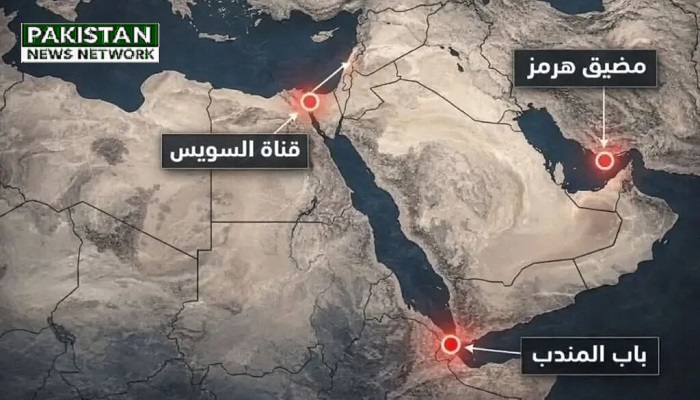
PNN – In an article for the Al-Mayadeen network examining the strategic importance of the Straits of Hormuz and Bab al-Mandeb, Syrian writer Ahmad al-Darzi wrote that recent developments at these two maritime chokepoints could signal the emergence of a new trajectory in West Asia and a shift in the region’s power dynamics.
According to the report of Pakistan News Network; al-Darzi noted that the major “upheaval” caused by Ansarullah—through its seizure of Yemen’s western coast over the past ten days—has resonated widely across the globe, as it has resulted in full control over one of the most critical routes for international trade.
He added that the issue is not merely the transport of energy carriers—the lifeblood of the global economy—but also encompasses the flow of global trade, which accounts for approximately 12 to 15 percent of total international commerce.
According to this Syrian writer, Western powers have sought to control trade routes ever since Vasco da Gama discovered the Cape of Good Hope in 1498. From that time onward, Western colonial powers realized that their international standing depended on increasing their economic strength and growth—factors inextricably linked to controlling overland and maritime trade routes.
He emphasized that the primary significance lies in maritime routes, which facilitate faster transport and the movement of larger volumes of goods and commodities; this factor has driven Western powers to seek control over West Asia—whether through influence or direct and indirect occupation—and to establish military bases there.
Hormuz and Bab al-Mandab: Two Chokepoints in the Power Equation
Pointing to the rivalry among naval powers, Al-Darzi wrote that control over maritime routes has become a key indicator of the shifting status of dominant powers, and any party that controls the Straits of Hormuz and Bab al-Mandab establishes itself as a major power.
He cited the 1622 transfer of control over the Strait of Hormuz from the Portuguese to the British as an example of this shift, linking it to the rise of the British Empire and the decline of the Portuguese Empire.
Under the heading “Two Ruling Powers and the Discovery of the Power Latent in Straits,” the Syrian author went on to write that, from the very early days of the Islamic Revolution, Iran grasped the immense importance of the Strait of Hormuz—a waterway that, due to its connection to the global economy, stands as the world’s most powerful geopolitical weapon.
Al-Darzi added: Tehran viewed this strait as a final weapon for defending the Revolution’s domestic, regional, and international principles and objectives—as well as its sovereignty and independence. Since its inception in 1992, Yemen’s Ansarullah movement has also recognized the importance of striving to restore Yemeni sovereignty and establishing a regional role within the framework of the balance of power.
What Connects Tehran and Sana’a
Al-Darzi notes: What binds Tehran and Sana’a together is neither a shared religious background nor a matter of faith; rather, it is a sovereignty-oriented and emancipatory framework, coupled with the realization that the problems facing the nations of the region and the world stem from more than just poverty, ignorance, underdevelopment, tyranny, and corruption.
He added that, from the perspective of Tehran and Sana’a, a foreign factor acting on behalf of dominant Western powers stands as an obstacle to the freedom, independence, and sovereignty of nations; the United States and the Zionist regime, in particular, have played a role in this regard since World War II.
Al-Darzi identified this as the underlying reason for the shared slogan: Death to America, Death to Israel.
Shifting Equations in the Strait of Hormuz and Bab al-Mandab
The Syrian writer noted that Tehran took control of the Strait of Hormuz earlier this year, while Sana’a finalized its control over the Bab al-Mandab Strait last Friday.
In another part of his article, Al-Darzi wrote that the events unfolding since the start of the war against Iran over six months ago mark a reversal of the trend of Western hegemony—which had persisted in West Asia and globally for more than two centuries—and have established new power dynamics.
He believes that the US inability to alter the new situation in the Strait of Hormuz, combined with its refusal to accede to the request of Saudi Crown Prince Mohammed bin Salman—who reportedly contacted the US President twice seeking military intervention in western Yemen to prevent Sana’a from seizing control of the Bab al-Mandab Strait—demonstrates that Washington’s options for regaining control over the arteries of Western hegemony have become limited.
The author further notes that the countries bordering these two waterways now have greater opportunities to consolidate their sovereignty and independence.
The Expansion of Sana’a’s Influence
Al-Darzi went on to write: Yemen’s geopolitical earthquake will not cease; although Riyadh is attempting to halt it through Omani mediation, the momentum that has reached the Bab al-Mandab Strait will not be stopped, and the path has been opened for an advance toward Taiz and Aden, and subsequently across the entirety of Yemeni territory.
According to him, this process has moved beyond the scope of the memorandum of understanding with Riyadh—an agreement whose provisions have remained unimplemented over the past four years. The most significant direct leverage gained from this development is the ability to fully control the movement of oil tankers sailing from the Saudi port of Yanbu toward Asia, which have an estimated capacity of approximately 2.4 million barrels per day.
He added that Sana’a has also disrupted the East-West pipelines, effectively depriving Saudi Arabia of the ability to export 4.7 million barrels of oil daily.
Al-Darzi notes that these developments have directly impacted the global economy, driving the price of a barrel of oil above $107.
The New Path for West Asia
Elsewhere in the article, the Syrian author writes that the United States has effectively suffered a defeat; to substantiate this, one need only look at the views of certain American experts and theorists, such as Robert Kagan, Robert Pape, Jeffrey Sachs, and John Mearsheimer.
He added that acknowledging this defeat depends on the U.S. President and the Zionist lobby exerting pressure on him.
He also notes that alternative energy transport routes proved inadequate following the disruption of Saudi Arabia’s East-West pipelines, and that such alternatives cannot diminish the strategic geopolitical significance of the Strait of Hormuz and the Bab el-Mandeb Strait. This raises the question: what would happen if Egypt capitalized on this major shift, successfully asserted its sovereignty in the coming years, and integrated the Suez Canal into an “alliance of transit-chokepoint powers”?
The Emergence of a New Security Order
In the conclusion of his article, Eldarzi wrote: The formation of a new security order among the region’s countries—and a move away from U.S. hegemony, which will continue to decline in West Asia—is the only path to stability for all nations in the region.
He also identifies the Zionist regime as a threat to the countries of the region and their peoples, writing: Regional states—particularly those in the Persian Gulf, led by Saudi Arabia—are facing a new reality; they must gradually move beyond policies of political caution, pursue the interests of their own nations and those of the Greater Levant, and establish new rules for the region.
In conclusion, the Syrian author poses the question: Will the countries of the region choose this path, or will they continue to incur strategic losses?