
PNN – The four-pronged southern geopolitical doctrine rests, in fact, on a simple premise: no single southern actor should serve as the sole option for Central Asia.
Geography plays an unparalleled role in the destiny of nations and states. Location, access—or the lack thereof—to the sea, trade routes, neighbors, and strategic depth are not merely matters depicted on a map; they directly impact national security, economic development, and the scope of a country’s foreign policy choices.
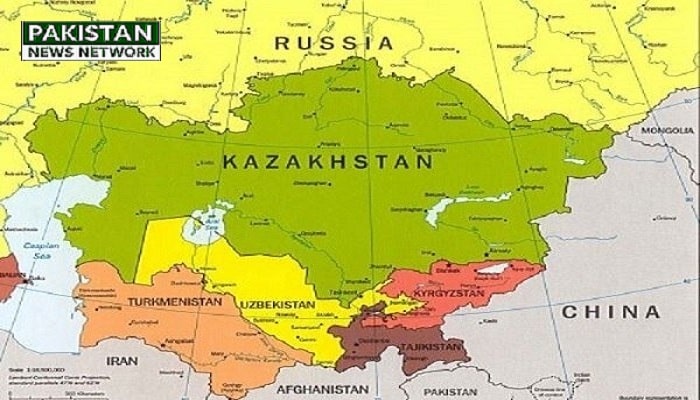
This reality holds even greater significance for the countries of Central Asia. Situated amidst major powers like Russia and China—and in proximity to Europe, West Asia, and South Asia—these nations share the common constraint of being landlocked. Consequently, access to diverse land and maritime routes represents not just a simple commercial advantage for them, but a vital component of their strategy for geopolitical independence.
Within this context, the concept of a “four-part southern geopolitical doctrine” can be proposed as an analytical framework for understanding how a segment of Central Asian elites views their southern environment—a framework that places the four countries of Iran, Afghanistan, Pakistan, and Turkey within a single constellation, despite their significant differences. It should be noted, however, that this is not an official state doctrine; rather, it is best understood as a conceptual formulation explaining the geopolitical logic underlying Central Asia’s relations with the countries to its south.
It is important to note that this “quadrilateral” grouping should not be understood solely in terms of territorial contiguity. Turkey shares no border with Central Asia, and Pakistan lies outside the traditional geographical confines of the region. Thus, these four nations establish a “function-based neighborhood relationship”: Turkey serves as a gateway to the West; Iran acts as a link connecting Central Asia to the Persian Gulf, the Sea of Oman, and West Asia; Afghanistan serves as Central Asia’s direct southern link; and Pakistan offers a potential route for the region to connect to the Arabian Sea.
This perspective also aligns to some extent with the official foreign policy orientation of most Central Asian countries. These nations generally prioritize their immediate neighbors within the Central Asian region while simultaneously emphasizing the development of relations with Iran, Afghanistan, Pakistan, and Turkey, the expansion of transport corridors, and the diversification of trade routes.
What is the underlying logic of the Southern Quadruple Doctrine?
The primary logic of this doctrine can be summarized as establishing geographic security by maintaining connectivity. For a landlocked country, insecurity in peripheral corridors, crises in transit nations, or border closures are not merely external issues; they directly impact trade, energy, food supplies, migration, and even domestic security. In this regard, Afghanistan holds particular importance for Central Asia, as it shares direct borders with Uzbekistan, Turkmenistan, and Tajikistan, and any instability there would spill over to the north.
From this perspective, viewing Afghanistan solely as a security issue is inappropriate; the country can simultaneously serve as a security challenge and a potential link connecting Central Asia to South Asia. In recent years, Uzbekistan has pursued precisely this approach, regarding the Trans-Afghan railway project as one of the most important initiatives for connecting Central Asia to South Asia. On July 17, 2025, Afghanistan, Uzbekistan, and Pakistan signed a framework agreement to conduct a joint feasibility study for the Trans-Afghan Railway—a project designed to connect Uzbekistan, via Afghanistan, to Pakistan’s rail network and, ultimately, to ports on the Arabian Sea. The process moved into a more operational phase in 2026; the President of Uzbekistan ratified the trilateral agreement in February, and in June of that year, Uzbek officials announced that field studies for the project had commenced and that the feasibility study would be completed by the end of the year.
A second rationale lies in the necessity for diverse access routes. For Central Asia, total reliance on a single route, port, or foreign power creates geopolitical risk. Consequently, it is natural to simultaneously focus on the Middle Corridor (via the Caspian Sea), the Northern Route (through Russia), eastern routes (via China), and southern routes (through Iran, Afghanistan, and Pakistan).
United Nations documents have long identified Central Asia as a region requiring multiple alternative routes to the ports of South and East Asia. In this context, corridors involving Iran, Pakistan, and China have been highlighted in regional studies as complementary options for connecting Central Asia’s landlocked nations to the sea.
The third logic is interdependence rather than one-sided dependence. The “Southern Four” geopolitical doctrine posits that the interests of Central Asian nations are not realized merely by extracting concessions from southern countries; rather, their interests become sustainable only when these four nations themselves benefit from one another’s stability and development. This perspective aligns with the official policy of a country like Uzbekistan, which emphasizes the development of regional trade, transportation, and energy, as well as the resolution of the Afghanistan issue and the fostering of cultural and humanitarian cooperation.
The fourth rationale is strategic autonomy achieved through balancing power among various actors. In recent years, Central Asian countries have sought to strike a balance among Russia, China, Turkey, Western nations, Iran, and other players. Consequently, the “southern geopolitical quartet” doctrine does not necessarily imply the formation of a political bloc. A more realistic interpretation is that Central Asia is attempting to leverage the rivalry among surrounding actors to expand its own range of choices.
A fifth rationale lies in civilizational and social ties. The history of Central Asia cannot be fully explained through today’s political borders; the regions of Khorasan and Transoxiana—along with the broader Persian and Turkic worlds—have engaged in constant interaction over the centuries. Alisher Navoi, born in Herat, stands as a prime example of this reality; regarded as a pivotal figure in the history of Chagatai and Uzbek literature—and a poet who also wrote in Persian—he demonstrates that the cities of modern-day Afghanistan, Uzbekistan, Iran, and other parts of the region cannot be isolated from one another merely by contemporary borders.
Why is Turkey important in this quartet?
In this equation, Turkey is more than just a geographical neighbor; it serves as a Western gateway and an economic-institutional hub. Turkey’s NATO membership, its location at the crossroads of Europe, Asia, and the Mediterranean, and its role in the Middle Corridor grant it significant potential to connect Central Asia with European markets. Furthermore, NATO recognizes Turkey as possessing the second-largest military force within the alliance.
In the economic sphere, Turkey’s presence in Central Asia is steadily expanding across sectors such as trade, investment, energy, regional connectivity, the defense industry, education, and tourism. Concurrently, the Trans-Caspian Corridor—or “Middle Corridor”—is being developed; the World Bank identifies it as a route linking China, Central Asia, the Caucasus, Turkey, and Europe. New railway investments in eastern Turkey are also being undertaken to eliminate bottlenecks along this route.
Thus, Turkey’s primary advantage for Central Asia lies in a combination of capital, market access, institutional ties, transportation networks, and linguistic-cultural bonds.
Afghanistan; nearest security and transit ring
Afghanistan is fundamentally different from the other three countries in one respect: it directly affects the security environment in Central Asia. At the same time, the Afghanistan route could connect Central Asia to Pakistani ports and South Asian markets in the long run. Therefore, Central Asian countries have had a dual policy towards Afghanistan in recent years: pursuing stability and security, while trying to integrate Afghanistan into the economic processes of the region.
However, a significant constraint for Afghanistan is the fragility of its economic and infrastructural framework. The World Bank reports that while Afghanistan’s economy grew by approximately 4.3 percent in 2025, it simultaneously grappled with poverty, a trade deficit, a weak banking system, and structural limitations; a May 2026 report estimated economic growth of 4.8 percent alongside a 5.6 percent decline in GDP per capita.
For this reason, Afghanistan represents both an “opportunity” and a “risk” for Central Asia: an opportunity in terms of connectivity routes to the south, and a risk regarding security, stability, and the feasibility of infrastructure projects.
Pakistan: Gateway to the Indian Ocean
Within this quartet, Pakistan is a major player in terms of both population and military capacity. The country’s population is estimated at approximately 255 million for 2025, and according to assessments by the Stockholm International Peace Research Institute (SIPRI), Pakistan possessed around 170 nuclear warheads as of January 2026.
However, Pakistan’s significance for Central Asia stems primarily from its access to the Arabian Sea and South Asian markets. The proposed Trans-Afghan Railway could ultimately link Central Asia to Pakistan’s rail network and its Arabian Sea ports.
Consequently, Pakistan can serve as a complement to Iran’s routes rather than necessarily a replacement for them. From a geopolitical perspective, the existence of two distinct southern routes for Central Asia reduces reliance on any single path.
Iran: The Distinction between “Geographic Advantage” and the “Capacity to Transform Geography into Power”
Among the four southern nations, Iran possesses a unique attribute: the ability to simultaneously link Central Asia with the Persian Gulf, the Sea of Oman, the Caucasus, Turkey, and West Asia via a relatively dense network of roads and railways.
For instance, the Uzbekistan–Turkmenistan–Iran–Turkey route has long been a subject of regional transport studies; furthermore, a protocol was signed in 2023 to establish a multimodal corridor connecting Central Asia to Europe through these very four countries.
In 2026, officials from Uzbekistan and Iran also emphasized the development of transit links and the increase in the volume of cargo passing between the two countries. The Kazakhstan–Turkmenistan–Iran corridor, which connects the rail networks of Kazakhstan and Turkmenistan to Iran’s southern ports—particularly Bandar Abbas—and holds significance within the framework of the International North–South Transport Corridor; the China–Kazakhstan–Turkmenistan–Iran route, developed in recent years to facilitate the transport of goods between China and Iran, with increasing cargo volumes; the Central Asia–Turkmenistan–Iran–Armenia route, capable of providing regional countries with access to the Caucasus and Europe via Iran; and the Uzbekistan–Afghanistan–Iran route—specifically the Termez–Mazar-e-Sharif–Herat–Bandar Abbas and Termez–Mazar-e-Sharif–Herat–Chabahar branches—which have been proposed in transport studies as options for connecting Central Asia to Iran’s oceanic ports.
Therefore, Iran’s significance is not limited to a single route. Bandar Abbas, Chabahar, the Trans-Iranian Railway, and the connection of the country’s rail network to Turkmenistan enable the planning of several distinct routes. Documents from the World Bank and ESCAP also identify Iran as a key route connecting Central Asia to Middle Eastern markets and southern ports.
Chabahar holds added significance as it has recently emerged as a hub for cooperation among India, Iran, and Central Asian nations. In an official report, India’s Ministry of External Affairs announced that a long-term agreement for the operation of the Shahid Beheshti Terminal in Chabahar was signed in 2024, and the third meeting of the Chabahar working group involving India, Iran, and Uzbekistan was held that same year. India regards this port as crucial for the expansion of trade with Afghanistan and Central Asia.
What is Iran’s most significant advantage compared to the other three countries?
Iran possesses five key advantages relative to the other three nations. The first is its geography and simultaneous access to multiple regions. To reach Central Asia, Turkey relies primarily on routes through the Caucasus and the Caspian Sea; Pakistan depends on Afghanistan—which itself faces severe infrastructural and economic constraints—to access the region. Iran, however, shares direct borders with Turkmenistan and Afghanistan, and its network can extend from Central Asia to Turkey and the southern ports of Asia. This distinction creates a structural advantage.
Second is the diversity of port options. In Central Asia’s long-term strategic calculations, the availability of routes to Bandar Abbas and Chabahar is highly significant, as it moves transit competition beyond an “all-or-nothing” scenario. For a landlocked country, having multiple routes is, in itself, a form of leverage.
Third is Iran’s institutional overlap with Central Asia and South Asia. Iran is a full member of the Shanghai Cooperation Organization (SCO)—a body that also includes Pakistan and four Central Asian states. Turkey holds “dialogue partner” status in the organization, while Afghanistan is an observer.
Alongside this, the Economic Cooperation Organization (ECO) brings together—within an institutional framework—virtually the same four-part geographic region under discussion; its members include Iran, Turkey, Pakistan, Afghanistan, Uzbekistan, Turkmenistan, Tajikistan, Kyrgyzstan, Kazakhstan, and Azerbaijan. The organization’s secretariat is also headquartered in Tehran.
Fourth is the nature of Iran’s civilizational ties with the region’s cultural networks. While this potential is most evident in the connections with Tajikistan and Afghanistan, it is also deeply rooted in the historical context of Transoxiana and Khorasan. The strength of these ties is further enhanced when they extend beyond mere cultural symbols to encompass academia, tourism, the book market, Persian language education, media, and people-to-people connections.
Fifth is Iran’s capacity to transform itself from a mere “route” into a “platform.” A route consists simply of roads and railways; a platform, however, comprises an integrated set of ports, railways, warehouses, customs facilities, banking and insurance services, energy infrastructure, free trade zones, distribution centers, and markets. As the share of these components in Central Asian trade grows, economic interdependence will deepen.
Where does Iran’s weakness lie?
However, geography alone does not generate power. Iran’s primary weakness in this competition is the gap between its potential advantage and its operational capability.
Today, Turkey boasts a significant presence of investors, companies, and extensive business networks across Central Asia, whereas Iran remains far from achieving such a position. Meanwhile, the Middle Corridor is rapidly expanding, and Turkey is investing in efforts to eliminate bottlenecks along this route.
For Iran, however, the challenge extends beyond mere railway construction; critical factors include the predictability of transit times, tariffs, customs procedures, insurance, financial transfers, banking access, technical standards, and service continuity. Indeed, from the perspective of landlocked nations, the reliability of a route is just as important as its length.
Conclusion: How is the “upper hand” defined?
The four-part southern geopolitical doctrine rests on a simple premise: no single southern actor should serve as the sole option for Central Asia. These countries are significant precisely because each constitutes part of a larger network.
Turkey possesses advantages in terms of market, capital, institutional ties, and the Middle Corridor. Afghanistan benefits from direct proximity to a large part of Central Asia and the potential to connect to South Asia. Pakistan holds advantages regarding population, market size, and access to the Arabian Sea. Iran, meanwhile, enjoys a combination of advantages: geography, a rail network, access to the Persian Gulf and the Sea of Oman, membership in the Shanghai Cooperation Organization (SCO) and the Economic Cooperation Organization (ECO), and the capacity to link Central Asia with Turkey and the Middle East. None of these advantages is decisive on its own; rather, it is their combination that becomes significant.
Therefore, within the framework of this analysis, Iran’s “upper hand” should be defined neither as the exclusion of Turkey, Pakistan, or Afghanistan nor as Iran becoming the sole route for Central Asia. Its more practical meaning is for Iran to become an indispensable node in Central Asia’s connectivity and economic network—a node whose removal would entail significant economic and geopolitical costs.