
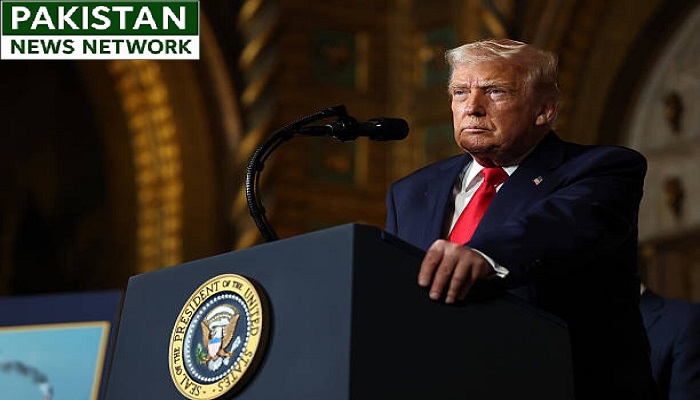
PNN – As the number of U.S. military casualties in the war with Iran rises, the Donald Trump administration’s efforts to delay the release of casualty figures or downplay the consequences of Tehran’s attacks are unlikely to prevent the spread of public discontent—especially given that polls show a majority of Americans view this war as misguided and not worth continuing.
According to the report of Pakistan News Network; citing MS News, the resumption of hostilities between the United States and Iran has led to an increase in casualties among U.S. forces. Last week, U.S. Central Command confirmed the deaths of three additional service members killed during operations, bringing the total number of U.S. military personnel killed in this conflict to 18. Meanwhile, following an intensified Iranian response targeting U.S. bases across the Middle East, nearly 100 U.S. troops have also been wounded over the past two weeks.
U.S. President Donald Trump continues to portray this conflict as an operation over which the United States has gained total control; however, Iran’s retaliatory strikes have made it increasingly difficult for him to justify continuing this unpopular war.
Furthermore, given the U.S. President’s stated readiness to further escalate hostilities in the coming weeks, there is also a possibility of rising American casualties.
The Trump administration, already criticized for a lack of sufficient transparency, now appears to be acting more cautiously and conservatively regarding the release of information on military casualties. However, attempts to delay or withhold such information are unlikely to alter a reality that will inevitably come to light; as the number of dead and wounded rises, the war will increasingly face public hatred and opposition in the United States.
CNN reported on Monday that the Pentagon has been slow to release figures on U.S. troops wounded during the conflict with Iran and has refrained from publicly acknowledging the impact of Iranian attacks, largely limiting casualty data to a military website that is updated with a delay of several days or even weeks.
The network also noted a shift in the Pentagon’s reporting practices regarding casualties: while U.S. Central Command regularly issued reports on the number of wounded troops during the early months of the conflict, it no longer consistently announces non-lethal attacks or the resulting casualties.
The New York Times also reported that the Pentagon refrained last week from disclosing Iranian attacks on U.S. bases in Jordan—a move that may have misled public opinion regarding the reasons behind U.S. airstrikes on Iranian military positions.
This comes amidst a general reluctance on the part of the U.S. Department of Defense to provide updates on the course of the war. According to the newspaper, the last major Pentagon briefing on the conflict took place in early May.
Responding to the New York Times report, Parnell dismissed the allegations of a cover-up as “completely fabricated.”
Given what critics view as the Trump administration’s track record of disseminating misinformation regarding this war, the U.S. President has long since forfeited any claim to the benefit of the doubt. Yet, regardless of whether the administration’s shift in communication stems from security considerations or an attempt to conceal the extent of the bloodshed, the reality is gradually coming to light: U.S. troops continue to be killed and wounded.
Ultimately, the Trump administration will find it difficult to ignore the fact that rising casualties diminish the popularity of wars. In the 1970s, political scientist John Mueller demonstrated that public support for the Vietnam and Korean Wars declined logarithmically in proportion to the increase in American military casualties.
However, subsequent researchers have emphasized that the public’s reaction to casualties is more complex than the mere number of deaths; people generally show greater sensitivity to sudden spikes in casualty rates than to the overall death toll.
However, perhaps the most concerning research for the Trump administration is a study conducted in 2006 by researchers from Duke University and Loyola University Chicago. This study revealed that public tolerance for the human costs of war depends largely on two factors: first, the extent to which the public views the war as “right or wrong,” and second, the degree to which they believe in the likelihood of success. Naturally, these findings do not bode well for Trump.
According to a joint poll by The Washington Post and Ipsos, 68 percent of Americans believe a war with Iran is “not worth fighting,” while only 28 percent hold the opposite view. CNN has also noted that the 40-point negative margin in this poll exceeds the level of public opposition to the wars in Iraq and Afghanistan recorded in joint polls by The Washington Post and ABC.
Furthermore, an April poll by The Washington Post and ABC showed that 61 percent of Americans consider a war with Iran to be “a mistake.” Given rising oil prices and the resulting strain on Americans’ cost of living—coupled with the Trump administration’s continued failure to force Iran to back down—it is difficult to imagine these figures shifting in the U.S. president’s favor.
Widespread public skepticism regarding the necessity and effectiveness of this war has made the government more vulnerable to any potential casualties; for it is one thing for soldiers to lose their lives for a just cause—or even a controversial one—and quite another for them to be killed without a clear and justifiable reason.
The Trump administration’s failure to release accurate figures regarding U.S. military casualties comes as Brigadier General Hossein Mohebbi, a spokesperson for the IRGC, announced yesterday that the number of U.S. fatalities following the violation of the agreement exceeds 200.
Mohebbi added: The figures provided by the Americans regarding personnel casualties are an outright lie; the number of U.S. dead in Operation Nasr-2 exceeds 200, and the number of wounded is far higher. In the attacks on U.S. targets, we struck eight troop deployment centers; in just one instance, twenty hangars were destroyed.