
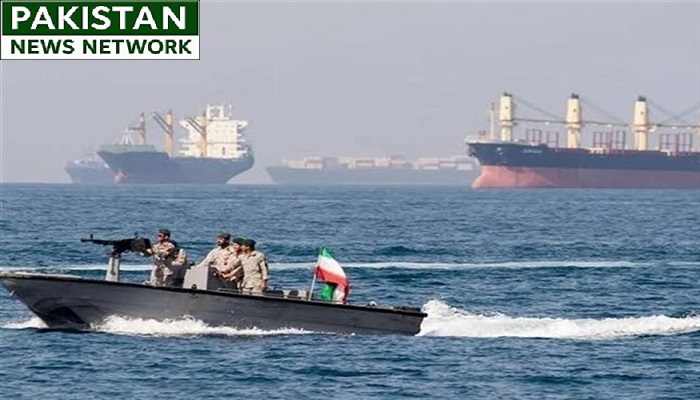
PNN – Maintaining the Iran’s strategic levers—including exercising control over the strait and preserving offensive capabilities—represents the most rational choice for establishing a balance.
According to the report of Pakistan News Network; during the joint attack by the United States and the Zionist regime on the territory of the Islamic homeland, the enemy—harboring a deluded notion—intended to deal a final, decisive blow to the Islamic Republic of Iran once and for all. However, the resilience of Iran’s political and military structures, combined with the demonstration of the country’s capability to impose restrictions on the Strait of Hormuz, shifted the center of gravity of the conflict.
For the time being, the nuclear issue has ostensibly been relegated to a secondary priority, and the central question is whether shipping in the Strait of Hormuz will eventually fall under Iranian oversight and security arrangements. In practice, the Trump administration opposes Iranian control over this vital global energy artery and—contrary to the agreement signed by the parties—seeks a return to the pre-war status of free transit. The White House’s primary objective is to wrest this strategic asset—which has become a key instrument for Iran’s projection of power and deterrence—out of Tehran’s hands.
A Worthless Signature: Why Does Trump Want to Return to War?
In pursuit of this very objective, Donald Trump announced on July 8 that the two countries’ June agreement was at an end. He ordered the U.S. military to launch intense airstrikes aimed at destroying or undermining Iran’s military capability and resolve to control the Strait of Hormuz. Trump has also resumed the rhetoric and threats he voiced during the “40-Day War”—including threats of strikes on infrastructure and the full-scale occupation of Kharg Island. However, he faces a fundamental challenge. None of these options have worked in the past, and there is no reason to believe they will yield results now. In fact, Trump’s return to the very same failed options—which previously failed to end the war on terms favorable to the U.S.—underscores the severe limitations facing both him and the U.S. terrorist military.
The White House’s Persistent Addiction to Sanctioning Iran
Under current circumstances, the imposition of severe economic pressure—in the form of a prolonged naval blockade of Iranian ports—appears to be Trump’s primary tool; a move that could target the country’s internal cohesion by precipitating a debilitating economic crisis. However, the consequences of this economic pain are two-sided. As long as the blockade remains in place, it is highly unlikely that Iran will allow the flow of oil and gas through the Strait of Hormuz. The prospect of such a confrontation—and the resulting spike in energy prices—would directly disadvantage the United States.
On the other hand, implementing such a blockade entails specific operational constraints—particularly given the U.S. need to deploy forces elsewhere in the world—and, fundamentally, no blockade can be sustained indefinitely. Furthermore, assessments by various institutions and experts unanimously emphasize that Iran’s capability to jeopardize shipping in the Strait of Hormuz is, in all likelihood, unstoppable.
In this latest round of tensions, U.S. strikes have targeted not only Iran’s offensive capabilities in the south of the country but also critical civilian infrastructure, such as inter-city bridges and water and power facilities. Some analysts believe the U.S. is laying the groundwork for high-risk actions that it had refrained from executing during the Ramadan War.
These scenarios had been proposed previously, and there was speculation regarding their implementation; however, they were—and remain—considered extremely high-risk. Military and political experts have undoubtedly assessed the potential human and material costs of such actions as exceedingly high. Nevertheless, Washington faces severe limitations in its choice of rational options. While stripping Iran of control over the Strait of Hormuz—and thereby depriving Tehran of this strategic lever—holds great appeal for the United States, achieving this objective in a practical, existential conflict appears virtually impossible. Yet, precisely because of this strategic impasse, the possibility of the U.S. accepting greater risks cannot be entirely ruled out.
Another plausible scenario is that the United States’ primary objective is simply to erode the infrastructure in the country’s south and maintain a campaign of multifaceted pressure against the Islamic Republic of Iran. By doing so, Washington seeks to undermine national cohesion and deepen internal rifts within both Iranian society and the ruling establishment, aiming to leverage this mounting pressure in future negotiations—all without having to resort to its riskiest operational and military measures at this stage of the conflict, which began on February 28, 2026.
The Strait of Hormuz as a Lever of Pressure
An assessment of Tehran’s behavior reveals that, for Iran, the Strait of Hormuz is more than a mere waterway; it serves as a strategic lever for managing the level of conflict and containing the scope of the adversary’s attacks. Consequently, it is unlikely that Iran’s political and military establishment—whether facing operational pressures or sitting at the negotiating table—would readily forgo this key instrument. The roots of this approach must be sought in how Iranian decision-makers perceive the existential nature of the conflict and the magnitude of the threats involved.
Within the framework of strategic calculations, maintaining strategic levers—such as exercising effective control over the strait and preserving both offensive capabilities and the political will to inflict massive costs on the global economy—represents the most rational and logical choice for establishing balance and deterrence in the face of threats to the country’s infrastructure. The objective of retaining these levers is not necessarily to prolong the conflict, but rather to create conditions that allow our country to move—from a more balanced position—toward a diplomatic solution to exit the state of war and end the escalating regional tensions at this juncture.