
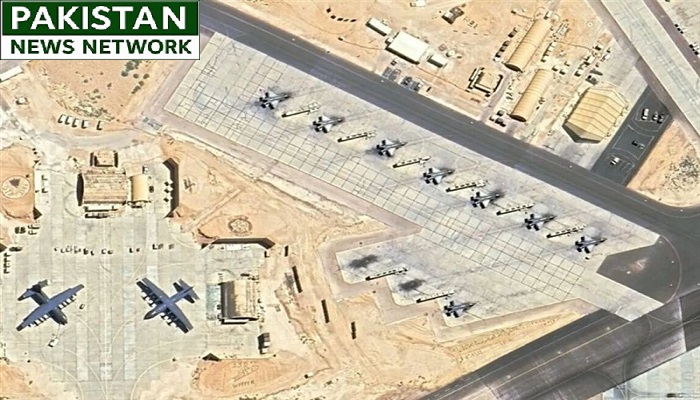
PNN – An American newspaper questioned Donald Trump’s claims regarding the destruction of Iran’s missile capabilities on Wednesday.
According to the report of Pakistan News Network; the American newspaper The Wall Street Journal published a report on Wednesday questioning the claims made by Donald Trump—the head of that country’s terrorist administration—regarding the destruction of Iran’s military and missile capabilities.
The newspaper writes that Iran’s missile attack on an airbase in Jordan, which resulted in the deaths of three U.S. military personnel, demonstrates that the country still possesses a significant arsenal.
Through its deadly attacks on an airbase in Jordan, Iran has proven that—despite Trump’s claims regarding the “total destruction” of the Iranian military—it still holds a vast stockpile of missiles and drones that threaten U.S. forces and America’s regional allies.
The newspaper reported: Military analysts say Friday’s attack on the Muwaffaq Salti Air Base, which resulted in the deaths of three U.S. service members, was likely carried out using Tehran’s most capable missiles, including the medium-range Kheibar-Shekan system.
According to analysts, this missile system—along with others—was housed in vast underground facilities that the U.S. and Israel had repeatedly targeted during March and April.
The Wall Street Journal noted that since then, Iran has cleared the blocked entrances and resumed launches from some of these bases.
An American newspaper reported that this incident highlights the persistent challenge facing the United States; more than a week after the resumption of airstrikes against Iran, the U.S. has failed to curb Tehran’s capacity to retaliate.
Military analysts state that this was the fourth attack by Iran on U.S. forces in Jordan within five days—an indication that Tehran has not exhausted its missile stockpiles and may have become more adept at bypassing U.S. air defense systems.
In April, U.S. Secretary of War Pete Hegseth told reporters that Iran’s missile program had been “operationally destroyed” and that its launchers and missiles had been depleted, destroyed, and rendered almost completely ineffective.
Trump also stated last month that only 21 percent of Iran’s pre-war missile stockpile remained, though he acknowledged that this amount was still very large.
Yesterday, Tuesday, during an Appropriations Committee hearing, Democratic Senator Jon Ossoff of Georgia sharply questioned Hegset regarding his April remarks about the U.S. achieving its war objectives—including “eliminating the Iranian missile threat.” Hegset replied: We never expected them to lose the ability to fire altogether; the issue is the magnitude and scale relative to an adversary like the United States.
Tom Karako, a missile defense expert at the Center for Strategic and International Studies (CSIS), said that the ongoing attacks highlight the difficulty of defending against missile strikes from an adversary that has spent years studying how the U.S. military fights.
He said: After decades of observing how the U.S. fights, the Iranians have designed a comprehensive infrastructure to withstand and endure a war with the United States.
The Wall Street Journal has noted that the fact that missiles managed to penetrate U.S. air defenses highlights the challenges of protecting the approximately 50,000 troops stationed in the region—even though Iran is using fewer missiles in its attacks compared to the early stages of the war.
Ran Kochav, the former commander of Israel’s air and missile defense forces, stated that more missiles are likely to penetrate defenses because radars and other air defense systems sustained damage during previous Iranian attacks throughout the war.
Noting that U.S. air defense radars and batteries in Jordan and the Persian Gulf states were struck during the initial phase of the war, he said: These radars are exposed and vulnerable; their infrastructure has been compromised.
Iran has utilized the ceasefire period for reconstruction. According to Ben Zion Makales, an Israeli geopolitical analyst who has examined commercial satellite imagery of these sites, Iran has been constructing new roads and reinforcing tunnel entrances at several missile bases across the country.
Nicole Grajewski, an expert on Iran’s strategy at Sciences Po in Paris, said that the missiles fired at Jordan likely originated from a base near the city of Tabriz or other bases in western Iran that have resumed operations.
She stated: This means Iran has managed to replenish its missile stockpiles—or perhaps retrieve some missiles that had been stored in underground facilities—and it is clear that they still possess some of their more capable missiles.