
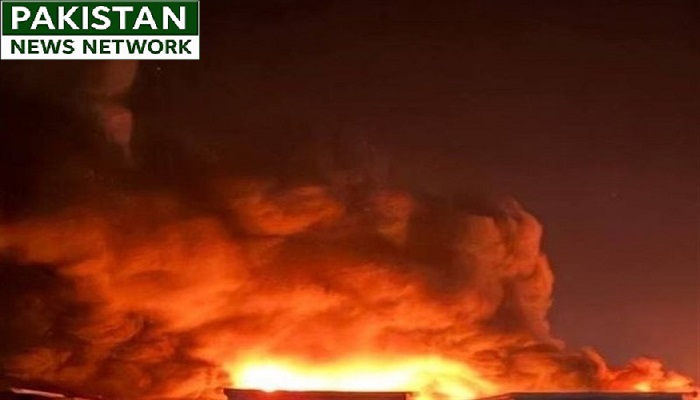
PNN – Americans acknowledge that successful Iranian attacks in Jordan have exposed the vulnerability of U.S. bases.
According to the report of Pakistan News Network; amidst ongoing media analysis regarding Iran’s new strategic equation in the conflict with the U.S.-Zionist enemy—and specifically the targeting of U.S. bases in Jordan, a region effectively serving as a security zone for the Zionists—Al Jazeera published an article titled “Iran’s Attacks Exposed the Vulnerability of U.S. Bases.” The article noted that the renewed hostilities between Iran and the United States have resulted in the deaths of four U.S. service members, all of whom were personnel assigned to air defense units at U.S. bases in Jordan and Iraq.
How did Iran disrupt U.S. war calculations?
These American casualties resulting from Iranian missile and drone strikes have occurred amidst fundamental shifts in the nature of regional conflict and mounting pressure on U.S. air defense systems and the operational capabilities of American bases.
Unlike previous decades—such as the wars in Iraq and Afghanistan, where the greatest threat faced U.S. ground forces and troops were targeted during foot patrols and ground convoys—the conflict with Iran sees the highest casualties among U.S. air defense units; personnel who have never set foot on Iranian soil, and who are stationed at bases hundreds of miles from the front lines, are being killed in Iranian aerial attacks.
The American newspaper The Washington Post reported that since the war began in February, Iran has launched approximately 8,500 missiles and drones at various targets in the region, successfully penetrating the air defense systems of the U.S. and its allies in at least 100 attacks.
It is worth noting that U.S. sources withhold precise figures regarding their own casualties and the attacks carried out against their positions.
The complex crisis Iran has created for U.S. air defense forces
Brad Bowman, a former U.S. Army officer and senior director at the Foundation for Defense of Democracies, stated that this shift has placed immense pressure on the U.S. military—particularly its air defense units—to adapt rapidly.
He added that, due to the changing nature of warfare, the forces responsible for operating these systems have become among the most heavily utilized and active military units.
Pointing to Iran’s expanding use of drones and the significant challenge facing US and Israeli air defense systems in intercepting them, this US military official stated that US air defense units have been compelled to assume new responsibilities. Factors such as autonomy, artificial intelligence, and mass production make the already difficult task facing US Army air and missile defense personnel even more challenging.
Meanwhile, on the political front, US President Donald Trump sparked controversy regarding the management of air defense in the region. Speaking to reporters on Tuesday—without specifying the country in question—he claimed that US forces might have relied on another nation’s defense systems to intercept missiles.
To explain the failure of U.S. air defenses against Iranian missiles and drones, Trump stated that had there been different operators, this would not have happened. When you let others do the job, things sometimes do not go well.
Nevertheless, these events have raised questions regarding the safety of U.S. troops and the readiness of U.S. facilities in West Asia.
Iran Shocks U.S. Military Doctrine in the Region
According to a Washington Post report citing a knowledgeable military official, these facilities were generally not designed to withstand retaliatory strikes. This is because, during previous wars in Iraq and Afghanistan, combat took place within those countries themselves rather than at the regional facilities supporting the war effort.
Prior to the conflict with Iran, the Pentagon had moved many of its forces away from major bases to shield them from potential Iranian retaliation. However, Iran’s response was far-reaching; attacks targeted facilities of all sizes as well as civilian infrastructure, and Iran threatened to strike any nation that supported U.S. military operations.
Citing a U.S. official, The Washington Post reported that Iran has increasingly targeted Jordan in recent days, coinciding with the U.S. deployment of additional aircraft to the country. In this context, three U.S. service members were killed in Iranian attacks on Friday targeting the Muwaffaq Salti Air Base in Jordan.
According to the report, the nature of the mission undertaken by the service members killed in the Iranian attacks reveals new challenges. The unit in which they served was responsible for managing and operating integrated air defense systems, combining the well-known Patriot defense system—designed to counter long-range ballistic missiles—with the lesser-known, field-based Avenger systems.
The Avenger system consists of truck-mounted weaponry equipped with Stinger missiles and a heavy machine gun. Although designed nearly 40 years ago as a last line of defense against low-altitude helicopters and combat aircraft, the U.S. Army has been compelled over the past decade to adapt and upgrade the system to target drones—which have emerged as a primary threat—in response to the high demand for such capabilities.
A U.S. service member who previously served at the Muwaffaq Salti Air Base in Jordan told The Washington Post that many of the structures there consisted of metal trailers and thin-walled tents incapable of withstanding missile, rocket, or drone attacks.
The service member emphasized, however, that even newer structures at some bases in the region—now featuring layers of thick walls—cannot withstand a direct hit from a ballistic missile.
He added: We never expected attacks to be launched against U.S. bases in Jordan, and the operational setups at these bases were not prepared to counter such large-scale conflicts.
The Foundation for Defense of Democracies (FDD) in the U.S. stated that these Iranian attacks on U.S. bases in Jordan reflect Iran’s strategy of punishing regional countries that host U.S. military forces, with the aim of driving the United States out of the region.
According to this report, significant advancements in Iran’s long-range strike capabilities appear to have paved the way for a more overt use of force to target nations hosting U.S. bases and to impose costs upon them.
Meanwhile, in a new strategic development over the past few days, the Islamic Revolutionary Guard Corps (IRGC) has added U.S. bases in Jordan—where substantial numbers of American troops and equipment have been deployed—to its list of targets, successfully striking them one after another.
US sources believe that Iran’s objective in these attacks is not merely to target US bases or inflict casualties and material damage. David Deptula, a retired US Air Force general and a key architect of the 1991 Gulf War, holds that interpreting these attacks solely from a military perspective would be incomplete.
Speaking to Fox News, the retired general stated that Jordan’s location enables the United States to conduct more effective air operations in Syria, Iraq, and the broader region; therefore, Iran’s attack on the Azraq airbase targeted more than just a military facility.
He added that Iran is seeking to raise the political cost for Jordan of hosting U.S. forces, such that the price of this continued presence—whether in security or political terms—exceeds the benefits Jordan and Washington derive from this military cooperation.
The U.S. general emphasized that Iran’s message in carrying out these attacks is directed as much at the country’s regional allies as it is at the United States itself.