
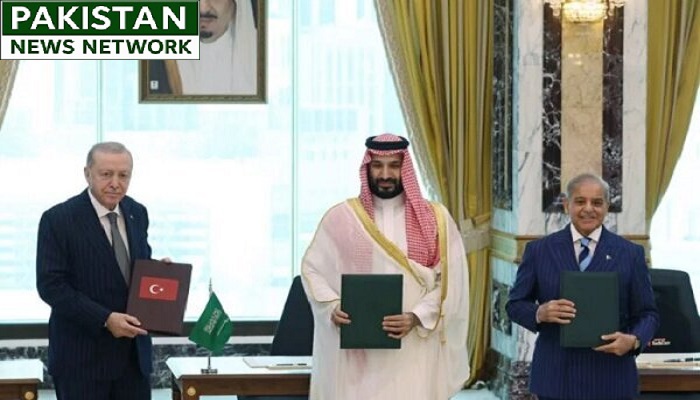
PNN – One of the key factors behind the formation of the Mecca Agreement is the growing doubt regarding the traditional role of the United States in regional security.
According to the report of Pakistan News Network; the signing of the “Mecca Agreement for Joint Defense” among Saudi Arabia, Turkey, and Pakistan must be regarded as one of the most significant recent security developments in the Islamic world—an agreement forged amidst an unprecedented escalation of regional tensions and growing doubts regarding the reliability of the U.S. security umbrella. The significance of this pact extends beyond mere military cooperation among the three nations; it may also signal an effort by regional powers to reduce their reliance on extra-regional security arrangements and to establish new mechanisms for deterrence.
An Agreement amidst a Security Crisis
On August 7, 2026, Saudi Arabia, Turkey, and Pakistan signed an agreement stipulating that an armed attack on any one of the three nations would be considered an attack on all of them; the parties committed to strengthening collective deterrence and expanding defense cooperation. This agreement emerged at a time when the war waged by the United States and Israel against Iran has subjected regional security to new pressures, while tensions regarding vital energy and shipping routes in the region have simultaneously escalated. From this perspective, the timing of the agreement is as significant as its content, signaling that regional security arrangements are entering a new phase.
In such an environment, the issue of security for regional countries is no longer solely dependent on national defense capabilities. Missile and drone attacks, threats from armed groups, the insecurity of energy transit lines, and potential disruptions to shipping lanes have all demonstrated that the traditional boundaries of national security have largely eroded. A country may be militarily powerful, yet if threats emerge from multiple fronts—posed by both state and non-state actors—relying exclusively on domestic capabilities will not suffice to meet all security needs. It is within this context that the Mecca Agreement should be evaluated.
Why Saudi Arabia, Turkey, and Pakistan?
The combination of the three signatory nations conveys a strategic message in itself. Saudi Arabia holds a unique religious and economic position; given its role in the global energy market, security developments surrounding the country have repercussions that extend well beyond its borders. Turkey possesses significant military and industrial capabilities, operational experience, and an active presence across multiple security environments, while also being a NATO member. Pakistan, meanwhile, is the Islamic world’s only nuclear power—a characteristic that enhances its strategic weight in any regional defense arrangement.
From a geopolitical perspective, the three countries are situated in distinct zones of the Islamic world’s security landscape: Saudi Arabia at the heart of the Persian Gulf and the Arabian Peninsula, Turkey at the crossroads of the Middle East, the Caucasus, and the Black Sea, and Pakistan in South Asia. Consequently, an agreement among them could potentially establish an extensive network, transforming security from a strictly regional matter into an issue with supra-regional dimensions. It is precisely this characteristic that leads some observers to view the Mecca Agreement not merely as a short-term measure, but as an initial step toward forming a broader security cooperation network across the Islamic world.
The Most Important Feature: Collective Deterrence
The core of the agreement lies in the provision that treats an attack on one country as an attack on all three. The strategic value of this principle lies not primarily in its application once a war has begun, but rather in the influence it exerts on the adversary’s calculations beforehand. When a country realizes that attacking one party could drag the other two powers into the conflict, the potential cost of military action rises—potentially leading it to abandon the idea of attacking altogether. In other words, successful deterrence is that which prevents war before it even starts.
Of course, there is a gap between declaring a security commitment and the actual ability to implement it. Deterrence is credible only when the opposing party is not merely aware of the pact’s existence but also believes that its members would—if necessary—truly be willing to bear the costs of honoring their obligations. In the case of Saudi Arabia, Turkey, and Pakistan, substantial military, economic, and political capabilities could reinforce this message; however, the ultimate credibility of the agreement in practice will depend on how mechanisms for coordination, command, intelligence sharing, and joint decision-making are established.
The US and Doubts Regarding the Regional Security Umbrella
One of the key factors driving this agreement is the growing skepticism surrounding the traditional US role in regional security. For decades, many Arab states in the Persian Gulf had anchored their security to the US military presence, American bases, and defense arrangements with Washington; however, recent developments have once again raised the question of whether the United States would be willing or able to fully guarantee the security of its regional partners in the event of a major crisis. This uncertainty could prompt regional states to diversify their security partnerships and pursue more independent options.
From this perspective, the Mecca Agreement can be viewed as part of a process in which regional states are striving to transform “security” from an imported commodity into a regional responsibility. This does not imply excluding the United States from security equations; rather, it signifies an expansion of available options for regional nations, ensuring that—should Washington’s approach shift—they do not find their entire defense capability dependent on a single foreign partner.
The Challenge of Defining the Scope of Collective Defense
One significant issue that could impact the future of this agreement is the precise definition of the concept of “armed attack.” Modern security threats do not stem solely from the official armies of nation-states; armed groups and non-state actors are also capable of launching large-scale, organized attacks. Consequently, if the agreement’s mechanism covers only direct attacks by one state against another, certain real regional threats might fall outside its scope.
For this reason, clarifying the scope of obligations, defining the conditions for invoking collective defense, and establishing the decision-making process for any crisis will be vital to the agreement’s credibility. The clearer these rules are, the better third parties will be able to gauge the three nations’ likely response, thereby enhancing the agreement’s deterrent effect.
Is this the beginning of a new security order?
It is too early to give a definitive answer to this question, yet signs indicate that the region is undergoing a form of security diversification. According to Al Jazeera, discussions regarding this agreement began long before the current situation, and consultations aimed at establishing security cooperation among the three nations went beyond a mere short-term reaction to recent crises. Furthermore, the prospect of extending this framework to other regional states raises the possibility that the Mecca Agreement could evolve into the core of broader security architecture in the future.
In this context, Egypt’s non-participation is also noteworthy, though it should not necessarily be interpreted as Cairo’s opposition to this process. Egypt has consistently maintained its own specific considerations regarding regional security arrangements and places particular emphasis on the concept of Arab national security. Consequently, the country’s decision may stem from independent calculations concerning its own position within the regional security architecture, rather than necessarily signaling a rejection of the principle of security cooperation among regional states.
Overall, the Mecca Agreement should be viewed not merely as a defense pact among three nations, but as a sign of a gradual shift in how regional countries perceive the concept of security. Escalating threats, diminishing confidence in external guarantees, and the imperative to establish multi-layered deterrence have driven these nations toward new forms of cooperation. Ultimately, the true value of this agreement will be determined not by the signing ceremony itself, but by the members’ ability to translate political commitments into tangible mechanisms for defense cooperation and deterrence.
If this trend continues, the Mecca Agreement could serve as one of the first signs of an emerging new security architecture in which regional states assume a greater role in ensuring their own security—architecture characterized by reduced reliance on foreign powers and the gradual prominence of regional alliances within Middle Eastern security dynamics.