
PNN – Bin Salman’s dreams collide with reality; the Saudis drift away from “Vision 2030,” while Israel finds itself veering off its vital path.
According to the report of Pakistan News Network; the newspaper Maariv—in an article discussing this situation—examines the challenges that the Saudi-led war in Yemen has created for the Zionist regime. At the same time, it suggests that Tel Aviv should seize this opportunity to advance its own agendas, specifically by pressuring Riyadh toward an overt normalization of relations.
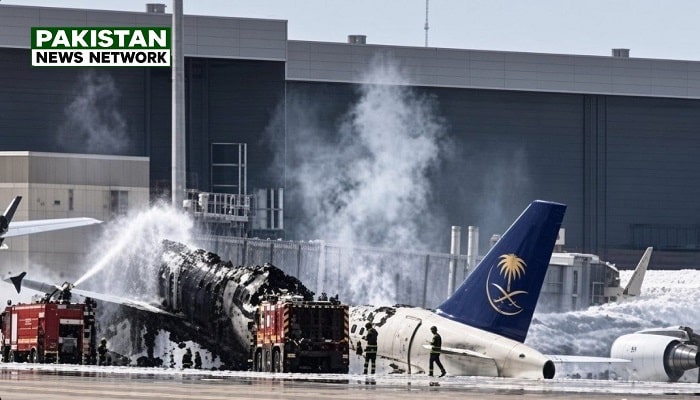
A section of this article states: Saudi Arabia’s inability to defend Riyadh International Airport—where Houthi (Yemeni government) missiles struck Terminals 3 and 4 this week, resulting in a number of casualties—exposes the country’s current military weakness and its future economic vulnerability.
The International Monetary Fund announced this week that Saudi Arabia’s Gross Domestic Product (GDP) is set to contract by 3.3 percent this year.
The Houthis are seeking to close Saudi Arabia’s airspace, and international airlines have cancelled their flights to Riyadh. Given Saudi Arabia’s growing need to finance the war against the Houthis, the country’s budgetary priorities are expected to shift.
Now that Saudi Arabia’s weaknesses and vulnerabilities have become apparent to all, the country’s standing in its relations with its neighbors in the Persian Gulf may also change, potentially leading to a decline in their cooperation with the Kingdom.
Saudi Arabia will not only have to invest vast sums to equip its military with defensive and offensive systems, but it must also find a solution to the shortage of actual combat troops capable of launching an offensive into Houthi-controlled Yemen (against the Yemeni Armed Forces).
It has now become clear to Saudi Arabia that the technology it has acquired from the United States over the past few decades is insufficient for warfare, and that the presence of actual soldiers on the battlefield is an urgent necessity.
The setback faced by Mohammed bin Salman Al Saud—a Crown Prince whose political future remains uncertain—will compel Saudi Arabia to shift its investment priorities. Instead of allocating financial resources toward economic and commercial sectors that yield positive long-term results, the Kingdom will be forced to direct them toward the military sector—an area that offers no return.
A more immediate consequence, concerning Israel, is the anticipated delay in the realization of the India-Middle East-Europe Economic Corridor (IMEC), which was announced at the G20 summit in New Delhi. This corridor is intended to serve as a geopolitical and strategic alternative to China’s Belt and Road Initiative—a project that also encompasses the Suez Canal.
The vision shared by the United States, India, the nations of the Arabian Peninsula, Israel, and Europe involves the creation of a continuous railway line. This route would originate in the United Arab Emirates, traverse the advanced railway networks of Saudi Arabia and Jordan, and ultimately extend to the port of Haifa and onward to Europe. A new financing crisis has emerged regarding the Saudi component of this project—which, under the original plan, requires an investment of tens of billions of dollars to construct new rail lines and upgrade existing ones as part of the “Saudi Land Bridge” initiative. This challenge has become increasingly apparent following significant cuts to development budgets by Saudi Crown Prince Mohammed bin Salman, as part of the “Vision 2030” framework.
Subsequent reductions will also lead to delays in project implementation and a slowdown in the development of the infrastructure required for this international trade corridor.
Turkish President Recep Tayyip Erdoğan—who aims to sideline Israel by establishing a land route—is seeking an alternative to the IMEC (India-Middle East-Europe Economic Corridor), a project that had stalled even before the recent military developments. Turkey advocates for the so-called “dry canal”—a freight transport route connecting the United Arab Emirates and Qatar to Iraq, and from there to Turkish ports and the European railway network. To finance this route, which bypasses Israel, Iraq and Turkey could potentially secure funding from Qatar, a rival of Israel.
On the other hand, the route via Turkey offers the advantage of bypassing Saudi Arabia, Israel, and the Suez Canal.
Elsewhere in the article, the author emphasizes that while Saudi Arabia has long been recognized as the security and political leader among the member states of the Gulf Cooperation Council, its inability to safeguard its own economy—which is dependent on oil production and exports—is undermining the confidence of its neighbors.
The article continues: As Saudi Arabia faces mounting challenges, the NEOM project—initiated by Mohammed bin Salman—now confronts a real risk. Located in the northwest of Saudi Arabia, along the Red Sea coast and the Strait of Tiran, this megaproject was intended to be the flagship initiative of “Vision 2030.” It was designed to transform the face of Saudi Arabia, embodying a transition from an oil-dependent economy into a global hub for innovation, technology, clean energy, and luxury tourism. However, in recent years, the project has encountered numerous practical obstacles, including unprecedented engineering challenges during implementation, a staggering rise in costs, the global economic crisis, and escalating military tensions in the region. All these factors have led to a reassessment of the project, a significant reduction in its scope, and even the partial suspension of certain components.
Under these circumstances, Israel—as a major power—should, in coordination with the United States, extend its support to Saudi Arabia. This time, Israel must take a firm stance, conditioning its provision of intelligence with significant military value on specific demands. This includes the immediate establishment of air defense ties with Riyadh; however, in exchange, Israel should insist that Saudi Arabia join the Abraham Accords and publicly commit to maintaining the Port of Haifa as the starting point for the IMEC corridor. Everything must be made clear from the outset to ensure that the alternative route through Turkey remains out of the running.
Bin Salman does not have many options: either he follows the Israeli-American path, hoping to inherit the throne, or he will be cast aside following a series of military defeats against the Houthis and financial setbacks resulting from unsuccessful investments.
Previously, it seemed unlikely that Saudi Arabia—which had once relied on Israel via U.S. Central Command—would receive aid at virtually no cost; but that is no longer the case. The Prince must select a successor who serves the Kingdom’s interests, before those waiting for the right moment to oust him manage to remove him from power. None of them have forgotten the wave of arrests he orchestrated at the Ritz Hotel in 2017. As dissatisfaction with Saudi Crown Prince Mohammed bin Salman continues to grow, the covert struggle over the succession to King Salman bin Abdulaziz is likely to intensify.