
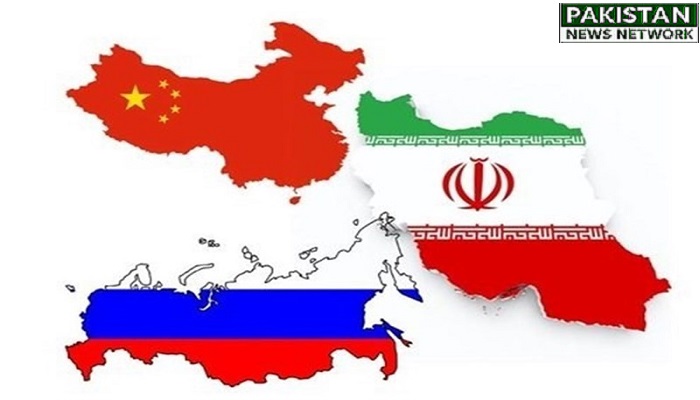
PNN – China, Iran, and Russia issued a joint statement opposing the West’s politicization of the IAEA Board of Governors’ approach toward Tehran.
According to the report of Pakistan News Network; the joint statement by the People’s Republic of China, the Islamic Republic of Iran, and the Russian Federation at the IAEA Board of Governors was released as follows:
Mr. President,
This joint statement is presented on behalf of the People’s Republic of China, the Islamic Republic of Iran, and the Russian Federation.
Pursuant to UN Security Council Resolution 2231 (2015), all its provisions terminated on October 18, 2025. We maintain that the efforts by the three European countries to invoke the so-called “snapback” mechanism are null and void and lack legal effect. Accordingly, the request for the Director General to report on the implementation of these resolutions lacks a legal basis and risks politicizing an issue that should fundamentally remain a technical matter.
We recall Iran’s long-standing commitment to nuclear non-proliferation as a party to the Treaty on the Non-Proliferation of Nuclear Weapons (NPT) and emphasize the need for the full and effective realization of the inalienable right of states to develop, research, produce, and use nuclear energy for peaceful purposes.
Repeated attacks against Iranian nuclear facilities subject to International Atomic Energy Agency (IAEA) safeguards—coupled with persistent threats of further aggression, which we strongly condemn—constitute an unprecedented situation in the history of the Agency and undermine the foundations of the NPT.
The relevant UN Security Council resolution, as well as resolutions of the IAEA General Conference, deem any attack or threat of attack against nuclear facilities to be a violation of the principles of the UN Charter, international law, and the Agency’s Statute.
US attacks against Iran are ongoing, with further strikes carried out in recent days. Consequently, the prevailing security situation has rendered the normal implementation of IAEA safeguards in Iran virtually impossible. This fact has also been confirmed in the Director General’s recent reports to the Board of Governors.
This fact has also been confirmed in the Director General’s recent reports to the Board of Governors. Despite these extremely serious circumstances, Iran has continued its cooperation with the Agency and responded positively to requests for access to the Bushehr nuclear power plant in mid-September 2026, as reflected in the Director General’s recent report. Such cooperation under extraordinary circumstances demonstrates Iran’s continued commitment to constructive and good-faith engagement with the Agency.
At the same time, we consider effective assurances—particularly guarantees against the recurrence of such actions—to be essential for the further development of Iran’s cooperation with the Agency.
Regarding the draft resolution proposed by the United States, Germany, France, and the United Kingdom, we wish to emphasize that—quite apart from its procedural and substantive shortcomings—the draft fails to make any explicit reference to the very attacks that constitute the root cause and primary driver of the current situation.
The findings concerning Iran’s alleged non-compliance with its safeguards obligations in June 2025 were politically motivated and far-fetched. This development also paved the way for attacks on Iran’s nuclear facilities—which are subject to IAEA safeguards—and became the root cause of subsequent difficulties in the implementation of safeguards in Iran.
This matter has been explicitly acknowledged in the Director General’s reports. The new draft resolution represents yet another attempt by its sponsors to exert further pressure on Iran and undermine cooperation between Iran and the Agency. Likewise, the alleged “referral” to the UN Security Council lacks legal basis, aims to escalate the situation, and contradicts the sponsors’ declared commitment to diplomacy. We therefore urge all responsible member states to carefully consider the consequences and refrain from supporting the draft resolution.