
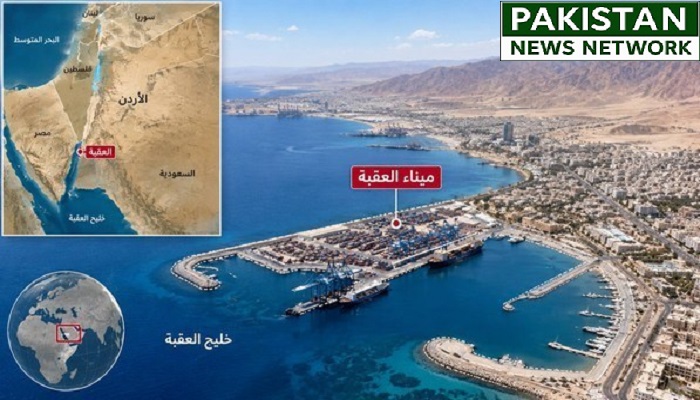
PNN – Iran’s attacks on US positions in Jordan have sparked significant concern regarding the impact on the status of the port of Aqaba.
According to the report of Pakistan News Network; observers believe that—particularly over the past week, as Jordan was added to Iran’s list of targets in retaliation for US aggression—the significance of these attacks on US bases in Jordan extends beyond the messages conveyed to the US and the Zionist regime; they also directly affect Jordan’s domestic landscape at various levels.
The Impact of Security Tensions on the Economic Role of the Port of Aqaba
In this context, attacks launched by Iran targeting the strategic governorate of Aqaba in southern Jordan have raised questions regarding the city’s ability to maintain its economic and logistical role amidst escalating regional tensions—particularly given that Aqaba is Jordan’s only seaport and its gateway to regional and global markets.
Situated at the northernmost tip of the Red Sea and bordering Saudi Arabia, Egypt, and the occupied Palestinian territories, Aqaba serves as Jordan’s closest access point to the open seas.
In this context, Arab economic expert Hesam Ayesh believes that the danger posed by any threat targeting Aqaba is not limited to security concerns; rather, given the city’s status as Jordan’s sole seaport, it extends to economic repercussions. More than two-thirds of Jordan’s foreign trade passes through this port, making it the primary artery for import and export activities.
Speaking to Al Jazeera, Ayesh stated that the importance of Aqaba extends beyond the trade sector to the energy sector as well. The port hosts a liquefied natural gas (LNG) receiving vessel that meets a significant portion of Jordan’s needs, in addition to handling shipments destined for Egypt. Furthermore, plans are in place to utilize the port in the future to supply gas to Syria and Lebanon via the Arab Gas Pipeline, thereby lending it regional significance that transcends Jordan’s borders.
This economic expert warned that any targeting of the Port of Aqaba could disrupt shipping and drive up transport and maritime insurance costs—factors that would be reflected in local market prices, increase the cost of Jordanian exports, and undermine their competitiveness, while also affecting transit traffic to Iraq, Syria, and Palestine.
The Cross-Border Economic Significance of the Port of Aqaba
According to operational data released by the Aqaba Special Economic Zone Authority, the volume of goods handled at the port and logistics facilities rose to approximately 13.3 million tons in the first half of 2026—up from 11.83 million tons during the same period the previous year—marking a growth rate of 12 percent.
The Aqaba Multi-Purpose Port led this growth, with cargo handling volumes surging by 61 percent to reach 3.58 million tons. This increase was driven by a 53 percent rise in grain handling, a 22 percent increase in general cargo, a 25 percent rise in roll-on/roll-off (Ro-Ro) cargo, and a 40 percent increase in livestock shipments, alongside the handling of approximately 468,000 tons of bulk sugar.
The port also recorded a 97% growth in the second quarter compared to the same period last year, with handling volume reaching nearly one million tons in June alone—the highest monthly level since its inception.
The Aqaba Port Management and Operations Company reported that the port has recently received vessels laden with wheat, corn, animal feed, and sugar, and is preparing to receive further shipments of iron and granules.
The Impact of Iranian Attacks on Jordan’s Tourism Sector
While economic activities at the port of Aqaba continue as usual, Jordanian sources report that the province’s tourism sector has been affected by recent security developments following Iranian attacks on U.S. bases.
According to Bilal Rubin, media spokesperson for the Association of Travel and Tourism Agents, although port operations and transportation have proceeded normally, the tourism sector appears to be the most sensitive to these security developments.
Speaking to Al Jazeera, he stated that Jordan, like other countries in the region, has been affected by geopolitical tensions that have directly impacted inbound tourism—particularly foreign tourism. This situation in Jordan has been exacerbated by recent security developments.
Meanwhile, Osama Abu Taleb, Deputy Secretary of the Aqaba Chamber of Commerce and a member of the Aqaba Governorate’s central committee, confirms that the economic sector—and tourism in particular—bears the brunt of any security or political tensions in the region.
He stated that the economy is the first sector to be affected and the last to recover, noting that Aqaba appears particularly vulnerable due to its heavy reliance on tourism and services.
The Jordanian economic official pointed out that Aqaba is immediately impacted by any escalation of tension in the region, even if it is not directly targeted; tourists base their decisions on their sense of security, rather than solely on events occurring within Jordan.
He noted that travel warnings issued by the United States and European Union countries rapidly impact the sector through the postponement or cancellation of bookings and flights, which in turn affects hotel occupancy rates as well as market activity and tourism-related services.
Osama Abu Taleb emphasized that these effects are not limited to outlying areas; major tourist destinations such as Petra and Wadi Rum have also experienced a significant decline in activity, with the drop reaching 50 percent in some areas and nearly 90 percent in others.
Lubna Namr, the representative for Aqaba Governorate in the Jordanian Parliament, stated that Iran’s attacks posed a significant threat to Jordan—particularly the port city of Aqaba—and that this crisis must be addressed through two channels, the most critical being the economic one. Currently, tourism and trade in Aqaba are being impacted by regional developments and the city’s designation as a “red zone,” a situation that necessitates immediate government intervention.
The Jordanian MP emphasized that the anxiety felt by citizens in Aqaba and other governorates—stemming from the sounds and explosions heard in Jordanian airspace—makes it essential to bolster public safety measures, intensify media and public awareness campaigns to reassure the public, and ensure round-the-clock medical and field readiness.
The Importance of the Port of Aqaba to the United States
The Port of Aqaba holds significant importance for the United States, as it plays a vital role in the logistical supply chain for American forces in the region. Although it does not host a permanent U.S. base, it has served as one of the most important support hubs for U.S. Central Command over the past two decades.
The port has provided logistical support to U.S. forces since the 2003 Iraq War and continues to play this role today; a substantial portion of the equipment for U.S. troops stationed in Jordan, Iraq, and Syria is transported through the Port of Aqaba.
Accordingly, observers believe that any threat to the Port of Aqaba would not only impact Jordan’s economy but also threaten U.S. operations in the region.