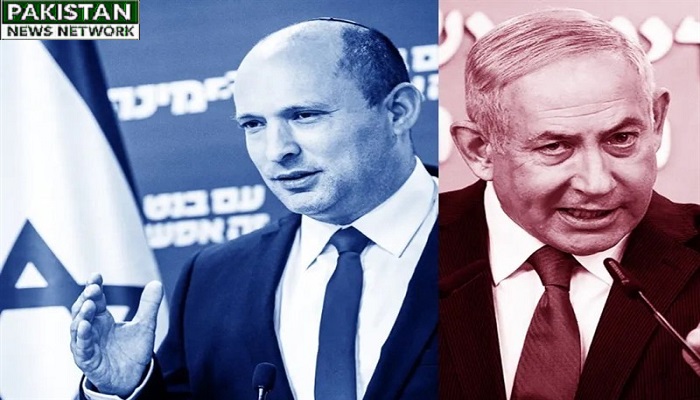
PNN – Naftali Bennett launched his fiercest attacks against Benjamin Netanyahu ahead of the Israeli Knesset elections.
According to the report of Pakistan News Network; the Maariv newspaper reported that with the election roughly two months away, Bennett outlined the key points of his political vision; in doing so, he cited Saudi Arabia, claiming that by preventing uranium enrichment in the Kingdom, he would avert a nuclear arms race in the Middle East.
The report states that Naftali Bennett, leader of the “Unity” party, outlined the key elements of his political vision and the measures he would prioritize if he were to form the next government—covering issues ranging from Iran, Gaza, and the northern front to relations with the United States, Europe, and Arab nations.
In his remarks, Bennett acknowledged that Israel is in a state of “political emergency.” He pledged to work toward the destruction of Hamas and Hezbollah. He also emphasized that his government would prevent uranium enrichment in Saudi Arabia.
According to Bennett, three years after the events of October 7 (Operation Al-Aqsa Flood), Israel has failed to achieve victory in the political arena. He stated: Israel is in a state of political emergency. Political decisions are being made far from Tel Aviv, foreign leaders are deciding our future, and hostile nations are redrawing our borders.
Bennett linked the political crisis to Israel’s internal developments and launched a scathing attack on Benjamin Netanyahu following the latter’s remarks this week, saying: What Netanyahu did this week was an unjust slander. I do not recall any Israeli leader taking such a harsh stance.
According to him, Netanyahu is aware that millions of Israelis believe a betrayal has taken place, and he continues to aggressively propagate the narrative of betrayal.
Bennett stated that the next government would face the “grave consequences” of the previous administration’s actions; he described the resulting political void as a “massive vacuum” and asserted that his party possesses the “right tools and personnel” to fill it.
Regarding relations with the United States, Bennett acknowledged that Israel’s standing in American public opinion has plummeted to an all-time low. He claimed to have a plan to bolster Israel’s image among the American public.
He described Donald Trump as “the most pro-Israel president we could hope for,” but claimed that Trump currently lacks an Israeli partner with whom to achieve political gains. He stated: In our administration, he would have a partner for achieving results, not a politician who creates obstacles.
Regarding Iran, Bennett asserted that he would continue to impose direct sanctions on the country. He also announced plans to reactivate the strategy of undermining the Iranian regime—an initiative he had launched during his own premiership but which was halted under the current administration.
Regarding Gaza, Bennett stated that Netanyahu and his government have failed to destroy Hamas, but he intends to bring countries like Egypt—which seek to eliminate Hamas—into the Gaza arena.
After outlining his plans regarding Hezbollah, Syria, and other regional issues—specifically concerning Saudi Arabia—Bennett drew a red line, asserting: In the next government, we will use diplomacy to prevent uranium enrichment on Saudi soil—a move that could trigger a dangerous nuclear arms race in our region. He accused Netanyahu of giving the green light for this initiative without even securing a commitment to normalize relations.
Bennett also revealed that he and Yair Lapid, leader of the “Yesh Atid” party, are currently collaborating with certain European nations in an effort to resolve the crisis in relations.