
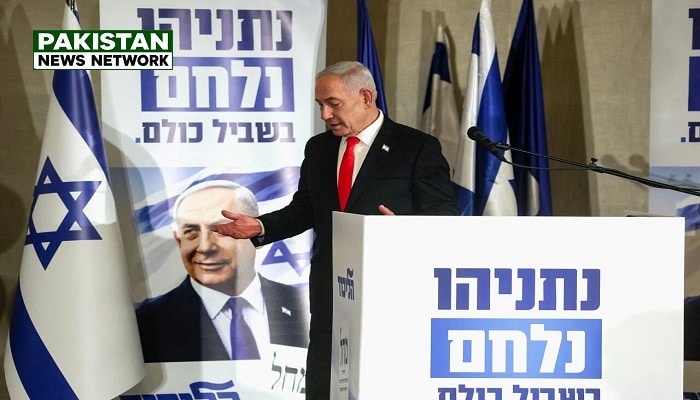
PNN – In an op-ed examining the trajectory of negotiations regarding the Gaza ceasefire and prisoner exchange, an Israeli journalist and political analyst wrote that by stalling agreements and prolonging the war, Benjamin Netanyahu has shifted from the 2024 promise of “absolute victory” to the 2026 election slogan “We Will Not Surrender”—dragging the occupying regime toward the brink of an abyss in the process.
According to the report of Pakistan News Network; Nahum Barnea, an Israeli writer and political journalist, analyzed the decision-making process of Israeli Prime Minister Benjamin Netanyahu regarding ceasefire and prisoner exchange negotiations in an article for Yedioth Ahronoth titled “Netanyahu: From ‘Absolute Victory’ to ‘We Will Not Surrender’—All Roads Lead to the Abyss.”
In this article, Barnea wrote that July 2024 was a pivotal month in the Gaza war. A deal had been proposed that appeared to all parties to be a done deal; Netanyahu had agreed to it, and Yahya Sinwar—under pressure from Qatar in Doha and the Israeli military on the ground—had also consented.
According to Barnea, the families of Israeli hostages held in Gaza approached Karim Khan, the then-Prosecutor of the International Criminal Court in The Hague, to facilitate the agreement with Netanyahu. Khan’s mission was to take steps to have the arrest warrants issued against Netanyahu and Yoav Gallant—Israel’s then-Defense Minister—withdrawn.
Barnea believes that these efforts failed due to a fundamental flaw in Netanyahu’s approach. According to him, the heads of the intelligence agencies and the Israeli negotiating team—Barnea, Alon, and Bar—viewed every problem as an obstacle requiring a solution; Netanyahu, however, saw each problem as an opportunity to avoid the necessity of reaching an agreement.
Barnea wrote that at every stage of the negotiations, an official from Netanyahu’s office would secretly keep Finance Minister Bezalel Smotrich apprised of developments. Smotrich would insert himself into the discussions uninvited or hold press conferences, threatening to dissolve the cabinet if an agreement were signed. Following him, National Security Minister Itamar Ben-Gvir would also step in with a similar threat.
Pointing to the revelation of further details regarding what he described as a three-year-long saga, the author wrote that the ruling coalition’s periodic crises have proven to be nothing more than a ruse and a charade staged for the benefit of security agency leaders and the Joe Biden administration.
Barnea believes that Smotrich would not have abandoned the cabinet while in the midst of implementing his ideological vision for the West Bank, nor would Ben-Gvir have withdrawn from the coalition as long as he was reaping the benefits of holding power. According to Barnea, Netanyahu not only refrained from yielding to the demands and threats of these two figures but actually encouraged them to adopt such stances.
Barnea went on to write that, at that stage—after nine months of war and carnage—Netanyahu could hardly agree to a deal that might be construed as ending the war; for in that event, Israeli public opinion—including his own supporters—would have questioned the fate of his promised “total victory.”
He added that while the war had failed to achieve any of its objectives and Israel’s global standing had severely deteriorated, Netanyahu still saw no cause for complaint.
In the final section of the article, Barnia points to the Likud party’s campaign slogan, “We Won’t Surrender”—a slogan accompanied by an AI-generated image of Netanyahu. In the image, he gazes to the right and slightly downward, as if looking at Zionists stuck in traffic on the Ayalon Highway.
The author concludes by noting the long, bitter journey Netanyahu has traversed: from promising “total victory” in 2024 to pledging “we won’t surrender” in 2026. He had promised to deliver a knockout blow but ultimately settled for a stalemate, dragging Israel toward the precipice along the way.