
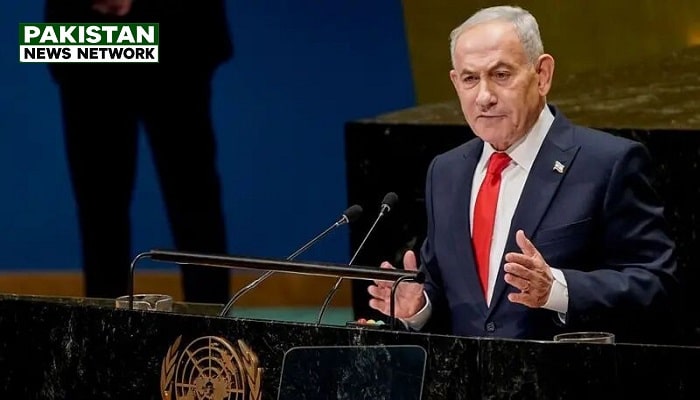
PNN – The Prime Minister of the Zionist regime addressed the 81st session of the UN General Assembly on Thursday night as dozens of delegations walked out in protest of his presence, leaving him to deliver his approximately 40-minute speech before empty seats—a speech in which he attempted to defend his cabinet’s policies in Gaza and the West Bank while launching verbal attacks against Iran, Qatar, Turkey, and France.
According to the report of Pakistan News Network; the Shehab news agency noted in a commentary that in a striking scene, Israeli Prime Minister Benjamin Netanyahu addressed the 81st session of the UN General Assembly on Thursday night while dozens of delegations walked out of the hall in protest of his presence, effectively turning his approximately 40-minute speech into an address delivered to empty seats. During the speech, Netanyahu sought to defend his cabinet’s policies in the Gaza Strip and the West Bank and lashed out at Iran, Qatar, Turkey, and France, while simultaneously directing messages to public opinion within the occupied territories.
Before taking the podium, Netanyahu had stated that he would present “surprises” in his speech; however, the address largely reiterated positions his cabinet has maintained since the outbreak of the war in Gaza. He once again advanced narratives and claims regarding humanitarian aid, settler violence, the events of October 7, and the situation in Bethlehem, while also attempting to absolve Tel Aviv of responsibility for the conditions facing Palestinians.
Below are eight prominent claims made in Netanyahu’s speech that conflict with United Nations data, media investigations, and official documents concerning the events in question:
Downplaying Settler Violence
In his speech, Netanyahu attempted to frame settler attacks in the West Bank as the actions of a limited group of youths; he stated that around 150 individuals engage in stone-throwing, the felling of olive trees, and occasional arson, claiming that the number of Palestinians killed as a result of these attacks is no more than two or three.
However, data from the UN Office for the Coordination of Humanitarian Affairs (OCHA) presents a picture that differs from Netanyahu’s account. Over the past few years, the organization has documented a steady rise in settler attacks—along with their consequences, such as injuries, killings, displacement, and the destruction of property and farmland—and the number of recorded attacks has reached high levels compared to previous years.
According to United Nations data, the consequences of these attacks extend beyond injuries or material damage; coupled with restrictions on Palestinian movement, they have led to the full or partial displacement of dozens of Palestinian communities—making settler violence a primary driver behind the depopulation of Palestinian areas.
Furthermore, characterizing these attacks as the actions of a small group of youths ignores the reality that prominent figures from the settler movement hold ministerial positions in Netanyahu’s cabinet, even as settler attacks against Palestinian villages, towns, citizens’ property, and agricultural lands continue.
Theft of Humanitarian Aid
Regarding humanitarian aid, Netanyahu once again reiterated the Israeli regime’s narrative that Hamas seizes a significant portion of the aid entering the Gaza Strip—a narrative the Israeli cabinet has used to justify restrictions imposed on the mechanisms for aid entry and distribution within the territory.
However, a review conducted by the U.S. Agency for International Development (USAID) concerning incidents reported by its partners between October 2023 and May 2025 found no evidence of organized aid theft by organizations designated as terrorist groups.
This review covered 156 reported incidents of aid theft or loss, and the results indicated that less than one percent of the aid was affected by theft, diversion, or waste—findings that contradict the narrative often presented of widespread aid theft as an established fact explaining the humanitarian crisis in the Gaza Strip.
The New York Times also reported, citing Israeli military officials, that the Israeli army has found no evidence of organized aid theft by Hamas from UN distribution sites; this is despite repeated warnings from humanitarian organizations regarding the difficulties surrounding aid entry, distribution, and the ability of the needy population to access such assistance.
Engineering Starvation
In an effort to address allegations regarding the humanitarian situation in the Gaza Strip, Netanyahu cited the entry of two million tons of food into the region and the provision of one million doses of the polio vaccine, using these figures to refute accusations of starvation and genocide.
However, the volume of aid the Israeli regime claims to have permitted does not, in itself, reflect the humanitarian reality inside the Gaza Strip. Throughout the war, international organizations have documented widespread difficulties regarding residents’ access to food and recorded dangerous levels of food insecurity—to the extent that famine was declared in parts of the Gaza Strip at various stages of the conflict.
In August 2025, the Integrated Food Security Phase Classification (IPC) declared that famine conditions existed in Gaza City, even as humanitarian organizations warned of persistent malnutrition, shortages of basic necessities, and escalating humanitarian needs.
Regarding the polio vaccination campaign cited by Netanyahu, it is important to note that the initiative was carried out by the World Health Organization (WHO), UNICEF, UNRWA, and other health partners under temporary humanitarian arrangements that enabled the campaign to take place within the Gaza Strip. The execution of this campaign cannot be interpreted as evidence of normal health and humanitarian conditions in Gaza or that the basic needs of its residents were being met.
Discrepancies in Statistics
Continuing his speech, Netanyahu addressed the city of Bethlehem, claiming that when the city was under Israeli control, it had an overwhelming Christian majority; however, after being handed over to the Palestinian Authority, it shifted to a Muslim-majority city in roughly the same proportion, forcing Christians to leave.
Yet, historical statistics regarding Bethlehem’s demographics do not support the characterization of the city as having had an overwhelming Christian majority. Data from 1967 indicate a population of approximately 14,439, with Christians comprising 46.1 percent and Muslims 53.9 percent. When the population of the refugee camp within the municipal boundaries is included, the proportion of Muslims rises further.
Data regarding Christian emigration from Bethlehem also points to multiple factors that have accumulated over several decades—including economic and political conditions, the occupation, land confiscation, military checkpoints, and restrictions on movement and access to Jerusalem and other Palestinian areas.
Therefore, attributing the demographic shifts in Bethlehem solely to the “expulsion” of Christians following the transfer of the city’s administration to the Palestinian Authority overlooks the broader historical and political context examined in various studies and reports on Palestinian Christian emigration.
A Lie Resurfaced
In his speech, Netanyahu once again raised narratives surrounding the events of October 7, 2023—including claims that children and infants were burned during the attack. These narratives had circulated widely in the early days of the war, and aspects of them were later scrutinized in investigations by Israeli media.
In its own investigation, the newspaper Haaretz examined these accounts, citing testimony and data from the Israeli National Insurance Institute, kibbutz leaders, and the police; it reported that no evidence had been found to substantiate the claims regarding the beheading of children and infants in the manner originally publicized.
The investigation also addressed the death of Mila Cohen, a 10-month-old infant who was killed by gunfire at Kibbutz Be’eri during an attack on her family’s home. At the same time, accounts alleging the mass burning or beheading of dozens of children have not been substantiated.
Nevertheless, Netanyahu once again raised these narratives before the UN General Assembly, attempting in his speech to cement the Israeli regime’s version of the October 7 events and establish it as the basis for justifying subsequent military operations in the Gaza Strip.
Detached from the actual circumstances of the incident
In his attack on French President Emmanuel Macron, Netanyahu spoke of a French citizen named Nathanael Chkroun—a father of six—claiming that he had been killed a few days earlier while visiting a spring with his son, and that the perpetrator was a Hamas member who shot him at close range.
However, the information released regarding the incident included neither an official claim of responsibility by Hamas nor an identification of the attacker matching Netanyahu’s description; yet, in his speech, Netanyahu presented the incident as an event with clearly defined details and established responsibility.
Furthermore, presenting the site of the incident merely as a spring visited by settlers ignored the ongoing dispute over the surrounding land. Located near the “Halamish” settlement, the spring has been brought under settler control—with settlement and tourism activities established there—while Palestinian landowners have, at times, been denied access to it.
The area also has a history linked to settlement expansion and restrictions on Palestinian access to their own land—a context notably absent from Netanyahu’s narrative before the UN General Assembly.
There Was No Israeli Presence
In yet another falsehood, Netanyahu claimed that on October 7, no Zionists—whether civilian or military—were present in the Gaza Strip, attempting to portray Gaza as a territory devoid of any Israeli presence prior to the attack.
While the claim that the Zionist regime withdrew its settlers and permanent military forces from within the Gaza Strip in 2005 is geographically accurate, this did not signify the end of Tel Aviv’s control mechanisms following the withdrawal. These mechanisms have encompassed control over airspace and territorial waters, the imposition of sweeping restrictions on the movement of people and goods, control over various crossings, as well as the conduct of military operations and the enforcement of security restrictions.
In its 2024 advisory opinion, the International Court of Justice emphasized that the Zionist regime’s obligations under the law of occupation did not cease merely with its withdrawal from the Gaza Strip; rather, these obligations remain in effect as long as the regime continues to exercise effective control over the territory.
Previous reports have also addressed the nature of the blockade imposed on Gaza since 2007 and the restrictions placed on the movement of residents and goods. Furthermore, other reports have indicated that Zionist authorities imposed limits on the quantity of food allowed to enter the Gaza Strip, including calculations of the minimum caloric intake required to avert widespread famine.
Accusations against Qatar
In the final part of his speech, Netanyahu intensified his attacks on Qatar, accusing the country of spending billions of dollars to influence American public opinion and fund universities and media outlets—including Al Jazeera—in order to disseminate what he termed “lies” about Israel and sway American youth.
In response, Majed Al-Ansari, the spokesperson for Qatar’s Foreign Ministry, rejected these allegations, describing them as an attempt to divert attention from the policies of the Zionist regime in the Palestinian territories; he stated that the shift in the views of American youth cannot be reduced to foreign influence campaigns.
Public opinion polls in the United States also reveal a significant shift in the stances of various age groups regarding the conflict between the Palestinians and the Zionist regime. A Gallup poll released last February showed that, for the first time since the survey began, more than half of Americans aged 18 to 34 sympathized more with the Palestinians than with the Zionists. In contrast, sympathy for Israelis within this age group stood at 23 percent—the lowest level ever recorded for this demographic in the survey.
This shift extended to the 35–54 age groups, which also saw a change in sympathetic leanings over the course of a year—indicating that the shift in American public opinion has become a measurable trend in polls—even as Netanyahu’s interpretation of this change as a direct result of Qatari campaigns remains part of his political narrative.