
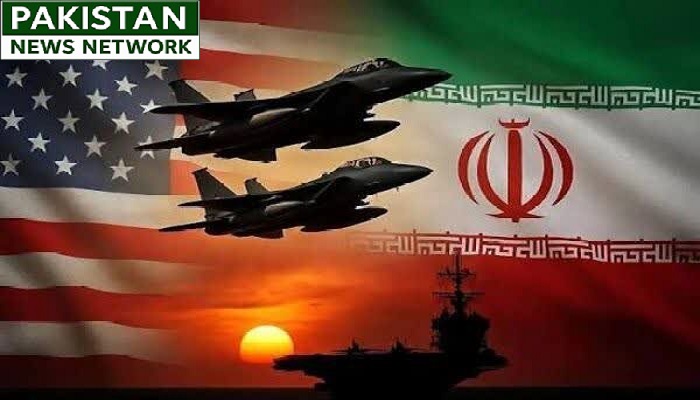
PNN – The elaborate plan to evacuate the U.S. President from the aircraft using a catering truck has taken even Washington officials by surprise, and some experts believe the humiliation of Trump amounts to a form of revenge.
Since the onset of the military aggression by the US and the Zionist regime against Iran, not only have the declared objectives of the operation failed to materialize, but—as acknowledged by Western officials and American media—the aggressors have faced a strategic impasse as well as defeats on both the battlefield and the political stage. This war, which began with massive attacks and the killing of civilians—including innocent schoolchildren—rapidly assumed broad humanitarian, security, and economic dimensions, eliciting diverse reactions across international media.
Global media outlets have each sought to shape the narrative of this war through their own specific perspectives; examining these portrayals can offer a clearer picture of the conflict’s actual situation and its future outlook.
British Media
In a report by Andrew Roth, The Guardian wrote that the unprecedented security measures taken to secretly move Donald Trump from Air Force One in Turkey underscore the seriousness of the terror threat posed by Iran. According to the report, the complex plan to extract the U.S. President from the aircraft using a catering truck caught even Washington officials off guard. Security experts described the move as “undignified” and dangerous—a maneuver that could make Trump appears “weak.”
Bruce Hoffman, a senior counterterrorism expert at the Council on Foreign Relations, noting that “revenge is taken very seriously by Iran,” emphasized that the assassination of General Qassem Soleimani—ordered directly by Trump—has “triggered very serious threats.” He added that, from Iran’s perspective, “humiliation is itself a form of revenge,” and reports regarding this covert relocation would be “highly gratifying” to Tehran.
Colin Clarke, Executive Director of the Soufan Center, also emphasized that the threat against Trump “will persist as long as he is alive, whether in office or out of it.” Pointing to Iran’s historic patience in orchestrating complex attacks, he concluded: We are nowhere near the end of this conflict.
In an analysis, the BBC’s Anthony Zurcher wrote that the covert switch of Donald Trump’s aircraft in Turkey has revealed the deeply personal dimensions of the conflict with Iran. According to the report, Trump was transferred from Air Force One to another military plane using a catering truck, while the primary aircraft—carrying journalists and most White House staff—took off as a decoy. This unprecedented operation, revealed more than a month after it occurred, demonstrates that the U.S. Secret Service took the threat of an Iranian missile attack on the presidential plane very seriously.
Reviewing the history of Iranian threats against Trump—ranging from the 2020 assassination of General Qassem Soleimani ordered by him to thwarted plots in 2024—this analysis emphasizes that, contrary to Trump’s claims of ending the war and completely defeating Iran, “the Iranians say the war is not over yet, and Trump himself is a target for revenge.” The BBC points to “#Kill_Trump” banners displayed during ceremonies and a massive mural in Tehran depicting Trump in a black coffin alongside the slogan “Blood for Blood.”
Chinese and Russian Media
In a report titled “US Demand for Compensation from Iran Aimed at Pressuring Tehran and Countering Washington’s Image of Compromise,” China’s Global Times addressed the escalating tensions between Iran and the US regarding the reopening of the Strait of Hormuz and the potential conditions for resuming negotiations.
The newspaper reported that US President Donald Trump, responding to Iran’s demand for war reparations, has called on Tehran to pay compensation for US troops killed or wounded, as well as for victims of various conflicts and protests over the past five decades.
In this context, Washington has cited incidents such as the 1983 Beirut bombing and the deaths of at least 603 U.S. military personnel in Iraq between 2003 and 2011.
Citing Chinese expert Zhu Yongbiao, the Global Times reported that raising the issue of compensation is part of a U.S. strategy to increase pressure on Tehran and shift the country’s image from a conciliatory stance to an aggressive and assertive one.
According to him, expanding the scope of U.S. claims to cover the past five decades may be intended to divert attention from Washington’s failures in recent confrontations with Iran and to portray the United States as a victim of war.
In contrast, Iran has called for the reopening of the Strait of Hormuz, the lifting of the naval blockade and sanctions, the withdrawal of US forces from the region, the payment of war reparations, the unfreezing of assets, and a halt to attacks and threats against Iran and its regional allies. The report emphasizes that the dispute over reparations has now become a major source of tension, and the negotiating deadlock carries implications for Middle East stability and the global economy.
Rising tensions have also driven up oil prices. However, Chinese experts believe that the return of key issues to the negotiating table could signal an effort by both sides to re-engage in talks, even though a quick agreement still appears out of reach.
In a report titled “The Last Gas: EU Heads into winter with Critically Low Fuel Reserves,” the Russian newspaper Izvestia examined the concerning state of Europe’s gas stockpiles and the potential implications for the energy market.
According to the report, Europe’s underground gas reserves stood at only 59.1 percent capacity as of August 10—12.4 percent lower than during the same period last year. Disruptions to LNG shipments via the Strait of Hormuz—specifically a partial halt in Qatari exports—combined with an intense heatwave and surging electricity demand, have slowed the pace of gas storage. Additionally, reduced nuclear power generation in France and a drop in wind power output in Germany have heightened Europe’s reliance on gas-fired power plants.
By the end of July, European gas prices had nearly doubled compared to levels prior to the onset of the Middle East crisis, hovering around $700 per thousand cubic meters on August 11. High prices have dampened energy companies’ willingness to purchase and store gas.
Germany, which holds approximately 20 percent of the European Union’s gas storage capacity, has filled only 48.5 percent of its reserves, and the government currently has no plans to purchase gas directly.
Experts believe that Europe may struggle to reach the 80% target; should a cold winter coincide with continued disruptions to LNG supplies from the Middle East, gas prices could climb to $1,000 per 1,000 cubic meters. Under such circumstances, Europe would be forced to compete with Asian nations—particularly China—to secure additional gas supplies.