
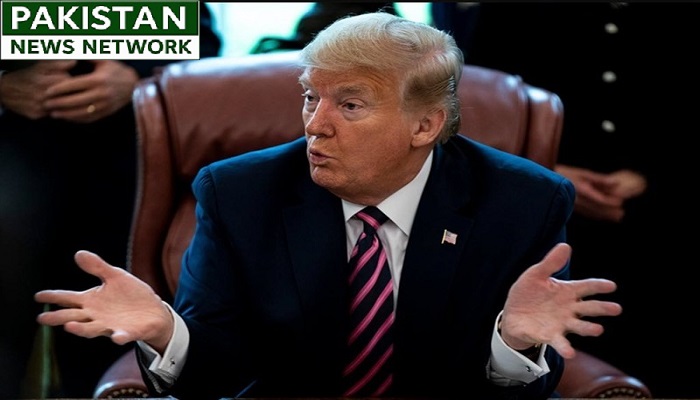
PNN – The new realities of the war have left Donald Trump with no face-saving options for withdrawal.
According to the report of Pakistan News Network; a report by The Atlantic notes that, five months into the war with Iran, the Donald Trump administration is facing a reality that contradicts Washington’s initial assessments: contrary to U.S. expectations, Tehran has not collapsed under military and economic pressure and has managed to continue resisting and exerting pressure. Key points from the report are outlined below:
- Iran’s Resistance Exceeds U.S. Expectations
The Atlantic reports that the Trump administration expected severe economic pressure to eventually push Iran to a point where negotiation would be the regime’s only option; however, U.S. officials have been surprised by the extent of Tehran’s resilience and are no longer certain that Iran will reach such a juncture.
- U.S. Pressure Backfires
According to The Atlantic, Washington assumed that sustained pressure would force Iran to back down; instead, despite economic hardships, Tehran has persisted in its resistance and has even gained greater confidence in testing the limits of U.S. resolve.
- Tehran Does Not Take U.S. Threats Seriously
The Atlantic notes that the Trump administration has repeatedly threatened Iran with new attacks but has backed down from carrying out those threats on numerous occasions. From Tehran’s perspective, this pattern demonstrates that Washington has limited appetite for a genuine escalation of hostilities—a factor that has enabled Iran to maintain its stance.
- Iran Still Retains the Capacity to Exert Counter-Pressure
According to the publication, Iran’s leverage is not limited merely to enduring economic pressure. Tehran remains capable of raising the cost of continued conflict for Washington by attacking vessels in the Strait of Hormuz and threatening U.S. forces and bases in the region—a dynamic that has complicated the Trump administration’s calculations.
- Washington is no longer certain of the outcome of escalating the conflict
The Atlantic emphasizes that even if the U.S. expands its attacks, there is no guarantee that Iran will capitulate or return to the negotiating table. This very uncertainty has transformed the military option—contrary to initial calculations—into a high-risk proposition for the Trump administration.
- Iran’s resilience has eroded U.S. leverage
According to The Atlantic, the White House is concerned that U.S. leverage is diminishing. Iran is aware of the constraints Washington faces, and this awareness has bolstered Tehran’s capacity for resistance and bargaining.
- Diplomacy has become the lower-risk option
The Atlantic concludes that, under current circumstances, negotiation and making concessions may pose less risk for the Trump administration than escalating the conflict—a shift that reflects a change in Washington’s calculations regarding an Iran that, contrary to initial expectations, has not collapsed under pressure.
- Conclusion
The Atlantic depicts a shifting calculus in the conflict: Washington entered the confrontation believing that military and economic pressure would quickly force Iran to capitulate or negotiate; yet, five months later, the Trump administration faces an Iran that continues to resist and possesses leverage to exert counter-pressure.