
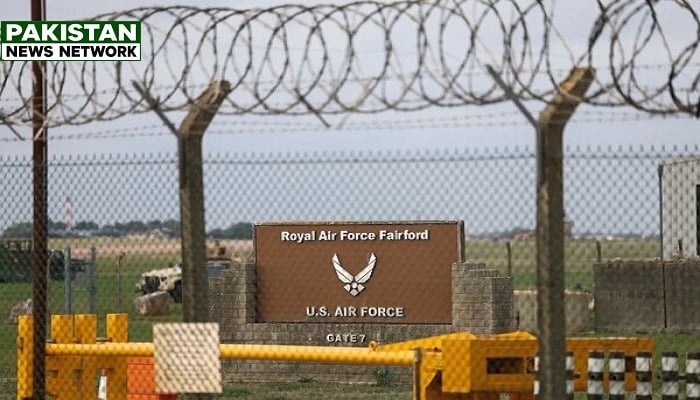
PNN – A few days after the security incident near the UK’s RAF Fairford base, the ambiguity surrounding the event’s details—coupled with the fact that Iran’s name has been raised in connection with it—has turned this case into a stage for the emergence of a new security narrative.
The Fairford incident has emerged as a high-profile security story in the UK over the past few days, occurring against the backdrop of the country grappling with the repercussions of its military involvement in West Asia and escalating tensions with Iran.
The significance of this event extends beyond a mere incident in the vicinity of a military base; in recent years, Fairford has served as part of the military infrastructure utilized by the US for regional operations, and consequently, any security incident there warrants attention beyond its local scope.
At the same time, the rapid emergence of media and political narratives surrounding this case—and the British Prime Minister’s formal allegation regarding Iran’s involvement—have raised questions about how an incident still under investigation has been transformed into a security issue linked to Iran; answering these questions requires distinguishing between verified facts, disclosed evidence, and the narratives that have taken shape at various stages of the case.
An Incident Shrouded in Security Ambiguity
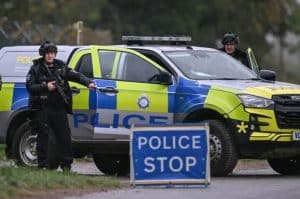
The Fairford case began in the early hours of Sunday, September 27, 2026, when British police detained five UK citizens near Royal Air Force (RAF) Fairford. The investigation initially focused on suspicions involving explosives before shifting to charges of preparing a terrorist act; subsequently, dozens of families were evacuated from the surrounding area.
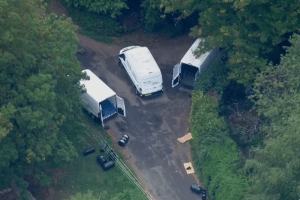
Despite the heavy security atmosphere, the five detainees were released on bail the following day without facing formal charges. British counter-terrorism police have stated that the investigation is ongoing and that it is too early to draw conclusions regarding the ultimate nature of the incident. Published reports also indicate that no explosives were found during searches of vehicles linked to these individuals—a fact highlighting a significant discrepancy between the initial scale of the security operation and the findings of the judicial proceedings thus far.
The situation becomes even more ambiguous as British police speak of pursuing multiple lines of inquiry. According to security officials, one possibility is that the detained individuals were acting—knowingly or unknowingly—on behalf of a foreign state or as its proxy; however, the police have not yet named any specific country as a potential perpetrator or sponsor. Consequently, the hypothesis of foreign involvement remains just one of the scenarios under investigation and cannot be equated with a role played by Iran.
However, Iran’s name quickly came to the fore in the narrative surrounding the case—a development that prompted a response from the Embassy of the Islamic Republic of Iran in London, which denied any link between Tehran and the incident. Subsequently, although British officials emphasized that the investigation was ongoing, British Prime Minister Andy Burnham claimed on Wednesday that there were strong indications of Iranian involvement in the incident; he made this claim without providing details regarding the evidence cited, while simultaneously stressing the continuation of the police investigation.
Consequently, at this stage, what we know regarding the Ferford incident is not proof of an Iranian connection, but rather the arrest of five individuals, the continuation of investigations, and the examination of various possibilities. This very gap between the legal realities of the case and the speed with which Iran’s name was raised serves as the starting point for examining why an unresolved incident has been linked—within Western media and political circles—to a narrative of an Iranian threat.
Struggling to Craft a Narrative against Iran
Observers note that Iran’s inclusion in the Salisbury (Skripal) case initially stemmed more from the media climate and statements by US officials than from a formal accusation within the UK; however, with the British Prime Minister’s remarks, this narrative has now reached the official level in London.
While British police continue to speak of examining multiple scenarios and ongoing investigations, Burnham has now claimed there is solid evidence regarding Iran’s role in the incident—a claim for which the British Prime Minister has provided no details.
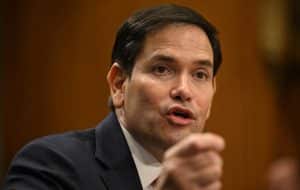
Before Burnham stated his position, the stances taken by U.S. officials and their baseless accusations—made without any supporting evidence or documentation—dominated global media headlines. U.S. Secretary of State Marco Rubio claimed that the incident clearly pointed to the involvement of a foreign actor, yet he offered no evidence for this assertion and did not even name a specific country. Donald Trump also raised the possibility of Iranian involvement.
London’s shift in stance is notable because, while the relevant British authorities are still in the investigation phase, the country’s Prime Minister is now speaking of an Iranian role without concrete evidence.
This divergence in positions is significant because, while Washington places greater emphasis on the hypothesis of foreign interference, the relevant British authorities remain in the investigative stage. Published reports on the case indicate that—alongside accusations against Iran—possibilities such as Russia and non-state actors have also been raised, and it remains unclear whether the incident was, in fact, state-sponsored. Nevertheless, the British Prime Minister’s recent claim has lent greater political weight to the hypothesis of an Iranian role compared to the early days of the case.
The Embassy of the Islamic Republic of Iran in London has also categorically denied any link between Tehran and the incident, dismissing the speculations as baseless and biased. Given that the legal proceedings against the five detainees have not yet resulted in formal charges and investigations are ongoing, attributing the incident to Iran currently rests solely on the British Prime Minister’s official claim; however, details of the evidence have not been released to the public, making it impossible to independently assess the basis of this allegation.
The significance of this matter is heightened by the fact that Fairford has itself been one of the bases used by the U.S. for military operations against Iran. Consequently, before the British investigation reaches a conclusion, transforming an ambiguous security incident into a narrative about an Iranian threat risks diverting public attention away from the core questions—namely, who was involved in the incident and what their motives were—toward a narrative of Iranian involvement; a narrative now officially advanced by the British Prime Minister, even though the details of the supporting evidence have not yet been disclosed.
Behind the Scenes of the West’s New Security Maneuver against Iran
From an expert perspective, Fairford cannot be examined in isolation from the base’s role in recent aggressive attacks on Iranian territory. In March 2026, the British government authorized the U.S. to use Fairford for operations against Iran’s missile facilities, and in the months that followed, the base became a key hub for the deployment of American bombers.
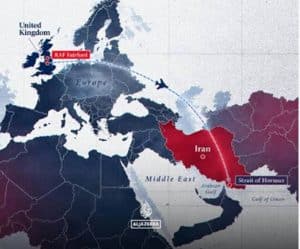
Consequently, the incident in question occurred at a location that effectively constituted part of the military infrastructure supporting US operations against Iran—a fact that imbues the matter with geopolitical dimensions extending well beyond a mere local security incident. Under these circumstances, highlighting Iran’s name risks shifting the focus away from the base itself and its aggressive military mission, redirecting attention instead toward the perceived threat posed by Iran.
Although London has leveled accusations against Tehran and aligned itself with the White House, it has failed to present the specific evidence upon which these claims are based. This stance has been adopted while investigations into the incident remain ongoing, and several aspects of the case—including the nature of the act and any external links involving the suspects—remain shrouded in ambiguity.
The second scenario involves an attempt to further securitize the European landscape regarding Iran. Even while investigations are ongoing and the details of the evidence alleged by London remain undisclosed, such a case could serve as a pretext for intensifying security at U.S. bases, ramping up intelligence and security operations, tightening surveillance on Iran-linked networks, and redefining potential threats within the UK.
For Europe and the United States, the significance of this issue lies in the fact that security-related cases—unlike purely political disputes—can lead to concrete measures and new restrictions, gradually cementing the image of Iran as a persistent threat within Western public discourse and security policy.
At the same time, a more significant scenario cannot be overlooked: the transformation of the Fairford incident into part of the architecture of pressure against Iran in the post-war phase. In this context, any incident involving US or UK facilities or interests could be grouped with issues such as cyber-threats, proxy activities, and military base security, and subsequently used to reinforce the narrative of “hybrid warfare” involving Iran. This is despite the fact that even British media reports on the case acknowledge lingering uncertainties regarding the level of the threat, the presence of usable explosives, and any external links the suspects might have.
From this perspective, the primary issue for Iran is not merely the final outcome of the Furford investigation, but the narrative taking shape alongside the ongoing inquiry. Now that the British Prime Minister has spoken of evidence regarding Iran’s role, the crucial question is what evidence underpins this claim and whether details will be released as the investigation proceeds. Should specific evidence be made public, any assessment of the claim must be based on that evidence.