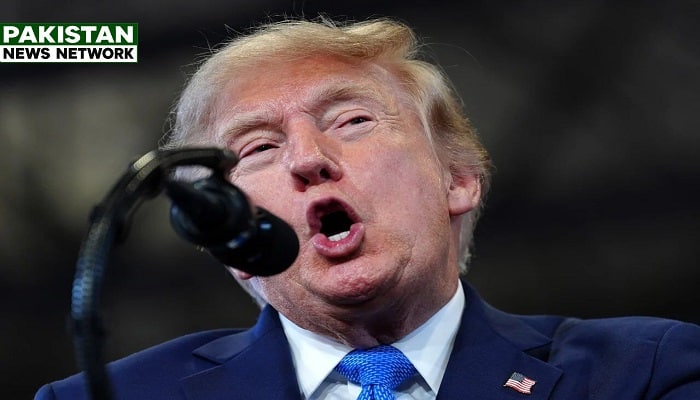
PNN – What was once considered unacceptable language in international forums for a U.S. president has been transformed by Donald Trump into part of the nation’s political discourse; through his lack of decorum and use of profanity, he has redefined the language associated with high-ranking government office in the United States.
According to the report of Pakistan News Network citing The Guardian, Trump has pioneered a shift in the norms governing acceptable language in public office throughout his time in power by employing profanity.
Having faced widespread criticism during his first term for using demeaning and harsh language—such as when he complained about accepting immigrants from “shithole countries”—he is once again in the spotlight for persisting with this rhetoric.
According to the newspaper, Trump has normalized the use of profanity—language never before heard publicly from a president.
The Guardian analyst then points to Trump’s use of expletives in June 2025 during the Zionist regime’s attacks on Iran—specifically when he reacted to the strikes by using foul language while speaking to reporters on the White House grounds.
The author emphasizes that such language is undoubtedly not a mere slip of the tongue, noting that a few months later—in October of the same year—Trump once again resorted to public name-calling, this time targeting Venezuelan President Nicolás Maduro.
The Guardian writer also points to Trump’s posts on “Truth Social”—his personal media platform—highlighting how he uses it to unleash even more vulgar insults. This includes the offensive language he employed in April regarding the reopening of the Strait of Hormuz following US attacks on Iran.
Michael Adams, a professor of English language and literature at Indiana University Bloomington and author of the book In Praise of Profanity, remarked: Trump has little sense of politeness or decorum.
Noting that the use of abusive language has various facets, the expert explained: Part of this lack of decorum stems from his personality, another part arises from the belief that the president is unpredictable, and yet another stems from the general sense that he simply does not care about the matter.
The article continues: Trump is not the only U.S. president with a penchant for profanity. Lyndon Johnson and Richard Nixon were both notorious for their unrestrained use of vulgar and coarse language—a fact that came to light following the release of recorded conversations involving the two presidents.
For instance, Nixon’s extensive use of profanity came to light during the Watergate scandal when the White House released transcripts of his recorded conversations—albeit with heavy redactions.
Joseph Phillips, a professor of American politics, notes that Trump has no qualms about airing his profanity; he attributes this behavior to a “quest for authenticity” in an era when the public standing of politicians has eroded.
According to this university professor: Politicians are motivated to use abusive language because of the shift in public perception regarding the profession. In other words, Americans’ level of political trust has plummeted, and this has altered how the public views politicians.
Phillips explains: Politicians are motivated to respond to this shift in perception by engaging in a very low-cost action—such as using profanity.
A Guardian analyst has also examined the rhetoric of U.S. Vice President-elect J.D. Vance—specifically how he uses a profanity, which he frequently employs in speeches and on social media, to provoke a reaction from his political opponents and critics.
For instance, remarks made by Vance last year at a military base in Kentucky during Thanksgiving drew widespread criticism.
Pete Hegseth, the U.S. Secretary of Defense—who employs crude language to mock “woke” policies within the U.S. military—also freely used profanity while addressing a group of commanders last year.
Noting that Democrats have also resorted to using foul language, The Guardian describes this practice as a “rhetorical tactic.”
As Phillips argues: A politician’s motivation is not to gain a reputation for credibility and respect among the public; rather, the only thing that matters is getting elected.
Adams also emphasizes that politicians seek to gain a kind of “hidden credibility” through the use of abusive language.
He believes: Abusive language carries a form of hidden credibility linked to the persona of the person using it—a kind of brash attitude that appeals to the public.
Benjamin Bergen, a professor of cognitive science at the University of California and author of the book What the F: What Swearing Reveals About Our Language, Our Brains, and Ourselves, stated: The polarized atmosphere prevailing in society causes words that once seemed impossible to use in public to now become the norm in presidential inaugural speeches.