
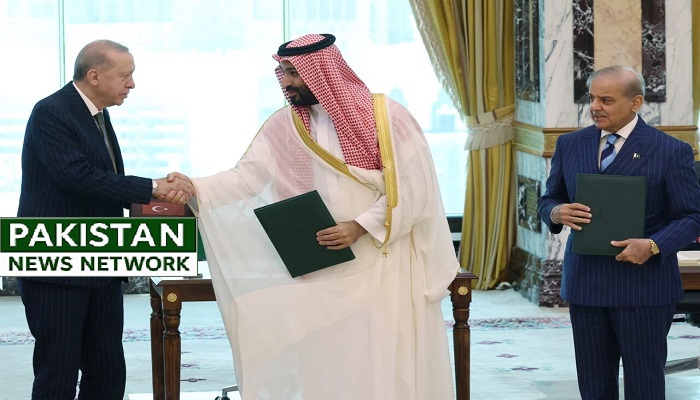
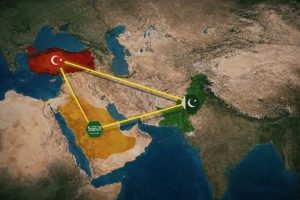
PNN – A new defense agreement was signed in Mecca between Saudi Arabia, Turkey, and Pakistan; however, alongside its geopolitical significance, global media and analysts have raised serious questions regarding its feasibility, the extent of the members’ genuine commitments, and the divergent security interests of the three nations.
According to the report of Pakistan News Network; the agreement known as the “Mecca Defense Pact” was signed on August 7, 2026, in the presence of Saudi Crown Prince Mohammed bin Salman, Turkish President Recep Tayyip Erdoğan, and Pakistani Prime Minister Shehbaz Sharif. Pakistan’s Ministry of Foreign Affairs announced that the agreement aims to strengthen collective deterrence against any act of aggression and to expand defense cooperation among the three nations, stipulating that any armed attack against one member would be considered an attack against all members.
However, Reuters has noted that the published statement does not specify the details of each country’s obligations or the type of military action expected in the event of an attack on a member—a point that raises one of the first serious questions regarding the pact’s future.
Ambiguity Surrounding “An Attack on One Is an Attack on All”
A key focus for Indian media is the gap between the political principle of the agreement and the practical mechanisms for its implementation.
Citing the cautious reaction of the Indian Ministry of External Affairs, the Hindustan Times reports that New Delhi is closely monitoring developments regarding the agreement. The outlet also highlights the clause stipulating that an attack on one member is considered an attack on all—a provision of particular significance to India given Pakistan’s role in South Asia’s security dynamics.
The Times of India also highlighted this ambiguity in its report; outlining the distinct capabilities of the three nations, it cited Mansoor Ahmed—a researcher at the Australian National University’s Strategic and Defence Studies Centre—noting that the defense and industrial capacities of Turkey and Pakistan could be combined with Saudi Arabia’s financial resources and investment. However, the new pact is not expected to entail the transfer of Pakistan’s nuclear deterrence to its partners, as that deterrence remains focused primarily on calculations regarding India.
From this perspective, one of the initial challenges facing the pact is determining the extent to which political-level “defense solidarity” can translate into a concrete and reliable commitment during a crisis.
Three Countries, Three Distinct Security Environments
The second challenge lies in the differing security priorities of the three members. Saudi Arabia primarily seeks to safeguard its territorial security, critical infrastructure, energy routes, and long-term economic initiatives amidst the volatile environment of the Persian Gulf. Turkey, despite its NATO membership, pursues a wide range of security interests within its immediate neighborhood, while Pakistan focuses a significant portion of its security calculus on South Asia and its relationship with India.
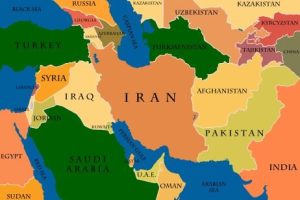
For this reason, the crucial question is whether these three countries would define a given threat in the same way during a specific crisis.
Previous analyses regarding the expansion of the Pakistan-Saudi pact to include Turkey also focused on this issue. In January 2026—prior to the signing of the trilateral agreement—Chatham House had assessed Turkey’s accession to the pact as part of a “balancing” strategy designed to broaden Ankara’s strategic options; it emphasized that such an arrangement did not necessarily equate to an increase in Turkey’s direct security, but could instead yield other political and geopolitical benefits for the country.
The Challenge of Transforming a Political Agreement into a Sustainable Security Structure
Another key issue is the institutionalization of this cooperation. Reuters has reported that the agreement was signed following nearly a year of negotiations, yet the extent of the members’ commitments remains unclear.
In its assessment, the Atlantic Council has also emphasized that this agreement should not be equated with an alliance like NATO. The center noted that Saudi Arabia has previously held a bilateral defense agreement with Pakistan and participated in Gulf Cooperation Council security mechanisms; however, in practice, none of these arrangements evolved into a mechanism comparable to NATO’s Article 5.
Therefore, the primary challenge for the new pact is not merely the signing of the agreement, but the establishment of mechanisms for political coordination, mutual trust, and joint decision-making during times of crisis.
India: The Pact’s Key Asian Observer
Among nations outside West Asia, India is one of the closest observers of this development; this is because Pakistan is a member of the pact, and relations between New Delhi and Islamabad remain shaped by historical and security-related disputes.
The Hindustan Times reported that, following the signing of the agreement, India’s Ministry of External Affairs stated that New Delhi is “closely monitoring developments.” This cautious stance indicates that, at this initial stage, India is assessing the true scope of the three nations’ commitments rather than adopting a confrontational position.
This concern is not limited solely to the relationship between India and Pakistan. In a Hindustan Times analysis regarding the 2025 bilateral pact between Saudi Arabia and Pakistan, South Asia analyst Michael Kugelman noted that while Pakistan’s formal entry into the Middle East’s security architecture is significant for India, Saudi Arabia—given its extensive ties with India—would likely seek to avoid allowing this pact to undermine the relationship between New Delhi and Riyadh.
From this perspective, a future test for the pact will be how Saudi Arabia and Turkey balance their new commitments against their broad relations with India should a crisis arise between India and Pakistan.
The Enigma of the U.S. Role
The Mecca Pact has also raised another question: Is Saudi Arabia truly distancing itself from the U.S. security umbrella, or is it merely seeking to establish a complementary layer of security?
The Hindustan Times has reported that Saudi Arabia has been striving to diversify its defense partners in recent years.
However, the Atlantic Council emphasizes that this development should not be interpreted as a severance of Riyadh’s security ties with Washington. According to this analysis, Saudi Arabia can reduce its reliance on a single partner by expanding its network of partners, without abandoning its security partnership with the United States.
This point is significant; for if the Mecca Pact were to be viewed as a substitute for the U.S. security umbrella, expectations surrounding it would be far greater—whereas if the goal is to establish “multi-layered security,” its role would serve primarily to complement existing arrangements.
The Turkey Issue: NATO Membership and the New Pact
Turkey’s NATO membership represents a significant complexity within this framework. Turkey is simultaneously part of the Western security architecture and a member of the new regional pact. Prior to the signing of the trilateral agreement, the Royal Institute of International Affairs (Chatham House) had assessed Ankara’s potential entry into the Riyadh-Islamabad pact within the context of Türkiye’s policy of “balancing.”
This situation indicates that the Mecca Pact does not necessarily entail the members’ withdrawal from existing security arrangements. Following the signing of the agreement, Turkish officials also emphasized that the pact is not directed against any specific country and will not replace existing security agreements.
Consequently, a key test for the future will be how this pact coexists with the members’ prior security commitments and relationships.
Pakistan: Strategic Capacity and Constraints on Commitment
Pakistan holds particular significance for this pact; beyond its long history of defense cooperation with Saudi Arabia, it possesses extensive military capabilities and nuclear deterrence.
However, Reuters has reported that Pakistan did not necessarily engage in a direct military response during recent attacks on Saudi Arabia—despite the 2025 bilateral pact—and Pakistani officials have previously emphasized that extending nuclear deterrence to allies is not on the agenda.
This track record raises a significant question regarding the extent of Islamabad’s practical commitment: will the new pact bind Pakistan to actions beyond political support and conventional defense cooperation in the event of a crisis?
Indeed, the credibility of any defense pact is tested not at the moment of its signing, but during its first serious crisis.
Is the Mecca Pact a “new bloc”?
Despite some interpretations suggesting the formation of a new bloc, officials from the three countries have emphasized that the agreement is not directed against any specific nation and is defensive in nature. Reuters has also reported that Saudi and Turkish officials have not characterized the agreement as a military axis or a sectarian bloc.
The Atlantic Council has likewise cautioned against viewing the agreement as a NATO-style alliance or the formation of an entirely new bloc. From the Council’s perspective, the pact’s primary significance lies in enhancing the diplomatic weight of Riyadh, Islamabad, and Ankara and establishing a network of security partnerships among them.
However, even if the pact’s official aim is not to create a bloc, the deepening security cooperation among the three nations could influence the calculations of other actors and gradually alter the region’s security architecture.
Conclusion
The Mecca defense pact can be viewed as a significant indicator of regional powers’ efforts to redefine security arrangements in West Asia; yet, its importance should not be gauged solely by the signing ceremony or the principle of “an attack on one is an attack on all.”
An examination of reports and analyses from Asian media—particularly in India—as well as assessments by strategic studies centers, reveals that several fundamental questions remain unanswered: To what extent is the members’ military commitment actually binding? Will the three nations reach a shared understanding regarding the definition of security threats? How will the pact coexist with the existing security ties of each member—such as Turkey’s relationship with NATO and the ties of Saudi Arabia and Pakistan with the United States? And finally, in the event of a genuine crisis, will this agreement lead to joint action, or will it serve primarily a political and deterrent function?
From this perspective, the primary challenge facing the Riyadh-Ankara-Islamabad triangle is not a lack of potential, but rather the task of transforming the three nations’ diverse capabilities into a shared and actionable security resolve—a test whose outcome will be revealed over time and during the first serious crisis.