
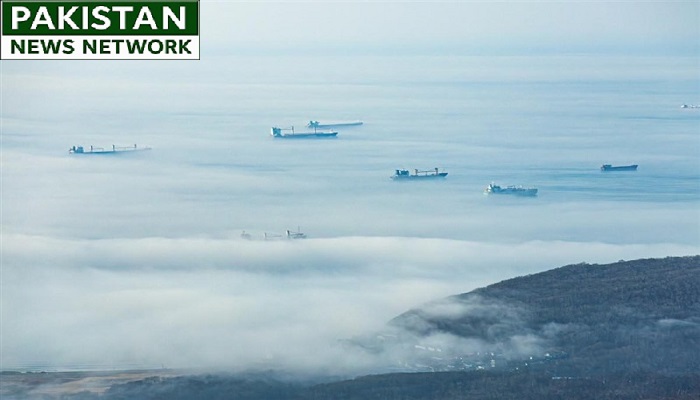
PNN – Citing Iran’s power to control the Strait of Hormuz, a US media outlet has stated that military superiority failed to secure a victory for Washington.
According to the report of Pakistan News Network; following the resumption of conflict in the region—precipitated by the US repeatedly reneging on its commitments and violating the Islamabad agreement—the strategic equation Iran has established in the Strait of Hormuz continues to fuel growing global concerns regarding navigation through the waterway and the impact of the current crisis on the global economy.
In this context, geopolitical risk analyst Wasay Mir, writing for The National Interest, observed that recent efforts to de-escalate tensions in the Strait of Hormuz amounted to nothing more than temporary truces that quickly collapsed in the face of the region’s complex geographic and military realities.
He emphasized that the memorandum of understanding signed by U.S. President Donald Trump with Iran in Paris on June 17 lasted only three weeks. The core dispute between the United States and Iran regarding the terms of this agreement remains unresolved. Tehran insists that controlling the strait grants it the “right to manage and levy transit fees,” whereas Washington maintains that it is an “open international waterway,” making any lasting agreement appear unlikely.
Iran’s Leverage over the Strait of Hormuz
The article further emphasizes that the issue lies not in malicious intent or poor diplomacy, but in the geography that grants Iran a strategic advantage. Iran exercises full control over the northern shores of the Strait of Hormuz, enabling it to threaten shipping traffic using coastal missiles, fast-attack boats, and naval mines without the need to deploy its main naval fleet.
According to the article, the Strait of Hormuz remains the sole maritime outlet connecting the Persian Gulf to the open ocean; it facilitates the transport of approximately 20 million barrels of oil per day, as well as the majority of the region’s liquefied natural gas (LNG) exports. Alternative pipelines in Saudi Arabia and the United Arab Emirates can accommodate only a limited portion of these volumes, rendering any attempt to bypass the Strait currently unfeasible.
The National Interest report further notes that Iran has bolstered its military posture through bases in Bandar Abbas and on islands surrounding the strait—such as Qeshm, Hormuz, and Larak—enabling it to deploy missiles, launch fast attack craft, and lay thousands of naval mines.
The author states that prevailing in this confrontation does not require Tehran to “win a naval battle,” but rather to make “transit through the Strait of Hormuz so costly that insurance companies cannot cover it”—a scenario that would lead to a drastic reduction in shipping traffic.
Three Scenarios for the Future of the Strait of Hormuz
This article examines three potential scenarios for the future of the Strait of Hormuz.
-The first scenario is a continuation of what is described as “selective closures,” wherein Iran—based on political considerations—permits the passage of vessels from specific countries while blocking or restricting the passage of ships belonging to Western nations.
In this context, ships from China, Russia, India, Turkey, Pakistan, Iraq, the Philippines, and other nations have been able to transit the strait after obtaining the necessary permits from Iran, whereas Western vessels continue to face significant restrictions. Some ships pay around two million dollars per voyage, while the Iranian parliament is working to formalize these fees as an official source of revenue.
This scenario offers certain major powers—primarily China and Russia—little incentive to push for the full reopening of the strait; Beijing benefits from the continued passage of its vessels, while Moscow reaps financial gains from high global oil prices.
—A second scenario involves a U.S. attempt to reopen the Strait of Hormuz using military force—an option the author considers unlikely to succeed, given the region’s geography. Repeated U.S. strikes against Iranian military sites, including islands overlooking the Strait of Hormuz, have failed to eliminate the threat.
Destroying military sites does not equate to controlling the coastline, and Iran is capable of rebuilding its unconventional capabilities faster than the United States can destroy them. Mention must also be made of the failure of the operation announced by Trump—aimed at safeguarding navigation—due to a lack of regional and international support, the refusal of several Western and Asian nations to deploy naval vessels, and Washington’s decision against deploying ground troops.
This turns the military option into a likely scenario of “escalation without a solution,” as any force seeking to forcibly reopen the strait would require full control of the coastline.
—However, the third—and most probable—scenario involves the reopening of the Strait of Hormuz while the effects of the crisis persist. A previous memorandum of understanding briefly allowed for the recovery of about one-third of maritime traffic before Iran resumed attacks on gas and oil tankers and commercial vessels; this prompted the United States to launch new waves of attacks and drove Tehran to close the strait once again.
Based on this article, it strongly appears that—given the ongoing mediation efforts involving Oman and Pakistan—opportunities for diplomacy have not been entirely lost. Nevertheless, the past few months have left lasting economic scars, as energy markets have experienced severe volatility.
The US Must Admit Failure to Resolve the Strait of Hormuz Crisis
The author of this article emphasized that the price of Brent crude oil surged by more than 55 percent whenever the prospect of an agreement was raised. Meanwhile, insurance companies have reassessed shipping risks, and long-term energy contracts now include clauses citing the closure of the Strait of Hormuz as a force majeure event.
He further stated that the US must acknowledge its military superiority has failed to resolve the crisis in the Strait of Hormuz; the diplomatic path is not merely an alternative to the military option, but rather the only route to a resolution where the costs do not outweigh the benefits.
The National Interest piece concludes by stating that lifting sanctions on Iran in exchange for clear commitments regarding its nuclear program and guarantees of freedom of navigation cannot form the basis of a lasting agreement. Whether the crisis ends through diplomacy or an escalation of tensions, geographic reality dictates that a political resolution to the Strait of Hormuz crisis remains the least costly option for all parties.