
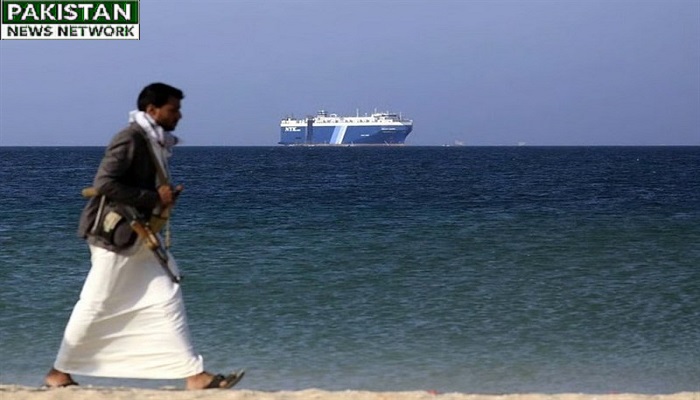
PNN – Western nations are attempting to securitize Sana’a’s regional connections and turn them into a pretext for exerting pressure on Yemen.
According to the report of Pakistan News Network; the Red Sea’s importance to Yemen extends beyond mere geopolitics or its potential as a military asset. This body of water is integral to the economic and social fabric of the lives of millions of Yemenis residing along the country’s western coast. Activities such as fishing, maritime trade, the transport of goods, and access to sources of livelihood have forged a direct link between Yemeni society and the Red Sea over the past decades. Consequently, any restriction on the Yemeni people’s access to this region would not merely constitute a security measure against Ansarullah; it would directly impact the economic and humanitarian conditions of Yemeni society.
This fact takes on added significance given that a large segment of the population in areas controlled by Sana’a has endured the effects of the blockade and economic hardship over the past years. Under these circumstances, Yemen’s west coast represents more than just a geographical location for a substantial part of the country’s society; it is one of the few remaining avenues for sustaining economic activity and securing livelihoods. Consequently, transforming the Red Sea and Yemen’s west coast into a new theater of military pressure could effectively tighten the economic stranglehold on the people living in these regions.
In recent days, alongside growing attention from Western media and security circles regarding Ansarallah’s potential ties to various actors in the Horn of Africa, signs of an emerging narrative concerning Red Sea security have become apparent. A recent report by The Century Foundation regarding the expansion of Ansarallah’s connections across Africa serves as a significant example of this trend. The report describes Ansarallah as transitioning from a primarily Yemeni actor into a “hub” within a network extending beyond the country’s borders, citing alleged links to Al-Shabaab in Somalia, certain Sudanese factions, and local groups in the Horn of Africa.

However, the crucial point in this report is not merely the allegations themselves, but the varying quality of the evidence the authors present regarding these connections. The report explicitly states that the reliability of the evidence varies across different aspects of these claims; specifically, there is little evidence to support the transfer of advanced weaponry—including missile and drone technologies—from Ansarullah to non-state groups in Africa.
However, what matters now is how these claims are translated into a security framework. The core issue is no longer merely which actors Ansarallah is connected to across the Red Sea; rather, it is how these connections are reframed in Western media narratives and how they might be leveraged to justify increased pressure on Yemen. In this context, an alleged link between Ansarallah and an African actor could be portrayed as part of a trans-regional network—a depiction that could subsequently serve as the basis for securitizing Red Sea dynamics and intensifying pressure on Yemen’s western coast.
This trend must be taken seriously, as the securitization of an issue often paves the way for its transformation into a military matter. When an actor’s or communication activities are defined as part of a “trans-regional threat,” the scope of the response extends beyond mere sanctions and political pressure. In the case of Yemen, the most natural theater for such pressure is the Red Sea and the country’s western coast—a region that is geographically close to the maritime routes of the Horn of Africa and has, in recent years, become a primary arena of confrontation between Ansarullah and the Saudi-led coalition.
In this context, it must not be forgotten that Yemen’s western coast is not merely a military front. Behind every port, maritime route, and coastal area lies a community whose livelihood depends on the sea. Restricting maritime activities, intensifying military operations, or imposing new constraints on movement and trade directly impacts this very community. From this perspective, efforts to cut off the people in Sana’a-controlled areas from the Red Sea could effectively exacerbate the same pressures—stemming from blockades and economic restrictions—that the Yemeni people have endured for over a decade.
Indeed, this is precisely where one of the most significant contradictions in Western policy regarding the Red Sea becomes apparent. On one hand, Western nations claim to be safeguarding freedom of navigation and securing trade routes; on the other, any escalation of military pressure on Yemen’s western coast risks further destabilizing the very security environment they purport to protect. Sustainable security for the region cannot be achieved by turning the Red Sea into a military theater. In reality, maritime security—if divorced from the political and economic realities of Yemen—will be, at best, temporary and fragile.
On the other hand, the experience of recent years has demonstrated that Ansarallah’s power cannot be curtailed merely by controlling the coastline or pressuring the ports. Sana’a’s ability to influence maritime dynamics does not hinge solely on a physical presence at a specific coastal location; rather, Ansarallah possesses a comprehensive array of missile, drone, intelligence, and operational capabilities. Consequently, even if pressure on the West Coast were to intensify, one cannot expect Sana’a’s deterrent capacity to simply vanish; on the contrary, transforming the West Coast into a new front could yield the exact opposite result.
If the people of Yemen once again face even broader restrictions on access to their means of livelihood and economic resources—and if military pressure intensifies—Sanaa will have a greater incentive to leverage its existing capabilities in the Red Sea. Under such circumstances, the policy intended to contain Ansarullah could expand the scope of confrontation from Yemeni territory to maritime routes.
From this perspective, the significance of recent reports by Western think tanks and policy-making bodies regarding Ansarallah’s connections in Africa must be viewed as extending beyond their immediate content. The core issue is not merely whether Ansarallah is establishing networks on both sides of the Red Sea; rather, the question is whether these claims are intended to serve as a basis for defining a new threat—and, consequently, for justifying increased military pressure on Yemen. Should such a scenario unfold, Yemen’s western coast risks once again becoming the primary theater of a confrontation—a conflict in which the initial price is paid not by military structures, but by the coastal communities of Yemen.