
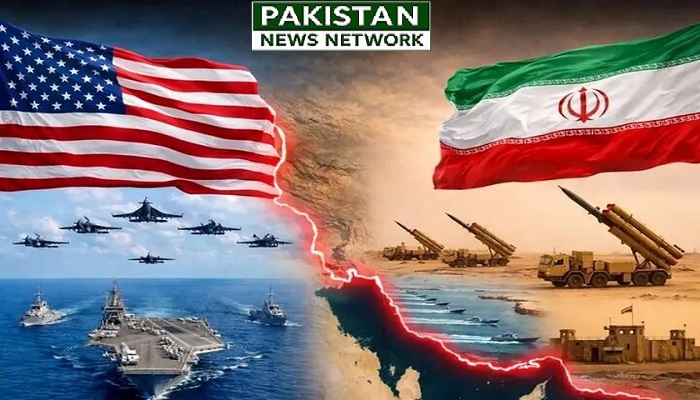
PNN – US hostile actions against Iran following the abduction of Maduro served as a major test for Trump’s second administration—a test that exposed the erosion of Washington’s capabilities, the failure to achieve its objectives, and the impact of Tehran’s resistance, thereby revealing the widening cracks in US power and hegemony.
According to the report of Pakistan News Network; the aggression against Iranian territory during Donald Trump’s second term cannot be viewed merely as a military confrontation between Washington and Tehran; this war of aggression became a test of the limits of American power.
After Washington reinforced the perception—through the abduction of Nicolás Maduro in Venezuela—that it could transform nations’ political structures by relying on military might, the aggression against Iran presented an even greater test for that calculus.
The Iranian resistance—characterized by sustained retaliatory capability, the rising military costs incurred by the U.S., and Washington’s inability to translate military strikes into desired political outcomes—has exposed a rift that transcends mere battlefield success or failure. It is a gap between U.S. military might and its capacity to impose its political will—a disparity capable of altering the foundations of American hegemony and reshaping the calculations of actors within the international system.
The Delusion of Absolute Power: From the Spectacle of Maduro’s Abduction to a Miscalculation Regarding Iran
The U.S. military operation against Venezuela and the abduction of Maduro on January 3, 2026, must be viewed as a key indicator of the aggressive stance adopted by Trump’s second administration. U.S. forces launched an incursion into Venezuelan territory, abducted Maduro and his wife, and transported them to the United States—a move that marked Washington’s transition from a policy of pressure, sanctions, and threats to one of direct intervention and the physical removal of a nation’s top leader. Following the operation, Trump announced that the United States would assume control of Venezuela’s administration for a period of time.
The significance of this event for Iran became even more apparent when Washington could infer from the Caracas experience that—by delivering a lightning strike, eliminating the leadership, and shocking the political structure—it was possible to steer a country toward a transformation desired by the U.S.
In this calculus, Maduro was not merely a target; he became a demonstration of the Trump administration’s new capability—a capability showing that Washington was no longer necessarily content with sanctions and political pressure, but would, given the right conditions, intervene directly to alter the balance of power.
From this perspective, drawing parallels between Caracas and Tehran might have appealed to the architects of a war against Iran; however, the comparison faced fundamental differences from the outset. Iran was incomparable to Venezuela in terms of territorial expanse, political and security structures, missile and drone capabilities, strategic depth, geographical location, and capacity for regional influence.
Consequently, the assumption that the abduction or elimination of a few key figures could replicate in Iran the same political shock seen in Venezuela amounted to ignoring the distinction between the vulnerability of a government and the vulnerability of a political system.
The aggressive attacks launched against Iran by the U.S., alongside the Zionist regime, demonstrated that replicating the “Caracas model” in Tehran faces far greater obstacles. Iran’s political and security structures did not collapse following the attacks and targeted assassinations, nor did the country descend into a power vacuum; instead, decision-making processes and military responses continued unabated.
This reality marked the first failure in a calculation that equated U.S. military might with the capacity to trigger political collapse, erroneously assuming that a blow to the leadership at the apex of the structure would automatically cause the entire system to disintegrate.
From this perspective, Maduro represented the starting point of a certain concept, while Iran served as the proving ground for it—a concept positing that Washington could directly alter the sovereignty of nations by leveraging its military and intelligence capabilities, thereby driving the cost of resistance to a point where the adversary had no choice but to capitulate. However, the reality that emerged in the case of Iran was a gap between the “capacity to execute operations” and the “capacity to alter the political equation”—a gap that, as the conflict unfolded, was not bridged by military strikes but rather widened as U.S. costs mounted and Iranian resistance persisted.
How Did Iran Upset War Calculations?
In the view of the US and its Zionist allies, a war against Iran was intended to eliminate the gap between military superiority and political collapse; however, their aggressive strikes—even those targeting sensitive facilities and senior figures—failed to paralyze Iran’s decision-making structure.
Consequently, Iran’s governing structure continued to function, its military response capability remained intact, and—rather than accepting Washington’s terms—Tehran raised the cost of the war for the opposing side. This reality effectively invalidated the initial premise that a heavy blow would pave the way for collapse.
In the view of observers, this defeat was not merely political; the military costs of the war for the United States reached a level that directly impacted its capacity to sustain the conflict.
According to a Reuters report from August 5, the U.S. military exhausted nearly its entire stockpile of Army Tactical Missile System (ATACMS) and Precision Strike Missiles (PrSM) during the war, and utilized close to half of its global inventory of Tomahawk missiles; meanwhile, published estimates indicate that approximately 65 percent of Patriot interceptors were expended.
While these figures do not signify the end of U.S. military power, they demonstrate that for Washington, the continuation of the conflict has entailed the rapid depletion of strategic reserves and rising costs for their replenishment.
Meanwhile, the Strait of Hormuz has emerged as Iran’s most critical lever of counter-pressure; this waterway—which prior to the conflict facilitated the transit of approximately one-fifth of the world’s oil—has effectively seen a drastic reduction in shipping traffic due to illegal U.S. aggression, and Trump’s efforts to reopen it have become a central focus of negotiations.
Continuing his hyperbolic rhetoric, Trump even spoke on August 14 about the possibility of declaring Hormuz “US territory”—a stance indicating that the issue has shifted from a potential military operation against Iran to a dispute over America’s ability to restore a situation favorable to itself.
From this perspective, Hormuz is not merely a maritime passage; it symbolizes a shift in the dynamics of the conflict. Washington initiated the confrontation believing that heavy blows could alter Tehran’s behavior, yet the reopening of a vital global economic artery has now become an issue that the US is attempting to resolve through a combination of pressure, negotiation, and mediation.
The Collapse of a Hollow Hegemony
The conflict involving Iran did not confine its consequences to the battlefield; it also impacted the strategic calculations of nations that had long shaped their conduct based on American power and threats.
What has changed today is not merely the assessment of Washington’s military capabilities, but the credibility of the American threat—specifically, the notion that whenever the U.S. enters a conflict, the opposing side will ultimately be compelled to yield to its demands. The erosion of this perception could prove more significant for Washington than a military defeat, for deterrence is established not by the firing of missiles, but by the adversary’s belief regarding the consequences of resistance.
This development also carries direct implications for U.S. allies. European nations and regional governments—which for decades had largely tethered their security to Washington’s presence and guarantees—now face a critical question: if the United States fails to rapidly impose its desired outcome in a large-scale confrontation while simultaneously grappling with depleting weapons stockpiles and escalating war costs, to what extent can its assurances be relied upon for future crises?
Under such circumstances, diversifying security relations and bolstering independent capabilities can shift from being merely a political choice to a strategic necessity. China and Russia, too, can draw upon this experience to reassess their calculations regarding U.S. intervention capabilities and the costs of protracted conflicts; meanwhile, in West Asia, governments that previously viewed the U.S. military presence as the primary guarantor of their security are finding greater incentive to simultaneously expand ties with Eastern powers.
The Strait of Hormuz has provided a tangible illustration of this shift in calculations. The global economy’s reliance on this waterway—coupled with the U.S. inability to swiftly restore pre-conflict conditions—has highlighted the price Washington must pay to manage the repercussions of a direct confrontation.