
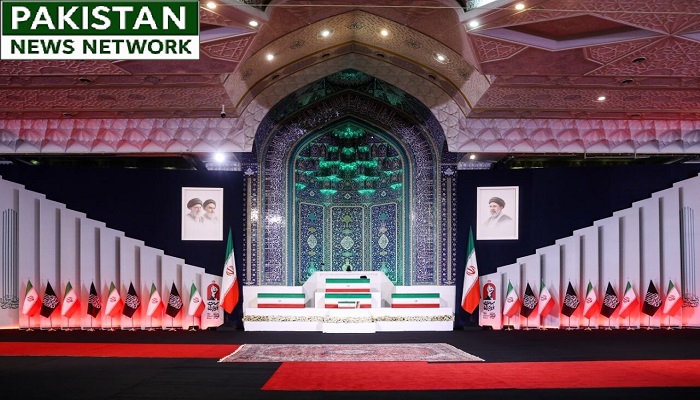
PNN – Today (Friday), Tehran became the scene of a global farewell to the martyred leader—attended by representatives, dignitaries, and grassroots groups from around 100 countries—who raised the banner of resistance, the pursuit of justice, and the defense of the oppressed far beyond Iran’s borders.
According to the report of Pakistan News Network; the official farewell ceremony and tribute to the sacred remains of the martyred leader of the Islamic Revolution began in Tehran at 8:00 a.m. on Friday and has continued into the evening. Heads of state and parliament speakers, foreign ministers, special envoys, religious leaders, intellectuals, political and cultural figures, and delegations from approximately 100 countries attended the ceremony to bid farewell to a leader whose name and ideology had, for decades, been inextricably linked to the pursuit of independence, Muslim unity, the liberation of Palestine, and resistance against global hegemons.
This massive turnout was not merely a gathering of official delegations or conventional ceremonial groups to bid farewell to a political leader. On that day, Tehran became a meeting point for nations, religions, cultures, and movements—each of which saw, in the person of the martyred leader, a reflection of their own long-held aspirations for justice, freedom, independence, and liberation from domination.
Prior to the event, Esmaeil Baghaei, the Foreign Ministry Spokesperson, had stated that the farewell and funeral ceremony for the martyred leader of the Islamic Revolution was a highly significant, historic event—not only for the Iranian nation but also for the people of the region, Muslims, and all free people across the globe.
He had stated that guests from approximately 100 countries—including dignitaries, heads of state, parliamentary speakers, foreign ministers, special government envoys, and numerous civic groups—would attend the ceremony. The presence of these delegations today highlighted the global dimensions of an event whose significance extends far beyond Iran’s geographical borders.
Amidst a multitude of flags, faces, and languages, a single, shared message resonated. People who stand for justice do not forget leaders who refuse to retreat from the truth, even in the fiercest of storms. Leaders who seek power not for personal comfort, but to defend the dignity of nations, endure in the memory of history; not even martyrdom can sever the bond they share with the free people of the world.
The Voice of a Nation’s Independence and Dignity in the Face of Great Powers
Throughout his leadership, the martyred leader of the Islamic Revolution upheld the independence of the nation’s stance, despite facing pressures, sanctions, threats, and imposed wars. At a time when many governments bowed to the will of great powers, he stood firm on the Iranian nation’s right to determine its own destiny and refused to let the clamor of hegemonic powers silence the voice of the nation’s independence and dignity.
This independence was not merely a political stance; rather, it was rooted in moral integrity and faith. In his view, the legitimacy of a position was not measured by the degree of approval from global powers; the true benchmarks were justice, human dignity, and the defense of truth. It was precisely this independence of judgment that imbued the discourse of the Islamic Revolution with a power transcending Iran’s borders, resonating among nations grappling with colonialism, discrimination, occupation, and foreign intervention.
The presence of representatives from dozens of countries in Tehran bore witness to the strength of this international discourse—a discourse that did not divide the world into East and West, North and South, or first- and second-class nations, but rather drew the fundamental line between justice and oppression, independence and domination, and resistance and submission.
Voice of Palestine
Palestine held a special place at the heart of this discourse. The martyred leader of the Islamic Revolution detached the cause of Palestine’s liberation from fleeting political calculations, transforming it instead into a humanitarian, moral, and global issue.
At a time when many Western governments were either remaining silent on, justifying, or providing arms for the Zionist regime’s atrocities, he became the voice of Gaza’s defenseless children, displaced Palestinian families, and a nation that has endured over seven decades of occupation and discrimination.
His support for Palestine was not dictated by diplomatic expediency or power dynamics. It stemmed from a profound conviction: that one cannot speak of justice while remaining silent about the occupation of a nation’s land; one cannot claim to champion human rights while ignoring the slaughter of thousands of women and children; and one cannot advocate for peace while bolstering the Zionist regime’s war machine with money, weapons, and political backing.
Thus, today’s farewell was not merely a leave-taking of a national leader. It was a tribute to a voice that championed the cause of Palestine at a time of widespread indifference—a voice that stood firm against the normalization of occupation and refused to let the plight of the Palestinian people be sidelined by the calculations of global powers.
Standard-bearer of the Ummah’s Unity
The martyred leader regarded Muslim unity not merely as a slogan for special occasions, but as a strategic necessity for liberating the Islamic world from domination and division. He repeatedly warned that colonial powers—by highlighting ethnic, sectarian, and geographical differences—deplete the strength of Muslim nations and plunder their resources.
In his view, the Islamic Ummah could defend its rights only by transcending the artificial boundaries of division and finding a unified voice against common enemies. The presence of figures and grassroots groups from various Islamic nations in Tehran was a manifestation of this very ideal. People of diverse languages and denominations had gathered—united in one place—to bid farewell to a leader who regarded unity as a shield for nations against colonialism and Zionism.
The World’s Awakened Conscience against Colonialism and Imperialism
Yet, the scope of this presence was not limited to the Islamic world; anti-war activists, academics, journalists, religious leaders, anti-imperialist groups, and independent figures from across the globe also attended the event. They represented a conscience that rejects domination—under any name or banner—and regards the struggle of nations for independence as their natural right.
This popular turnout once again highlighted the deep rift between freedom-loving nations and certain Western governments. Governments that had remained silent in the face of military aggression by the United States and the Zionist regime against Iran—or had sided with the aggressors through political statements—were denied the honor of official participation in this ceremony; yet, from those very societies, free-spirited individuals and opponents of war made their way to Tehran.
Steadfast in the Face of International Crises and Storms
The martyred leader demonstrated remarkable resilience and steadfastness amidst international crises and storms. Neither economic pressure forced him to retreat, nor did military threats break his resolve, nor could extensive media propaganda alter his course.
During trying times, he instilled calm within society and imparted firmness to the nation’s decision-making apparatus, standing tall against adversaries who believed that intensifying pressure would sever the Iranian people from their ideals.
His courage was not limited to mere words; true courage was manifested in accepting responsibility, bearing the cost, and standing firm to the very end. It is precisely this quality that distinguishes great leaders from run-of-the-mill politicians. Politicians fade from memory once their tenure ends, whereas leaders who intertwine their own destiny with that of nations and the oppressed of the world become part of humanity’s historical memory.
The Banner of the Martyred Leader Borne by Freedom-Seekers and Peace-Lovers Worldwide
Tehran did not merely host guests from around 100 countries; the Iranian capital became a stage where the ideals of generations of freedom-seeking and anti-colonialist fighters converged. From the free spirits of the Islamic world to opponents of war and imperialism across Europe, Asia, Africa, and beyond, all united in a shared message: the path of resistance does not end with the martyrdom of its standard-bearer.
On Friday, the world rose to bid farewell to a leader whose voice dominant powers had long sought to silence, yet the echo of whose ideas transcended Iran’s borders. Though the martyred leader’s remains have been laid to rest, the banner he raised for justice, independence, Muslim unity, and the liberation of Palestine will continue to be borne by nations that refuse to submit to oppression and will not erase the cause of freedom from their collective memory.