
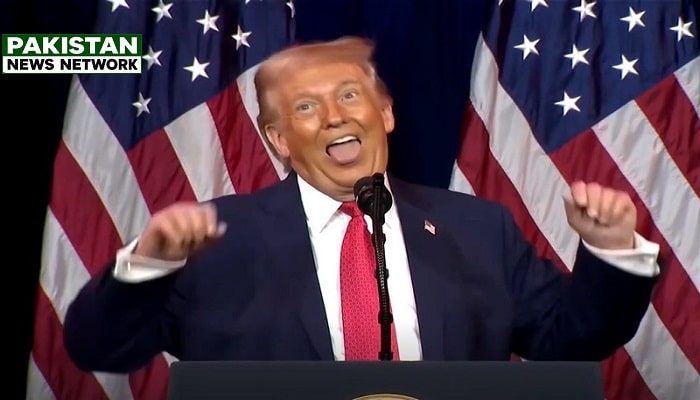
PNN – Recent poll results from the Pew Research Center indicate that Americans’ approval of Donald Trump’s performance has dropped to 30 percent, and dissatisfaction is rising even among the voters who returned him to the White House in the 2024 election.
According to the report of Pakistan News Network; the MS NOW news website noted that when former U.S. President Richard Nixon resigned in 1974 following the Watergate scandal, a Gallup poll showed his approval rating stood at just 24 percent.
Now, more than half a century later, support for U.S. President Donald Trump has not yet dropped to that level, though it appears he is approaching such a situation.
On Thursday, the Pew Research Center released the results of its latest nationwide poll, and the data holds no good news for the current U.S. president. The center’s report states:
Currently, only three out of ten Americans approve of the way Donald Trump is handling his duties as president, while 68 percent disapprove of his performance.
Approval of Trump’s performance has dropped significantly during his second term. His current approval rating matches the lowest level recorded during his first term—a figure that stood at 29% according to a Pew Research Center poll conducted between early 2021 and the end of his first term.
MSNBC reported that Trump’s problem is not merely that support from Democratic and independent voters continues to decline; the reality is that his support among these two groups has effectively hit rock bottom.
What makes the Pew Research Center data particularly noteworthy is that the decline in support for the U.S. President is now coming from the very voters who sent him back to the White House in the first place.
Nearly a month ago, Trump made a striking claim on his social media account. Referring to himself in the third person, he wrote: Trump’s approval rating within the Republican Party has now reached 95 percent. That is a record. Ronald Reagan is in second place with 86 percent. Thank you!
Trump did not specify exactly whom he was thanking. Of course, this mattered little, as he was citing polling data that did not appear to exist anywhere outside his own exaggerated imagination.
Nevertheless, according to the report, there was a significant point to his claim. Support for Trump among Republican voters had indeed reached 95 percent at one time. In fact, the Pew Research Center found that in early 2025—shortly after the start of Trump’s second term—95 percent of those who had voted for him in the 2024 election were satisfied with his performance as president.
However, a year later, that figure dropped to 83 percent. In July, his approval rating stood at 75 percent.
It has now fallen to 67 percent.
The author went on to discuss the decline in Trump’s popularity among Republican voters, noting that while some might be surprised to see that two-thirds of Republican voters still support the president, one should not overlook the bigger picture by focusing solely on that aspect.
When Trump’s second term began, only about one in twenty voters who had supported his candidacy was dissatisfied with his performance. Now, that ratio has reached one in three.
Furthermore, the broader context of the electoral contests should not be overlooked. Months ago, Trump and the Republican Party decided to turn the midterm elections into a referendum on the incumbent administration. They placed the President at the heart of the party’s election strategy to galvanize the enthusiasm of Trump supporters within the Republican base. This appeared to be the primary objective of the recent Republican midterm rally—which featured a speech by Trump—yet the event failed to yield the expected results.
The report states that this strategy has not succeeded. With only four weeks remaining until the 2026 midterm elections, Republican voters not only lack enthusiasm for supporting their party, but their dissatisfaction with their own party’s president is also on the rise.
This situation is the exact opposite of what Republican strategists had hoped for—and, based on some assessments, had expected to see—at this stage of the election campaign.