
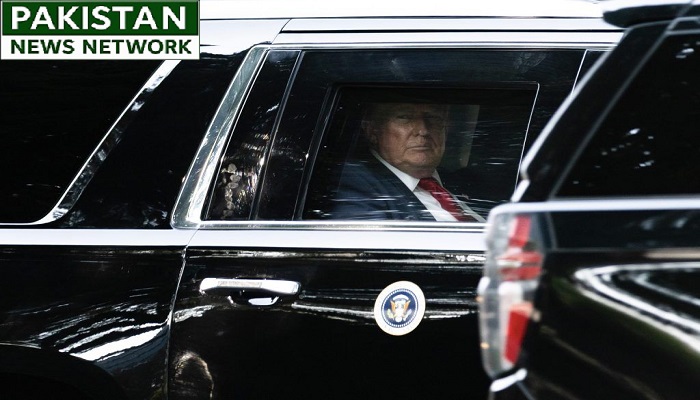
PNN – In an analysis highlighting Donald Trump’s declining popularity, the news outlet Axios writes that he has become trapped in a war he should not have started; furthermore, the tariffs he has imposed and the projects he has prioritized—such as border wall construction—could prove to be a political quagmire, potentially costing the Republicans their majorities in both the House and the Senate.
According to the report of Pakistan News Network citing this U.S. news outlet, an examination of opinion polls and economic indicators, combined with insights from individuals close to the U.S. President, can shed light on the likely outcome of a second Trump presidency.
According to an Axios report titled “Behind the Scenes: Trump’s Political Quicksand,” even some seasoned U.S. government officials worry that Trump has become ensnared in a war he should not have started, imposed tariffs he should not have enacted, and become obsessively fixated on historical monuments—an issue that never warranted such intense focus.
As the Axios analyst notes, these three issues consume a significant portion of Trump’s time and attention; yet, they are unpopular across all U.S. polls, and it is virtually impossible that American public opinion will suddenly shift to favor the war, the tariffs, or the historical monuments.
Poll results from Quinnipiac University, released last week, show that Trump’s popularity has dropped to a low of 32 percent.
For the Republican Party, an even more concerning finding—according to an Axios analyst—is that 68 percent of voters say Trump is not focusing enough on the problems facing most Americans.
Trump has also lost his party’s most enduring political advantage; according to a Reuters/Ipsos poll released this week, voters are divided on which party is better for the economy—a shift from the previous nine years, during which the Republican Party held the lead on this issue.
In this regard, a Trump associate told a New York Times reporter: He focuses on distractions that divert his attention from the dismal poll numbers. Furthermore, issues such as war, tariffs, and an excessive focus on historical monuments are eroding his base of support.
The individual, who requested anonymity, added: We regularly hear complaints from senior Republicans who are also dissatisfied with Trump’s reluctance to release $400 million in ‘Super PAC’ funds—a move that has frustrated donors.
According to this analysis, reports indicate that despite all this dissatisfaction, Trump shows no inclination to back down on any of the aforementioned favored issues—particularly regarding historical monuments and reconstruction projects—or to alter his political agenda either before or after the November midterm elections.
An Axios analyst believes that ahead of the midterm elections, Trump has squandered his political capital on yet another self-destructive obsession: the SAVE America Act, which mandates proof of national citizenship and voter identification. Republicans have repeatedly told Trump that the bill stands no chance of passing in the Senate; yet, he has refused to accept this reality, choosing instead to mobilize his MAGA base against Senate Majority Leader John Thune and other Republicans unwilling to yield to his demands.
According to this report, senior congressional Republicans have stated that Trump’s low popularity will likely result in the loss of the House majority and perhaps even the Senate. Consequently, some senior party figures have indirectly urged him to shift his focus toward the economy and the public’s purchasing power. At the same time, some have privately admitted that the 80-year-old president—who orchestrated the greatest political comeback in U.S. history—is too arrogant, stubborn, and undisciplined to change.
In fact, rather than accepting reality, Trump focuses on other matters—such as building a new White House ballroom and a triumphal arch, showing off his new Air Force One, discussing plans for Dulles Airport, and obsessing over the construction of a helipad on the White House South Lawn.
The source close to the White House ultimately reminded Axios that, historically, the sixth year in office has been a very difficult period for presidents. This reference alludes to the midterm elections that typically occur during the sixth year of a presidency for those serving a second term.