
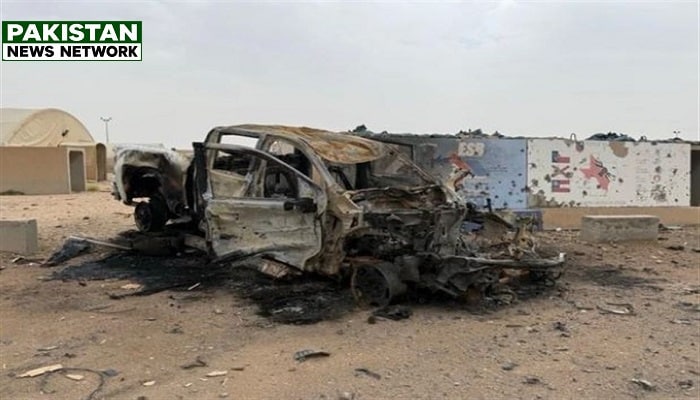
PNN – The Washington Post has written that Iran demonstrated the vulnerability of U.S. bases during the recent conflict.
According to the report of Pakistan News Network; a Washington Post op-ed by Max Boot examines the acute vulnerability of U.S. military bases in the region and warns that the experience of conflict with Iran serves as a serious wake-up call regarding a potential war with China. Key points from the report include the following:
- The Collapse of the Historical Assumption of “Base Security”
Since World War II and the attack on Pearl Harbor, U.S. military strategy has relied on an extensive network of 750 bases across 80 countries—under the assumption that absolute U.S. air superiority guaranteed the security of these bases and logistical hubs; a premise now invalidated by Iran’s missile and drone attacks.
- The Ineffectiveness of Air Defense Systems
Experience in the conflict with Iran demonstrated that even the densest air defense systems are incapable of continuously countering combined, high-precision drone and missile attacks; damage to U.S. infrastructure, hangars, and radar systems proved that fixed bases have become easy targets.
- Rapid Depletion of Interceptor Stocks and Exorbitant Costs
The recent conflict demonstrated that using multi-million-dollar interceptors to shoot down low-cost drones and missiles is neither economically nor logistically sustainable, as it rapidly depletes U.S. air defense stockpiles.
- A Warning Sign for Potential Conflict with China
If Iran has managed to inflict serious damage on regional bases, then in the event of a conflict in East Asia, key U.S. bases—such as those in Guam or Japan—would be highly vulnerable and untenable in the face of China’s vastly larger and more powerful missile arsenal.
- Forced Shift in U.S. Military Posture
Analysts emphasize that the era of massive, static, and centralized bases has ended; Washington is compelled to move toward a doctrine of force dispersion, high mobility, base downsizing, and underground structures.
- Ineffectiveness of the “Mountain of Iron” Warfare Model
The traditional strategy of massing equipment and weaponry at a single location prior to major operations—seen in the 1991 and 2003 Iraq wars—yields no benefit in modern combat driven by drones and satellite reconnaissance, other than providing the enemy with large, easy targets.
- Conclusion
An analysis by The Washington Post reveals that the war with Iran exposed the strategic error of U.S. reliance on fixed bases—a vulnerability demonstrating that American military power will remain exposed when facing major powers unless there is a fundamental reassessment of force-basing doctrine.