
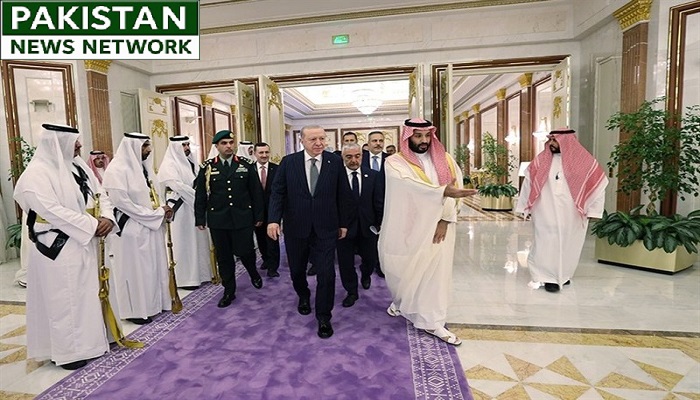
PNN – The national newspaper Gazete has likened Iran’s exclusion from the “Mecca defense equations” to a minefield and issued a warning to Turkey.
According to the report of Pakistan News Network; Ankara-based newspapers and analysts on Turkish television channels have once again commented extensively today on the “Mecca defense pact.”
Some newspapers aligned with Turkey’s ruling party have sought to frame the formation of this coalition as a bipolar struggle between the Ummah (the Muslim community) and the infidels, while highlighting certain muted reactions from the Greek and Israeli press.
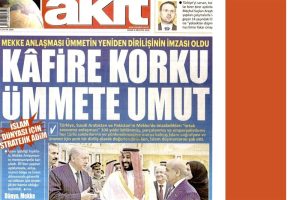
Yeni Akit, an Ankara-based newspaper with Salafi leanings that officially advocates for Turkey’s return to a caliphate system, ran the headline: Hope for the Ummah, fear for the infidels.
The paper claims that the “Mecca Coalition”—comprising Turkey, Saudi Arabia, and Pakistan—represents the most significant pact within the Islamic world in recent years, directed against Zionism and its allies globally, and particularly in the Mediterranean region.
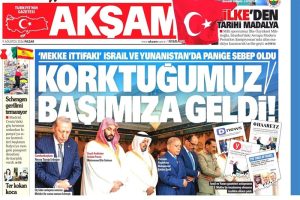
Akşam, another newspaper close to the Justice and Development Party (AKP), adopted a similar stance to Yeni Akit; citing Greek media, it highlighted the narrative that Turkey’s alignment with Pakistan and Saudi Arabia has placed Greece in a position of weakness vis-à-vis the Islamic world.
Today, numerous Turkish online news outlets and television networks also published detailed reports on the remarks made by Turkish Foreign Minister Hakan Fidan regarding the Mecca defense pact.
Commenting on the signing of the trilateral defense agreement between Turkey, Saudi Arabia, and Pakistan, Hakan Fidan stated: It is important for us to increase regional ownership, because foreign powers do not solve the region’s problems; instead, they exacerbate our predicaments, and the cost of their actions is extremely high for us. Regional nations must move toward more institutionalized frameworks that guarantee their own security, economic stability, development, and prosperity.
Noting that Turkey maintains excellent relations with virtually all countries in the region, Fidan stated: Relations are based on circumstances, political perceptions, and mutual understandings, and they can shift at any moment. However, under the leadership of President Erdoğan, Turkey’s foreign policy has long remained consistent. What we term ‘brotherly relations’—or simply relations—need to be more structural, professional, and self-sustaining to ensure the stability of the entire region. There is, in fact, a need for a defense alliance in the region. Nations cannot build economic frameworks upon one another without first ensuring each other’s security; history has demonstrated this. We witnessed this in the European Union as well; the European Economic Community emerged and subsequently evolved within the framework of the security umbrella provided by the United States. Here, too, there is a strong determination to eliminate—or at least halt—instability in the region and to advance the well-being of its people through greater economic and social integration. We recognize that this is no easy task and that we are only at the beginning of the journey; nevertheless, all the necessary conceptual and strategic groundwork is currently underway. Now that Turkey, Saudi Arabia, and Pakistan have signed a historic defense agreement, an attack on one will be regarded as an attack on all three.
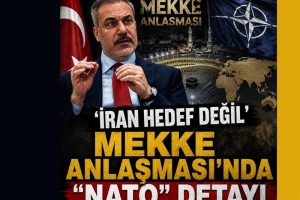
The Turkish Foreign Minister noted that the process of preparing this agreement had been lengthy.
He added: We knew what challenges we would face in this endeavor. For exactly two years and eight months, I have been continuously discussing these matters with our partners and other countries in the region. In technical terms, the Mecca joint defense agreement mirrors Article 5 of the NATO treaty regarding collective defense. That is precisely why countries ultimately decide to join an alliance—to benefit from mutual protection and support.
The Foreign Minister in Erdoğan’s cabinet has stated: By forming a joint defense pact, you enhance your deterrence capabilities. Furthermore, the purpose of entering into such alliances is not merely to send a message to the outside world; rather, the signatory nations must demonstrate and commit to the principle that they do not threaten—but instead guarantee—each other’s security. This is the starting point. Entering a security alliance is not an act directed against an external actor. We will now have a ministerial committee. Much like NATO, there is a political-military committee comprising foreign ministers, defense ministers, and the Chief of General Staff. This committee finalizes the vision set forth by the alliance’s leaders and drives the work forward. There will also be a General Secretariat—an organizational body—tasked with implementing the vision outlined by this committee.
Two other significant claims published by media outlets close to the AK Party, citing Fidan, are that Egypt will likely join the Mecca defense pact and that Turkey has discussed with Riyadh officials the groundwork for establishing an airbase in Saudi Arabia.
The Risk of a Minefield: Turkey versus Iran
Milli Gazete—the media outlet of Turkey’s Islamist Felicity Party (followers of the late Erbakan)—is one of the few Turkish newspapers to challenge the Mecca defense pact, writing: The Mecca agreement carries dangerous security implications and effectively paves the way for the creation of minefields. We must address the question of how to contend with regional fault lines and the U.S. presence in this equation. Completely excluding Iran—a key regional player—from this framework casts a shadow over the unity of the Ummah and presents a far more dangerous scenario. Let us not allow a situation to arise where Turkey is pitted against Iran.
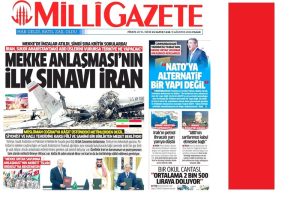
Milli Gazete further writes: What would happen if American bases on Saudi soil were targeted amidst the escalating tensions between Washington, Tel Aviv, and Tehran? Under the principle that ‘an attack on one of us is an attack on all of us,’ would retaliation entail Turkey taking action against its neighbor, Iran? Ankara’s stance regarding the risk of Turkish and Islamic-world troops being used as human shields for American bases will determine whether this agreement serves as a bulwark against the West or as a vehicle for fostering genuine Islamic unity. At a time when regional threats and the arrogance of the Zionist regime are mounting, the experiences of Turkey, the Pakistani military, and the Saudi capital are converging in a joint endeavor. Yet, beyond the agreements signed in opulent halls, the realities on the ground raise far more serious questions.
Continuing its coverage of the Mecca defense agreement, the Milli Gazete newspaper addresses the issue of the pact’s stance toward Iran, asking: The weakest and most questionable aspect of this agreement is whether Iran—a key regional power—has been excluded from the equation. The exclusion of Tehran—a primary target of the Zionist regime and US imperialism in the region—from this security framework raises serious doubts regarding the nature of the agreement. Given the divisive policies aimed at pitting Muslims against one another—policies long pursued by imperialist powers—any structure that excludes neighboring Iran, or creates the impression of a front formed against it, in no way serves the unity of the Ummah. A genuine regional security architecture is achievable not through the deepening of sectarian and political rifts, but through a comprehensive understanding that unites all regional nations against imperialism. If Iran, in exercising its right to retaliate, were to target US facilities on Saudi soil, what mechanism would come into play? Would Turkey and Pakistan enter into a military confrontation with their fellow Muslim neighbor, Iran, under the pretext of protecting US bases?