
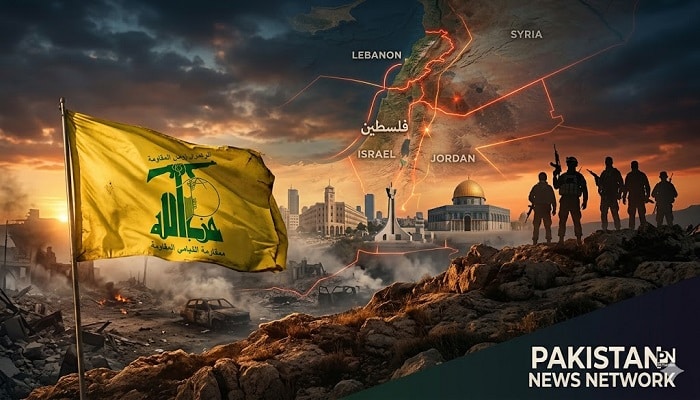
PNN – The war in Lebanon, as part of the structure of resistance against American-Zionist conspiracies, has witnessed 11 fundamental achievements by Hezbollah, which have a significant impact on the victory and final outcome of the regional war.
According to the report of Pakistan News Network; the course of the war between Hezbollah and the Israeli army cannot be isolated from other arenas of conflict in the region. The war in Lebanon is not simply a traditional military engagement influenced by equations of firepower or technological superiority, but is part of a complex regional scene in which initiative, perception, time management, and the redefinition of objectives are intertwined.
In this context, Al-Ahed News Agency listed a series of Hezbollah’s “phased achievements” that should be used as a tool to reach the final result in the war and impose structural changes to redefine the rules of engagement against the enemy, limit the enemy’s options, and impose new equations on the field and political levels.
These achievements are examined in a unified argumentative model that reveals the evolution of the Resistance’s presence and effectiveness in the calculations of its external and internal enemies. If these components are used in international dimensions and diplomatic and political negotiations and the need for the unity of the Resistance axis in confronting the American-Zionist conspiracies is emphasized, it can play significant regional results in the overall outcome of the conflict in the region and strengthen the upper hand of the Resistance against the American-Zionist conspiracies.
First: Eliminating the Enemy’s Element of Surprise
One of the most notable developments was the neutralization of the enemy’s plan to deliver a surprise blow to Hezbollah. This was achieved by imposing the reverse equation, which involved transforming the “element of initiative” from an Israeli advantage to an element that was “debatable between the two sides.” This achievement is not merely defensive, but a preventive defensive achievement.
Second: Breaking the equation of assassinations
Before March 2, the enemy had imposed a pattern of assassinations that constituted a rule of unilateral deterrence. But breaking this path is considered a strategic achievement, because it increased the enemy’s cost and brought this issue back into the enemy’s calculations. The attempt to re-impose this pattern under the roof of a ceasefire shows that the Zionist regime has not succeeded in establishing it as a sustainable rule.
Third: Surprise the enemy with effective preparation and tactics
The admission by some Israeli army commanders that they were surprised by Hezbollah’s preparation indicates a profound intelligence deficiency. Surprise here is not limited to having the capability, but rather the ability to conceal and manage the capabilities until the moment of use. This means that the resistance has succeeded in combining “strategic camouflage” and “tactical effectiveness,” which has resulted in the inability of the Israeli army to achieve decisive gains, despite its material superiority.
Fourth: The Reverse Equation of Strategic Ambush
One of the most telling indicators is Hezbollah’s success in luring the enemy into a strategic ambush. This is while the enemy was seeking to execute this strategic ambush. The reference to this development by Israeli army commanders, including Major General Rafi Milo, commander of the Northern Region, confirms that this is not a matter of propaganda, but an internal assessment of the shortcomings of the army. The argument here is that military superiority is not measured solely from the perspective of the one who plans; it is measured by the one who forces the other to act within his terms.
Fifth: Disappointing the Enemy from Decisive Military Victory
Hezbollah’s success in forcing the Zionist regime to admit that its disarmament is a long-term goal and not militarily achievable in the short term indicates a shift in the “ceiling of objectives.” When the goal shifts from decisive victory to field management, the opposing side has imposed strategic constraints on the enemy. This shift usually benefits the side that is weaker in terms of traditional power, because it buys time in its favor.
Sixth: Turning the occupation into a continuous security cost
The presence of the Zionist regime in the occupied territories is not accompanied by sustainable security, but has become a source of its financial and human costs. The constant lack of concentration of forces in some villages indicates a loss of field control, even if this military presence continues in appearance. This trend indicates the success of the resistance in implementing the model of “smart attrition”, which aims not to immediately expel the enemy, but to make its survival costly to the point of becoming unbearable.
Seventh: Imposing New Rules of Engagement
Lebanese Hezbollah, with the support of the Islamic Republic of Iran, was able to impose limits on the Zionist regime’s aggression in Lebanon. This indicates that the war in Lebanon is not simply bilateral, but part of a broader regional balance. The achievement here is to introduce external variables into the enemy’s calculations that reduce its freedom of action. In this way, the deterrence equations in this war are no longer local, but multi-level.
Eighth: The transfer of the war into Israel
One of the most prominent developments on the ground is the transfer of the war into the political structure of the Zionist regime, in such a way that a wide gap has emerged between the army and the cabinet on the one hand, and the cabinet and the opposition. This means that the resistance is no longer only targeting military capabilities, but also the coherence of political decision-making. In this way, weakening the decision-making structure of the Zionist regime is part of a strategic achievement that contributes to confusion in the decision-making process.
Ninth: Forcing the option of retreat into the enemy’s list of options
With the increasing human and security costs of this war, remaining in the occupied territories becomes a costly option for the Zionists, politically and militarily. This does not mean an immediate retreat, but rather creates a real possibility that is brought to the decision-making table.
Tenth: Restoring Trust and Imposing Presence in Equations
Hezbollah succeeded in restoring the trust of its environment and allies and presenting itself as an indispensable player in future equations. This shows that Hezbollah’s achievements are not only focused on the field, but also on political-strategic ones.
Eleventh: Imposing a new negotiation equation
The resistance created an equation according to which no agreement can be imposed on Lebanon without taking into account its position. This means that the balance of power is no longer measured only in the field, but also at the negotiating table. From this perspective, whoever has the ability to disrupt the balance also has a part of the decision, even if he is not directly present at the decision-making table.