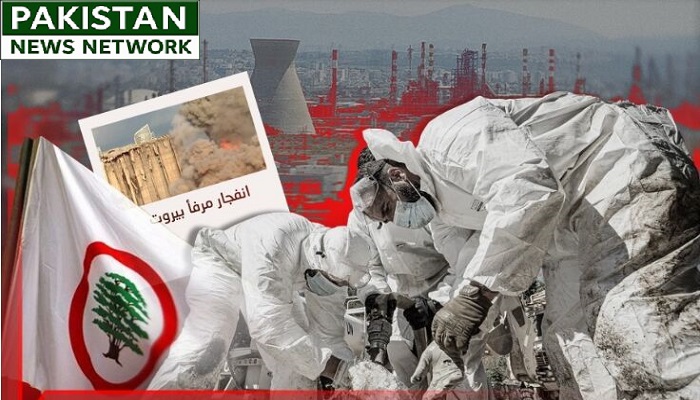
PNN – Coinciding with the sixth anniversary of the Beirut port explosion, the discovery of four tons of ammonium nitrate in southern Lebanon has once again thrust the dimensions of this case into the spotlight. This development—alongside calls to incorporate new information into the judicial proceedings regarding the port explosion—has reignited long-standing questions concerning the material’s origin, its potential link to the 2020 incident, and the role of the Zionist regime.
According to the report of Pakistan News Network, the “Al-Ahed” news outlet writes that as the sixth anniversary of the Beirut port explosion—which occurred on August 4, 2020—approaches, the case has once again entered a new phase. Despite the six years that have passed since the blast, the judicial investigation is still ongoing, and no indictment has yet been issued against the perpetrator or perpetrators responsible for the incident.
These developments followed an announcement by UNIFIL forces regarding the discovery of four tons of ammonium nitrate in the “Houla” area of southern Lebanon. According to the published report, the material was found in barrels bearing Hebrew markings, located in an area that remains under the occupation of the Zionist regime and is utilized for military operations. This discovery has drawn particular attention because the substance involved is the same type of ammonium nitrate linked to the Beirut Port explosion, and its technical specifications are described as identical to those of the material involved in that incident.
This development has also revived certain past cases—including the discovery of significant quantities of ammonium nitrate during a Lebanese Army inspection of a farm belonging to the brother of Ibrahim al-Saqr, an official with the Lebanese Forces party; at the time, large amounts of fuel stored in underground tanks were also found alongside the chemical.
Back then, critics had pointed out that the party in question had previously characterized ammonium nitrate as a substance with military applications linked to the production of explosives, rather than as a chemical fertilizer.
In the wake of these developments, questions have once again been raised regarding the reason for the substance’s presence at the site, the possibility of a link to the ammonium nitrate removed from the Port of Beirut, the party utilizing it, and the manner in which such a hazardous material was stored alongside a large volume of fuel.
In this context, the case of Joe Bejjani—a Lebanese photographer assassinated near his home on December 21, 2020—has also come back into focus. According to reports, security forces seized all hard drives and video footage from his home less than an hour after the incident. Bejjani’s wife later stated that this action was carried out without a judicial warrant. Bejjani held official authorization to photograph Lebanese Army activities, border areas, the Port of Beirut, and certain military installations; to date; no findings from the investigation into his murder have been announced.
In this regard, Lebanese lawyer Maan al-Asaad has submitted a request to Judge Tarek Bitar—who is presiding over the Beirut Port explosion case—calling for information concerning the discovery of ammonium nitrate in Houla to be examined as part of the main case file.
Speaking to the news outlet Al-Ahed, Al-Asaad emphasized that the port explosion case remains in the investigation stage and was originally predicated on the presence of 2,750 tons of ammonium nitrate in Hangar 12 at the Port of Beirut. According to him, the discovery of four tons of ammonium nitrate in southern Lebanon constitutes new information that must be investigated within the framework of this same case.
He also called for technical analyses of the materials discovered in Hula—including the determination of their origin, place of manufacture, and chemical composition, as well as a comparison with the materials that exploded at the Port of Beirut—stating that the presiding judge has the legal authority to cooperate with UNIFIL forces and international bodies to obtain samples and conduct specialized tests.
Al-Asaad went on to highlight the principles of criminal investigation, emphasizing the necessity of examining all hypotheses and stating that, in any criminal case, it must be determined which party stood to gain the most from the incident. In this context, he identified the Zionist regime as the “greatest beneficiary” of the Beirut port explosion, noting that the incident deepened internal divisions in Lebanon and undermined the port’s strategic position vis-à-vis the Zionist regime’s ports in the Eastern Mediterranean.
Regarding the discovery of ammonium nitrate at a farm owned by the brother of Ibrahim al-Saqr, the Lebanese lawyer emphasized that scientifically sampling and comparing these materials with the ammonium nitrate from the Port of Beirut could have helped clarify aspects of the case; however, no report on such analyses has been released to date.
Al-Asaad also maintains that the assassination of John Bejjani should be examined as part of the Port of Beirut explosion investigation, given the possibility of a link between the information or images held by the photographer and the explosion case—a matter that warrants judicial inquiry.
In conclusion, he emphasized that any judicial decision regarding the Beirut port explosion could only command the confidence of the Lebanese public if it were based on scientific investigation, legal evidence, and an examination of all existing possibilities, without excluding any hypothesis or piece of evidence from the investigative process.