

PNN – Riyadh’s policy of blockading Yemen has now—after 12 years of war—left the Saudi Kingdom itself hemmed in by strategic straits and missiles.
According to the report of Pakistan News Network; while the Strait of Hormuz is effectively closed due to the conflict between Iran and the United States, the Axis of Resistance has blocked a second vital artery for Saudi oil exports by opening a new front in the south of the peninsula. The spokesman for the Yemeni armed forces has upended the strategic equation by announcing a naval blockade alongside unprecedented missile and drone attacks on Aramco oil facilities in Jizan and Yanbu.
Regional tensions began in February/March 2026 with attacks on Iran by the United States and the Zionist regime. Countries on the southern shore of the Persian Gulf played a significant role in stoking the flames of conflict by supporting the U.S. and granting access to their airspace and territory for attacks on Iran. However, the development that has now escalated the crisis to a new level is the opening of a fresh front by the Yemenis in the southern Arabian Peninsula. The fragile ceasefire that had been in place between Yemen and Riyadh since 2022 was shattered in early July when the Saudi-led coalition launched attacks on the Yemeni capital’s airport and, subsequently, the port of Hodeidah. In response, Yahya Saree, the spokesman for the Yemeni armed forces, officially announced a naval blockade against Saudi Arabia last Sunday. Since then, not a single Saudi oil tanker has managed to pass through the Bab al-Mandab Strait. Extensive missile and drone attacks on Aramco oil facilities in Jizan and Yanbu have further complicated the situation. Today, Saudi Arabia finds itself under a blockade of which it was a primary architect.
Riyadh’s Maritime Blockade: The End of the Dream of Western-Route Exports
The Bab el-Mandeb Strait—through which approximately 12 percent of global maritime trade passes—has been effectively closed to Saudi oil tankers since the blockade was announced. According to data from the energy analytics firm Kpler, the transit of Saudi oil shipments through the strait has dropped by 36 percent. Saudi Arabia, which had diverted over 70 to 75 percent of its daily oil exports to the Red Sea port of Yanbu following the closure of the Strait of Hormuz, has now lost this alternative route as well.
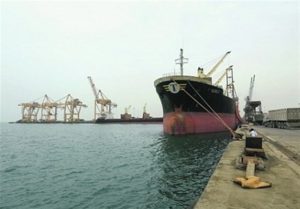
Crude oil loadings from Yanbu reached approximately 4.5 million barrels per day during the week ending July 20, underscoring Riyadh’s total reliance on this route. Yet, this very lifeline has now become Saudi Arabia’s greatest vulnerability; due to the maritime blockade, Saudi tankers are forced to utilize the far longer routes via the Suez Canal and the Cape of Good Hope. The simultaneous closure of the Straits of Hormuz and Bab el-Mandeb has significantly curtailed the global oil supply.
Attacks on Saudi Arabia’s Economic Heart: Fire at the Core of Aramco
On Saturday, July 25, Yemeni armed forces carried out two coordinated, large-scale operations against Saudi oil facilities. Brigadier General Yahya Saree, the spokesman for the Yemeni armed forces, announced that the first operation targeted Aramco facilities in Jizan using dozens of ballistic missiles and drones, while the second struck sensitive Aramco targets in Yanbu with a combination of ballistic missiles, cruise missiles, and drones. Ansarullah emphasized that both operations were “carried out with precision and success.” These attacks were launched in response to the Saudi-led coalition’s bombardment of the port city of Hodeidah and Kamaran Island in the preceding days.
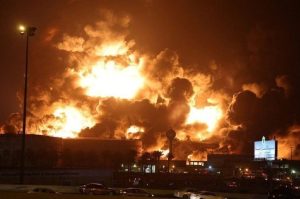
With a capacity of 400,000 barrels per day, the Jazan refinery is considered one of Saudi Arabia’s most important oil refining and storage facilities.
The Humiliation of Trump: The Heavy Price of Aligning with Washington
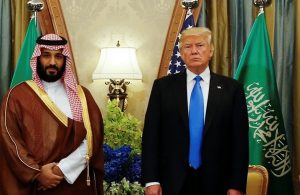
Perhaps the most bitter aspect of this affair is the way the United States has treated its strategic ally. Donald Trump has humiliated Saudi Crown Prince Mohammed bin Salman in an unprecedented manner on several occasions. This is despite reports indicating that Bin Salman had personally urged Trump to pursue a war against Iran, describing it as a “historic opportunity” to weaken the country. In exchange for supporting the U.S. war effort and hosting American military bases, Saudi Arabia has gained nothing but humiliation and the loss of two vital arteries for its oil exports.
Amidst this chaos and conflagration, however, a voice from Tehran offers a potential glimmer of hope for Saudi Arabia to emerge from the crisis. Iranian Foreign Minister Abbas Araghchi officially announced that Tehran is prepared to play a “positive and constructive” role in resolving the conflict between Saudi Arabia and Yemen. Araghchi explicitly emphasized that “the Yemen issue has no military solution” and can only be resolved through negotiation; he stated that should talks commence between Yemen and Saudi Arabia, Iran could play a constructive role in the process.
However, if Saudi Arabia wishes to continue its oil production and exports and extricate itself from this quagmire, it has no choice but to fundamentally alter its regional policies. Riyadh must cease military cooperation with the U.S. armed forces against regional nations, shift its stance toward Iran and its regional allies, and end the twelve-year blockade of Yemen. These three measures are not merely options but constitute a single, unavoidable strategy—a path without which Saudi Arabia is doomed to persist in this losing gamble. Should the negotiations between Iran and Saudi Arabia yield results, other Arab nations will likely follow suit, steering the region toward lasting stability.
Undoubtedly, Iran would welcome a reduction in regional tensions and the establishment of constructive relations with its neighbors—particularly Saudi Arabia—as stability in the Persian Gulf and the Red Sea serves the interests of all regional actors and, furthermore, the global economy.
Conclusion
Today, Saudi Arabia finds itself ensnared in a trap of its own making. On one hand, by backing the U.S. war against Iran and hosting Washington’s military bases, it has completely lost its eastern export route—in addition to the Strait of Hormuz. On the other, by persisting with the twelve-year blockade of Yemen and the bombing of Hodeidah, it has compelled Sana’a to open a new front and close the Bab al-Mandab Strait, thereby seeing its western export route blocked as well.