
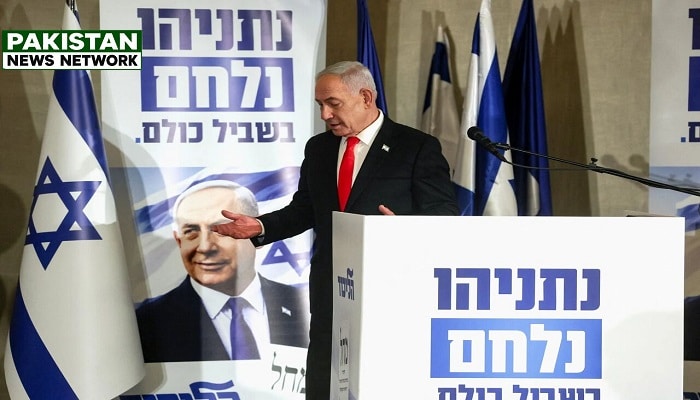
PNN – While opinion polls in the occupied territories point to a continuing political crisis and the absence of a decisive majority, the Haaretz newspaper has examined four potential scenarios for the formation of the Zionist regime’s next cabinet.
According to the report of Pakistan News Network citing Hodhod Palestine; Haaretz published an analysis stating that an examination of political developments reveals—despite existing complexities—that the electoral deadlock does not necessarily mean another round of elections is inevitable; rather, four main paths lie before the parties to resolve this situation.
This analysis is published at a time when the resurfacing of images from the initial moments of Operation “Al-Aqsa Flood”—coupled with the continued displacement of residents from the north and south of the occupied territories—has raised serious questions regarding the reasons for Netanyahu’s political survival, despite his direct responsibility for “the greatest catastrophe in the history of the Zionist regime.”
The details of these four political scenarios are examined below:
- Eisenkot’s Scenario for Winning over the Right
In this scenario, Gadi Eisenkot seeks to bring factions such as the “Ofer Winter” camp and the “Hendel-Zilka” alliance into the fold, despite the significant political cost involved. The objective is to secure Likud’s cooperation in providing the political cover necessary to facilitate Winter’s shift between political blocs, thereby obviating the need for the Ra’am party (United Arab List). The plan entails promising the Ministry of Defense portfolio to Winter and a key economic post to Zilka.
Pointing to the weakness of Eisenkot’s election campaign, this analyst emphasizes that—unlike historical figures such as Ehud Barak (in 1999) or Yitzhak Rabin (in 1992), who leveraged their military backgrounds to win the trust of the right-wing base—he has failed to highlight his military record or garner support from former heroes.
- Netanyahu’s Effort to Form a Coalition with Naftali Bennett and Avigdor Lieberman
The second scenario focuses on Netanyahu’s all-out effort to bring Naftali Bennett and Avigdor Lieberman together into a coalition. This plan involves making numerous offers—including a proposal to rotate the premiership—to entice them. Although it appears difficult for these two figures to join forces with Netanyahu, the political experience of Gideon Sa’ar demonstrates that one should neither be overly optimistic nor overly pessimistic regarding shifts in the stances of political actors. Nevertheless, forming such a coalition without the participation of the Haredi (Ultra-Orthodox) parties continues to face structural challenges.
- Conditional Likud Participation without Netanyahu’s Direct Presence
In the third scenario, Gadi Eisenkot extends a generous offer to the Likud party, contingent upon Benjamin Netanyahu remaining outside the official cabinet lineup. Under this model, Netanyahu would appoint Likud ministers and oversee them from outside the government, while simultaneously participating alongside Eisenkot in an informal decision-making forum—thereby paving the way for his potential future return. Given Netanyahu’s personality, this scenario is feasible only in the event of a decisive election outcome and the application of maximum pressure upon him.
- Formation of a Minority Cabinet by Eisenkot
The final scenario involves the formation of a minority cabinet by Eisenkot, facilitated by the refusal of Arab parties to participate in the vote. Under this plan, the government would immediately move to establish an “official commission of inquiry” and pass a “mandatory military service” law. Eisenkot would present this administration as an interim cabinet while simultaneously initiating negotiations to bring Haredi parties into the fold. The strategy for persuading the Haredim in this scenario rests on the premise that the “military service law has become an irreversible reality,” leaving them with no choice but to join the coalition to safeguard their share of the budget—a success that depends directly on the extent of Netanyahu’s post-election weakness and the decline of his influence over religious parties.