
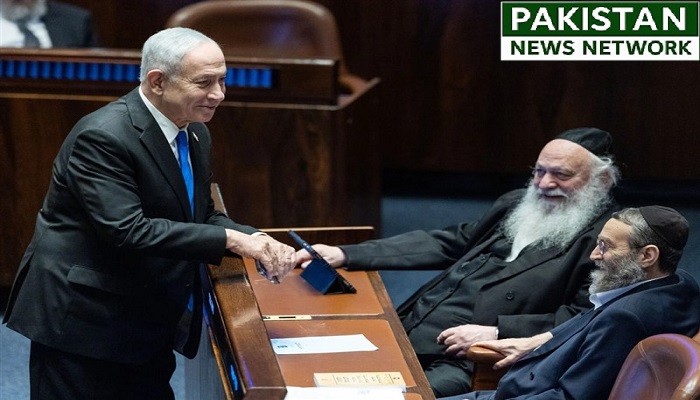
PNN – Netanyahu agreed to the law allowing Haredim to evade military service in the Israeli army in order to preserve his voter base ahead of the elections.
According to the report of Pakistan News Network; members of the Zionist regime’s Knesset voted on July 17 to dissolve the parliament’s 25th session. Following this move, the parliament suspended operations pending the formation of its 26th session, and lawmakers scheduled the upcoming Knesset elections across the occupied territories for October 27. This date corresponds to the original statutory schedule for the elections. By law, elections must be held at the conclusion of the four-year term and at the designated time—a requirement that has now been met. The decision to dissolve the parliament marked the transition into the election period and the conclusion of legislative activity; it does not constitute a call for early elections.
This matter is significant because, on May 13—following severe rifts within the ruling coalition, the announcement by two Haredi parties that they would not support the Prime Minister’s actions, and their push to dissolve the Knesset—Netanyahu took the preemptive step of introducing a bill to dissolve the Knesset and trigger early elections. Although the bill passed its first reading in the Knesset on June 2, it required approval in two additional readings to become law. At the time, the window for early elections was projected to fall between September 8 and October 20; however, the process was halted by concessions Netanyahu granted to the Haredi parties.
The source of the rift between the Haredi parties and Netanyahu was the issue of “military service exemptions for Haredi Zionists.” Following the second war with Iran and the Israeli army’s occupation policies in southern Lebanon, the regime’s military officials informed Netanyahu’s cabinet that, should current conditions persist, they would face a shortfall of 17,000 troops by the end of 2026—a deficit capable of disrupting operations across various fronts. Consequently, Netanyahu instructed the Knesset’s Foreign Affairs and War Committee to take action toward passing legislation mandating military service for Haredim. The directive included provisions for “establishing actual recruitment quotas for Haredim,” “stiffening penalties for military deserters,” and “reducing exemptions for religious seminary (Yeshiva) students.”
This issue sparked a fierce reaction from Haredi rabbis, as they realized that—more than three years into the cabinet’s term and despite Netanyahu’s promises to pass a law extending the Haredi exemption from IDF service—the Prime Minister had decided, in the final months of his tenure, to compel Haredi Zionists to perform mandatory military service in order to advance his military objectives and align with the demands of army commanders. Under these circumstances, the situation in the occupied territories was plunged into a genuine upheaval.
The official announcement that Haredi parties would not support Netanyahu—coming at a time when the opposition was also strengthening its base—signaled a premature and certain defeat for him, even before the upcoming Knesset elections. While there was much speculation regarding how the crisis might be resolved, Netanyahu ultimately overcame the issue using his customary tactic: granting concessions to the Haredim at the expense of other segments of society. Consequently, during the final week of the Knesset’s term, two controversial laws were passed, while concessions were simultaneously granted to the military to alleviate some of their security concerns and address their objections.
Netanyahu’s Concessions to Haredi Parties
During the final days of the 25th Knesset, two bills sought by Haredi parties—both concerning the issue of mandatory military service for the Haredi community—were finally passed.
A) Basic Law: Torah Study
This measure was enacted as a Basic Law on July 13; in the occupied territories, Basic Laws hold a status akin to a constitution. Its key provisions are as follows: Torah study was recognized as a fundamental Jewish value, and the Cabinet was mandated to support religious institutions (yeshivas) and students of religious studies.
Consequently, for the first time, full-time Torah study was enshrined in a Basic Law as a service of significant importance. The political objective of this law was to establish a legal safeguard for the continued exemption or deferral of military service for yeshiva students, ensuring that this Basic Law would provide protection should ordinary laws be challenged in court. The bill was passed in its second and third readings with 63 votes in favor and 52 against.

B) Legislation regarding the arrest of Haredi military personnel evading IDF service
One day after the Torah study law was passed, a controversial bill concerning the arrest of Haredi draft evaders was put to a vote on July 14; it was finally approved in its second and third readings by a narrow majority of 58 votes in favor to 54 against. As previously noted, this legislation pertains to the enforcement of conscription laws. Previously, if an individual liable for service was summoned but deliberately failed to report to the army, he was legally classified as a “deserter” (or draft evader), and the Military Police had the authority to arrest him.

However, under the new law, the detention of Haredim who had failed to report for service has been temporarily halted; these individuals will not be detained or imprisoned until a comprehensive law regarding Haredi service is drafted. Consequently, thousands of yeshiva students remain safe from the threat of immediate arrest.
As previously mentioned, on July 17, the parliament voted to dissolve itself and conclude its current term. It is worth noting that these two laws complement each other: the Basic Law on Torah Study reinforces the legal and intrinsic value of religious study, while the law suspending conscription arrests prevents—at least in the short term—the enforcement of criminal measures against Haredim subject to IDF service. Consequently, opponents of these measures—almost all of whom belong to the opposition—argue that the new laws effectively pave the way for a large segment of the Haredi community to continue being exempt from military service.
Accordingly, during the vote on the bill to suspend the arrest of Haredi military draft evaders, Yuli Edelstein, Dan Illouz, and Sharren Haskel—members of the ruling coalition—expressed their opposition and voted against the measure, contrary to the Cabinet’s stance. Notably, Benjamin Netanyahu was absent from the chamber during the final vote and did not cast a ballot. His aim was to create room to evade future responsibility—a tactic in which he is well-versed. In reality, however, the events unfolded under Netanyahu’s full direction and leadership, intended to keep the right-wing bloc united in the months leading up to the elections.
Reaction of the Israeli Opposition and Public Opinion
Following the passage of laws that effectively served as a concession by Netanyahu to Haredi parties—aimed at ending their protests—opposition leaders reacted to this political maneuver. Avigdor Lieberman, leader of the “Yisrael Beiteinu” (Israel Our Home) party, criticized the legislation—which he argued would weaken the military—and declared: We will repeal this law in the next government.
Naftali Bennett, head of the “Yachad” (Together) party, also stated: This is a deliberate and conscious attack on the Israeli military—both during the war and up to the present day—and we will ensure that this government’s record regarding its actions since October 7th is scrutinized, particularly its neglect of the IDF and its soldiers.

Meanwhile, a poll published by Israel’s “Channel 12” revealed the extent to which Netanyahu’s actions have caused rifts and divisions within Israeli society. Conducted following the passage of the aforementioned laws and the conclusion of the 25th Knesset’s term, the survey showed that 67 percent of Israelis oppose the legislation—passed during the parliament’s final days—that legalized the exemption of Haredim from military service. Furthermore, 64 percent of respondents view the Knesset’s overall performance as poor, and 74 percent believe that most Knesset members act solely in their own personal interests.
Concessions Granted to the Military
Alongside advancing legislation designed to appeal to Haredi parties, Netanyahu agreed to increase the military budget by 15 billion shekels ($5 billion) before the end of the year. It was also decided that, subject to the “validation of the military’s needs and performance,” the allocation of an additional 25 billion shekels—distributed in two stages—would be considered; however, military officials indicated that this second sum is unlikely to be allocated, given that the Knesset is concluding its session and political leaders are entering an election period. In a separate move aimed at alleviating the army’s manpower shortage, the Knesset voted in favor of a bill extending mandatory military service to 32 months. Under this measure, soldiers originally scheduled to complete their service in January 2027 are required to remain in the army for an additional two months. This law will remain in effect until June 2029, after which a decision regarding the matter will be made based on prevailing conditions.