
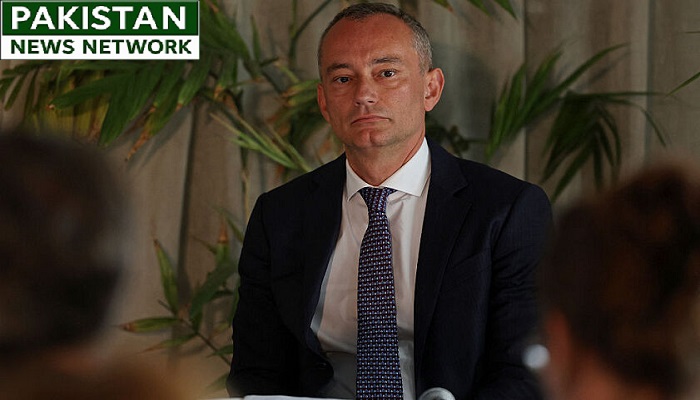
PNN – Following a meeting in the occupied territories with Nickolay Mladenov—the senior envoy for the Gaza peace process—and Ari Lightstone, an advisor to the council, the office of Israeli Prime Minister Benjamin Netanyahu issued a statement rejecting any withdrawal from its current positions within the Strip or the cessation of assassination operations.
According to the report of Pakistan News Network citing Arab48, Nickolay Mladenov, the UN Special Coordinator for the Middle East Peace Process, and Ari Lightstone, an advisor to the initiative, met with Israeli Prime Minister Benjamin Netanyahu. They urged him to halt attacks on the Gaza Strip and adhere to the terms outlined in U.S. President Donald Trump’s plan. However, Netanyahu’s office issued a statement rejecting any withdrawal from current positions within the enclave or a halt to targeted assassination operations.
Israel’s Channel 12 reported that Mladenov and Lightstone—who represents the Trump administration in this initiative—met with Netanyahu and conveyed that Israel must cease attacks in Gaza in accordance with its commitments under Trump’s 20-point plan.
Citing a source familiar with the details, the network described the atmosphere of the talks between the two sides as “difficult.”
Following the meeting, Netanyahu’s office issued a statement to Zionist media outlets declaring that Israel would not withdraw from its current positions in the Gaza Strip and would continue what it termed the neutralization of any threat against Israelis and their forces.
This stance by Netanyahu’s office signifies a rejection of two key demands made by the U.S. side during the meeting: the withdrawal of Zionist troops to the so-called “Yellow Line” stipulated in the Sharm al-Sheikh agreement, and the cessation of assassination operations and attacks within the Strip.
On Sunday, U.S. officials directed direct criticism at the Zionist regime over the continued killings in Gaza, telling Channel 12 that Tel Aviv had agreed to certain conditions—including a halt to targeted killings—in exchange for Hamas moving to the next phase regarding the arms issue.
The officials added that the occupying regime’s continued attacks provide a pretext for Hamas to “backtrack” and reinforce the perception among mediating nations that Netanyahu “is not keeping his promises and has no interest in peace”—a situation they believe increases the regime’s isolation in the region.
The position of the occupying regime is a reiteration of the statements made following the release of the “Peace Council’s” 15-point roadmap. That roadmap was the result of negotiations involving the Council, mediators, and the Hamas movement—which had previously signaled its agreement to the plan. At the time, Israel had declared that it would not withdraw from its current positions unless Hamas took “genuine” steps toward disarmament.
The term “current line” refers to the positions to which occupying forces advanced following the ceasefire agreement—positions that extend beyond those delineated in the Sharm el-Sheikh agreement (signed in October 2025). Prior to Israel expanding its occupation to encompass over 65 percent of Gaza’s territory, the original “yellow line” had placed approximately 52 percent of the Strip under the regime’s control.
Based on its stated position, Tel Aviv insists on making the disarmament of Hamas a precondition for any withdrawal—including a return to the positions held at the time the agreement was signed. This stands in contrast to the roadmap, which is predicated on the simultaneous, phased implementation of obligations by both parties under the supervision of an international fact-finding committee.
This roadmap stipulates that, concurrent with the cessation of military activities by Hamas and Palestinian factions, Israel must fulfill its remaining obligations under the Sharm al-Sheikh Memorandum—foremost among them the halting of military operations. It also mandates that a timetable and implementation mechanisms for the second phase be prepared within 14 days of the parties’ agreement, after which the National Committee for the Administration of Gaza would become operational and assume civil and security responsibilities.
Regarding weaponry, the plan entails a phased, scheduled process for dismantling and stockpiling heavy arms, as well as addressing tunnels, weapons depots, and military production facilities; this process is to be linked to Israel’s gradual withdrawal from areas in Gaza currently under military control.
Furthermore, under this roadmap, a temporary international stabilization force is to be deployed to separate Israeli occupation troops from areas under the administration of the Palestinian committee, monitor the ceasefire, train the Palestinian police, and ensure the delivery of aid and essential supplies. However, police duties regarding the Palestinians in this strip will not be assigned to it.
Mladenov’s visit to the occupied territories coincided with objections raised by the Zionist regime’s Finance Minister, Bezalel Smotrich, and Minister of Settlements and National Missions, Orit Strock, regarding the roadmap and the role of the international force within it. The two Zionist ministers claimed that the document altered the nature of the force’s mission—transforming it from a body intended to participate in disarming Hamas into an entity that would serve as a buffer between the occupation forces and the Palestinians, thereby restricting the operations of the occupation army.
Smotrich and Strock urged Netanyahu to reject the roadmap and revoke the regime’s cabinet resolution that had initially authorized the entry of an international force. Claiming the decision was based on “incorrect information,” they demanded that the force’s entry into the Strip be blocked until its objectives, legal compliance, and mandate were revised.
The meeting was held in the wake of continued Israeli attacks on the Gaza Strip, despite a ceasefire agreement and a roadmap that stated the cessation of military operations as a precondition. Sources in the Gaza Strip reported the martyrdom of 19 Palestinians since the early hours of the night during Israeli attacks on various areas.