
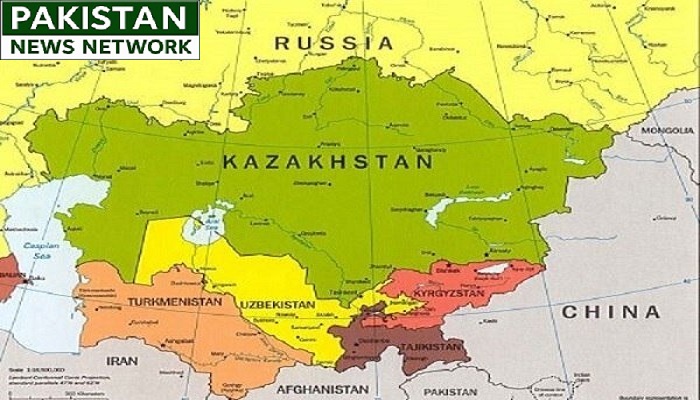
PNN – U.S. interest in exploiting Central Asia’s rare mineral resources, along with the Trump administration’s approaches in this regard, has sparked reactions and concerns among Central Asian nations.
According to the report of Pakistan News Network; U.S. interest in exploiting Central Asia’s rare mineral resources, along with the Trump administration’s approaches in this regard, has sparked reactions and concerns among Central Asian nations, and the implications of this development have been the subject of discussion and analysis in expert circles.
US Moves to Tap into Kazakhstan and Uzbekistan
Kazakhstan is among the Central Asian nations whose mineral resources the United States is keen to exploit on a large scale. In November 2025, representatives of Skyline Builders—a company in which entities linked to Donald Trump Jr. and Eric Trump (sons of Donald Trump) had previously acquired a stake—announced an agreement with Kazakhstan’s national mining company.
This news received widespread coverage in global economic media early in the spring; at first glance, the development appeared to be nothing more than a routine economic story. However, the Financial Times reported, citing its own sources, that entities linked to Donald Trump Jr. and Eric Trump had reached a merger agreement with a major mining holding company—a firm that had received approximately $1.6 billion in U.S. government funding to develop one of the world’s largest untapped tungsten deposits in Kazakhstan.
The Trump family initially acquired a stake in the construction group Skyline Builders, subsequently increased their holdings, and ultimately became the owners of 20 percent of the Kazakh company Kaz Resources—the firm that controls the Cove Kaz mining complex. Representatives of the company announced an agreement with Kazakhstan’s national mining company in November 2025, and on April 30, 2026, the two parties agreed to a merger and the listing of the new company’s shares on the US Nasdaq exchange.
In February 2026, the United States and Uzbekistan signed an agreement on cooperation regarding critical minerals. Additionally, the American company Traxys announced a $1 billion investment in Uzbekistan’s mineral extraction and processing sector. Meanwhile, the European Union and the United Nations launched a joint project for the extraction of “green minerals” in the region. This collaboration aims to extract and manage resources—such as copper, lithium, and rare elements—that are essential for advancing technologies required for the transition to clean, non-fossil energy. Kazakhstan has also commenced the processing of gallium and antimony and reached an agreement with Uzbekistan on cooperation regarding the extraction and export of certain rare earth elements.
Developments beyond Economic Transactions
On the surface, this news concerns commercial deals between several mining and investment firms; however, at a macro level, it signals a significant shift in the geoeconomic strategy of the West—and the United States in particular—regarding Central Asia. While great-power rivalry in previous decades centered on controlling the region’s oil and gas resources, the accelerating global transition toward the digital economy, advanced defense industries, and clean energy has now made critical and rare minerals the new focal point of geopolitical competition.
What amplifies the significance of this deal is its coincidence with the intensifying strategic rivalry between the United States and China. In recent years, China has emerged not only as the largest producer of rare earth elements but also as a key player in the processing of numerous strategic minerals—including tungsten, rare earths, antimony, lithium, molybdenum, gallium, and germanium. In response to China’s imposition of export restrictions on some of these materials, the United States has sought to establish alternative supply chains outside of China. Against this backdrop, Central Asia—with its vast mineral reserves—has become a prime target for U.S. industrial policy and economic security strategies.
The entry of companies linked to the Trump family into mining projects in Kazakhstan should also be analyzed within this framework. The presence of these companies is not merely a private investment; rather, many analysts view it as part of a broader trend of aligning US private capital with the country’s geoeconomic objectives. This is particularly significant given that the project in question has received financial backing from the US government and is slated to raise additional funds through a listing on the Nasdaq stock exchange. This model will facilitate the influx of substantial Western capital into the Central Asian mining sector.
On the other hand, this development could also alter the competitive balance among major powers in Central Asia. While Russia has maintained its traditional influence over the region’s energy and infrastructure sectors for decades, China—leveraging the “Belt and Road Initiative”—has emerged as the largest foreign investor in numerous infrastructure and mining projects. Now, the United States is also seeking to strengthen its position in the region and curb China’s economic influence by investing in strategic mineral resources.
From the perspective of economic security, the significance of these developments extends far beyond the mining sector. Today, tungsten, rare earth elements, gallium, germanium, and antimony serve as essential raw materials for numerous critical technologies, including missile systems, aerospace engines, electronic equipment, semiconductors, electric vehicles, wind turbines, and artificial intelligence industries. Consequently, controlling the supply chains for these materials has become a key component of national security for major powers.
From this perspective, the deals involving the Trump family can be seen as a sign of the onset of a new phase of geoeconomic and strategic competition over control of Central Asia’s critical minerals—a rivalry likely to expand in economic, technological, security, and even political dimensions in the coming years, further elevating the region’s standing in global dynamics.
Strategies of Central Asian Countries to Move beyond the Export of Raw Materials
Following the collapse of the Soviet Union, Central Asia became a prime destination for Western investment; after two decades of concerted effort, American and European investors succeeded in establishing a foothold in the mining sectors of Kazakhstan and Uzbekistan, as well as in Kyrgyzstan’s gold mining industry.
Analysts believe that global competition for access to critical mineral resources is intensifying day by day. However, foreign investors focus primarily on resource extraction, whereas projects involving deep processing—transforming raw minerals into higher-value, higher-priced products—are progressing much more slowly within Central Asian countries. Without the establishment and completion of domestic processing industries, a significant portion of raw materials will be exported without generating added value within the region.
Local experts in Central Asia warn that the primary risk lies in ceding control of domestic mines to foreign companies without simultaneously developing local processing industries. Should this occur, the region would remain locked into an economic model reliant on raw material exports. Investor interest in mineral extraction does not necessarily translate into a willingness to establish local industrial value chains; consequently, the bulk of the profits generated from these activities would accrue outside the region, benefiting only the United States.
However, signs of a shift in this pattern are emerging, and in recent years, Kazakhstan and Uzbekistan have sought to alter their mining policies. Kazakhstan has formulated plans to develop processing industries, produce high-purity metals, and participate in the global semiconductor supply chain. Uzbekistan, meanwhile, has made foreign investment conditional upon the establishment of mineral processing facilities and downstream industries in order to prevent the export of raw materials.
Some experts emphasize the need to revise mining laws and expand geological exploration activities in Central Asian countries. Without domestic expertise and appropriate legal frameworks, negotiations with major foreign players could result in an imbalance of bargaining power, potentially allowing the United States to unilaterally advance a scheme of exploitation.
Local experts state that while no one desires the isolation of the Eurasian region, the expansion of international cooperation must take into account the long-term economic interests of the region’s nations. Ultimately, the guiding principle must be rationality and a commitment to the interests of the entire population—rather than merely those of specific groups.
Ultimately, the most critical issue for Central Asian nations will not be merely attracting foreign capital, but rather how these investments are managed. If regional governments can retain control over their mines while linking foreign capital to technology transfer, the development of processing industries, workforce training, and the creation of domestic value chains, then mineral resources can become an engine for industrial development. However, if investments remain confined to the extraction and export of raw materials, the risk of perpetuating a raw-material-dependent economic model and reliance on foreign actors will persist.