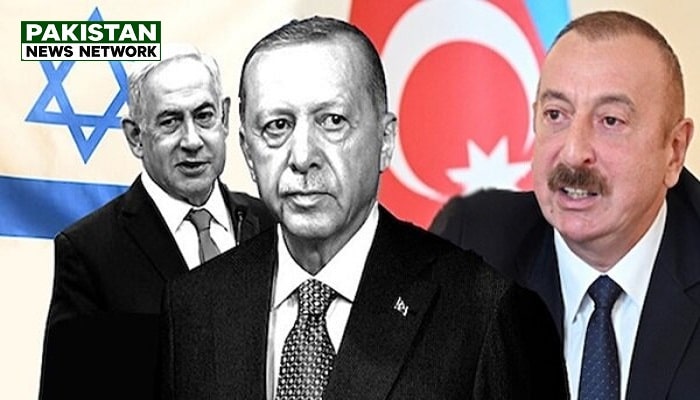
PNN – Relations between Turkey and the Republic of Azerbaijan have faced challenges following recent political disagreements and the expansion of cooperation between Baku and Tel Aviv—developments that have put the slogan “two states, one nation” to the test.
Azar Mahdavan: Relations between Turkey and the Republic of Azerbaijan have encountered difficulties stemming from a dispute over hijab restrictions in schools and recent political tensions. These disagreements—compounded by Baku’s growing closeness to Tel Aviv and the regional rivalry between Israel and Turkey—have evolved into something far more significant than a mere diplomatic dispute.
The slogan “Two states, one nation” is currently facing a serious test. Relations between Turkey and the Republic of Azerbaijan—long characterized by an emphasis on the historical, ethnic, and linguistic ties between the two nations—have encountered political and diplomatic tensions in recent weeks. While these tensions originated from regulations concerning student dress codes in Azerbaijani schools, their roots and implications extend well beyond a mere educational dispute.
The Onset of the Crisis: New School Regulations and Turkey’s Reaction
The situation began with the implementation of new school dress code regulations in the Republic of Azerbaijan. Under these rules, students were required to wear official school uniforms—a policy that, in practice, resulted in restrictions on the wearing of headscarves and prevented some students who wear the hijab from attending school.
This decision drew reactions from certain political and religious figures in Turkey. Among the critics was Oktay Saral, an advisor to the Turkish president, who spoke out against the policy. As the dispute escalated, Saral was removed from his post—a move reportedly ordered by Erdoğan as part of an effort to manage tensions with Baku.
Conversely, officials in the Republic of Azerbaijan viewed the criticisms voiced in Turkey as interference in their country’s internal affairs. Subsequently, Baku issued arrest warrants in absentia for seven Turkish citizens and placed 31 other Turkish nationals on a list of “undesirable persons,” effectively banning them from entering the country.
A Clear Sign of Discord: Aliyev’s Absence from the Ankara Summit
Tensions became more apparent during the 13th Summit of the Organization of Turkic States, held in Ankara on October 29–30, 2026. Despite a personal invitation from Recep Tayyip Erdoğan, President of the Republic of Azerbaijan Ilham Aliyev declined to attend; instead, the country’s Foreign Minister, Jeyhun Bayramov, represented Baku at the summit.
While official Azerbaijani media attributed Aliyev’s absence to prior commitments, some reports interpreted this decision as a reciprocal response to Erdoğan’s absence from the summit in Baku on October 15—an event where Hakan Fidan had attended as the representative of the Turkish President.
In his address at the Ankara summit, Erdoğan emphasized the necessity of preserving the unity of the Turkic world, stating that there is no room for discord or division within the great family of Turkic nations. However, the absence of the President of the Republic of Azerbaijan from the gathering served as a symbol of the cooling relations between the two long-standing allies.
A Less-Noticed Dimension of the Crisis: Educational Cooperation with Israel
A significant aspect of the recent controversy concerns the Republic of Azerbaijan’s educational cooperation with Israel—a matter that also drew attention during discussions regarding new school regulations.
Emin Amrullayev, the Minister of Science and Education of the Republic of Azerbaijan, has cited Israel’s educational experience and model as a reference point for reforming his country’s education system. Cooperation with Israel’s educational network has been ongoing for years, encompassing the implementation of pedagogical methods, the development of science and technology curricula, and the dispatch of Azerbaijani teachers and school administrators to Tel Aviv to participate in training programs.
According to published reports, this cooperation has expanded since 2019, with hundreds of teachers and educational administrators from the Republic of Azerbaijan taking part in courses focused on the Israeli education system. Furthermore, through joint projects, teaching methods rooted in science, technology, and innovation have been introduced into schools in Azerbaijan.
The introduction of these collaborations, alongside the restrictions imposed on students who wear the hijab, has become a focal point of criticism in Turkey; critics question why—despite the emphasis on modeling the education system after Israel’s—religious restrictions in the schools of the Republic of Azerbaijan have also increased.
The Rivalry between Tel Aviv and Ankara: From the Eastern Mediterranean to the Caucasus
To understand the strategic dimensions of these developments, one must consider the broader rivalry between Israel and Turkey within Ankara’s immediate periphery. In recent years, Israel has expanded its security and military ties with Greece and Greek Cyprus. In December 2025, the three parties signed a joint military action plan for 2026, which included joint exercises, Special Forces training, the exchange of military expertise, and security coordination.
From Ankara’s perspective, this cooperation is of particular significance; the deepening of military coordination among Israel, Greece, and Cyprus could impact the security balance in the Eastern Mediterranean, as well as Türkiye’s strategic interests in the region.
Alongside this trend, the development of Israel’s relations with the Republic of Azerbaijan holds added significance. Due to its geographical location and its historical and ethnic ties to Turkey, Baku is considered one of Ankara’s most important partners in the Caucasus and a primary gateway for Turkish influence within the Turkic world.
Relations between the Republic of Azerbaijan and Israel extend beyond the energy sector and arms procurement, encompassing cooperation in intelligence, technology, education, and security. The Republic of Azerbaijan is a major supplier of oil to Israel; conversely, Israeli military equipment has played a significant role in bolstering Baku’s defense capabilities. According to a report by the Middle East Institute, Israel accounted for approximately 69 percent of the Republic of Azerbaijan’s arms imports between 2016 and 2020.
Alongside these state-level collaborations, reports have also emerged regarding economic investments by Ilham Aliyev’s family in Israel. In July 2017, the Israeli newspaper Haaretz published a report concerning investments made by the family of the President of the Republic of Azerbaijan in the occupied territories. According to claims made in the report, the Aliyev family had invested approximately $600 million of their personal wealth into the Israeli stock market. The report also noted the purchase of a luxury villa in the city of Haifa—valued at around $6 million—by the wife and son of the President of the Republic of Azerbaijan.
From this perspective, the expansion of Tel Aviv’s relations with Baku can be viewed as part of Israel’s effort to strengthen its presence and cooperation with key actors surrounding Turkey. The simultaneous development of Israel’s cooperation with Greece and Cyprus in the Eastern Mediterranean, and with the Republic of Azerbaijan in the Caucasus, impacts two geographical areas of critical importance to Turkey’s foreign policy and national security.
A Challenge to Erdoğan’s Vision for the Turkic World
These developments also carry significance for Erdoğan’s regional strategy. In recent years, Turkey has sought to solidify its position as the central power within the Turkic sphere by strengthening the Organization of Turkic States, expanding economic and security cooperation, and fostering closer ties among Turkic-speaking nations.
In this context, the Republic of Azerbaijan—by virtue of its strategic ties with Ankara and its position in the South Caucasus—serves as one of the most critical pillars of this strategy. Consequently, Baku’s deepening rapprochement with Tel Aviv, alongside the expansion of independent cooperation in the defense and security spheres, could impact the extent of Turkey’s influence in the country, as well as the realization of Ankara’s objectives within the Turkic world.
Indeed, by developing its relations with the Republic of Azerbaijan, Israel has positioned itself to exert influence over one of the key axes of Turkey’s regional reach. This is particularly significant given that the two nations hold divergent views on issues such as foreign policy, the Palestinian question, and engagement with Israel.
The Baku Summit: A Test for the Convergence of Turkic Nations
Another instance of this divide could be observed during the 7th Summit of the Conference on Interaction and Confidence Building Measures in Asia (CICA), held in Baku on October 15, 2026.
As Isaac Herzog, the President of the Zionist regime, delivered his speech, delegations from several countries—including Turkey, Iran, Pakistan, and Kuwait—as well as representatives of Palestine, walked out of the hall. In contrast, other delegations present at the summit—notably representatives from Turkic-speaking nations—remained in the hall.
This development has once again demonstrated that ethnic, linguistic, and cultural commonalities among Turkic-speaking nations do not necessarily translate into political and ideological alignment. Regarding the issue of Israel, the Republic of Azerbaijan’s approach differs significantly from Turkey’s stance; Ankara has strongly condemned Israel’s policies in Gaza, whereas Baku has maintained its close ties with Tel Aviv.
This divergence in approach indicates that the project of Turkic integration faces serious limitations, and one cannot expect the member states of this bloc to adopt a unified position on all regional and international issues.
Conclusion
Recent developments between Turkey and the Republic of Azerbaijan cannot be dismissed merely as a dispute over school dress codes or a diplomatic misunderstanding. This crisis has emerged at a time when Israel is simultaneously expanding its cooperation with Greece and Cyprus in the Eastern Mediterranean, while deepening its strategic ties with the Republic of Azerbaijan in the Caucasus.
From this perspective, Tel Aviv is well aware of the significance of the Republic of Azerbaijan’s position within Turkey’s regional strategy. Consequently, the expansion of relations with Baku could impact Ankara’s ties with that country, as well as Erdoğan’s efforts to extend his influence across the Turkic world.
What was observed during the Baku summit—and subsequently in Aliyev’s absence from the Ankara meeting—highlights the limitations of political convergence among Turkic-speaking nations. In fact, despite the slogan “two states, one nation,” the economic, security, and strategic interests of the Republic of Azerbaijan do not align with Turkey’s priorities across many issues.