
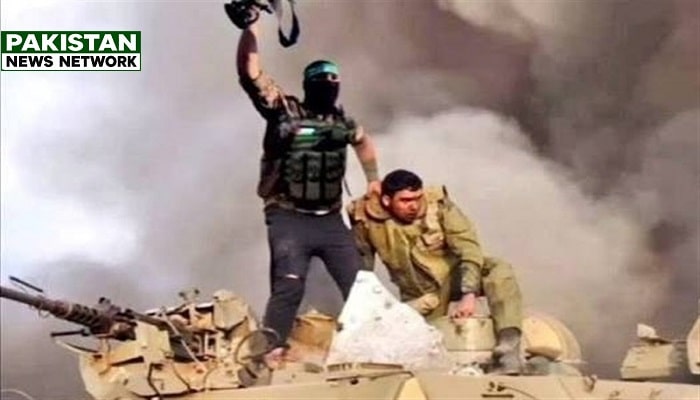
PNN – The regime that once harbored ambitions of normalizing relations with Arab nations now finds itself held captive by the repercussions of Operation Al-Aqsa Flood.
According to the report of Pakistan News Network; as the third anniversary of Operation Al-Aqsa Flood (October 7, 2023) arrives, it is evident that the West Asia region continues to exist in an atmosphere defined by the aftershocks of that historic operation.
Over the past three years, the Zionist regime’s military machine has engaged in its most extensive and unprecedented military actions; the killing of tens of thousands of civilians, the destruction of the entire fabric of life in Gaza, the expansion of the war into Lebanon, targeted assassinations across the region, and entry into broad regional conflicts have constituted the core of Tel Aviv’s operational landscape.
It was against this backdrop of intense media frenzy that certain observers and analytical circles sought to argue—citing the sheer scale of these offensive attacks and the resulting carnage—that Tel Aviv was leveraging this crisis as a springboard to consolidate its authority, redefine power dynamics, and secure a position of dominance.
However, a profound assessment of a strategic shift requires moving beyond the surface of events on the ground to examine the enduring foundations of power. The fundamental question is whether this intense military action has succeeded in shifting macro-level geopolitical, economic, and social trends in Israel’s favor, or if—beneath the visible layers of the conflict—a process of deep, irreversible attrition has been unfolding.
To grasp the answer, if we view the issue from a more strategic perspective, we encounter a vastly different picture. The most critical historical undertaking for Israel and the United States in recent decades has been the effort to structurally integrate Tel Aviv into the global economic and security architecture.
A Shot at Israel’s Integration Project
Israel’s most vital historical doctrine over the past decade was the thesis of “structural integration into the global economy and security architecture.” Strategic thinkers in Tel Aviv believed that by moving past the Palestinian cause and effectively freezing the issue of the occupation, Israel could establish itself as a regional anchor for technology, transit, energy, and security. This doctrine rested on the assumption that shared economic, commercial, and security interests between Arab and Western nations and Israel would ultimately neutralize the historical weight of the Palestinian issue.
The signing of the normalization agreements known as the “Abraham Accords” in 2020 marked the first operational step toward validating this hypothesis; prior to October 7, the Zionist regime had already established official relations with countries such as the UAE, Bahrain, and Morocco within this framework.
The final link in this diplomatic project was the accelerated negotiation process aimed at normalizing relations with Saudi Arabia. Washington and Tel Aviv were vigorously pursuing a plan under which Riyadh would formalize ties with Israel in exchange for a defense pact with the U.S. and access to nuclear technology. At the time, reports suggested that Saudi Arabia had sidelined the Palestinian issue and was prepared to publicly announce the normalization of relations with Israel.
The next step in finalizing this new architecture was the unveiling of the “India-Middle East-Europe Economic Corridor (IMEC)” project at the G20 summit—a mega-project designed to transform the Port of Haifa into a central artery for trade and transit between Asia and Europe, serving as a key strategic counter to China’s “Belt and Road Initiative.” Under this model, Israel sought not only to break out of its geographic isolation but also to position itself as a regional hub for energy, fiber-optic cables, and rail transit.
However, the shock of October 7 and the war in Gaza instantly shattered this fragile structure and the regional schemes orchestrated by the US and Israel. Riyadh immediately suspended all normalization talks and once again insisted on the establishment of an independent Palestinian state based on the 1967 borders as a non-negotiable condition.
Meanwhile, the implementation of the IMEC corridor project stalled due to maritime insecurity, attacks in the Red Sea, and political unrest, prompting international investors to pull back. The Abraham Accords were reduced to a hollow shell; ambassadors were recalled, and open commercial exchanges gave way to widespread public revulsion across the Arab world.
The Collapse of the Illusion of Israeli Invincibility
Beyond the diplomatic ramifications, the blow dealt to Israel’s security doctrine on October 7 shattered the very foundations of its military prestige and deterrence. For over seven decades, Tel Aviv’s security doctrine rested on three core pillars: “early warning,” “impenetrable defense,” and “swift, decisive victory on enemy soil.”
For years, Israel has sought to cultivate a global brand of “absolute security” and “invincibility” through extensive media promotion of advanced technologies—such as the smart border wall with Gaza and the Iron Dome system—and the prowess of its intelligence agencies, Aman and Shin Bet.
Operation Al-Aqsa Flood shattered this modern myth in a matter of hours. The sudden collapse of defense lines around the Gaza envelope, the blinding of electronic surveillance systems, and the hours-long confusion within the military command revealed that not only was there no timely warning, but the premise of invincibility was merely a fragile, glass-like veneer masking deeply vulnerable layers.
Even according to the latest official assessments by Israel’s own security think tanks, this strategic failure has by no means been rectified. A comprehensive report titled “Israel’s National Security Balance,” recently published by the Institute for National Security Studies (INSS), reveals deep public disillusionment and mistrust regarding military achievements.
In the institute’s survey, 42 percent of Israelis described the regime’s national security situation as “poor or very poor,” while only 20 percent rated it as “good.” Furthermore, the INSS survey on “existential threats” identified the scenario of “intense, violent conflict between domestic Israeli groups” as the primary threat—ranking it above even Iran’s nuclear program and external crises.
According to statistics cited in this report, between 12% and 23% of residents in occupied Palestine have stated that the consequences of the crisis and the upcoming elections have led them to consider permanently leaving the territory (reverse migration)—a phenomenon that has resulted in an unprecedented negative migration balance, particularly among the academic and technical elite.
Structural Paralysis in Economic Arteries
In addition to the collapse of deterrence and a diplomatic impasse, Israel’s economic arteries have also suffered severe structural paralysis following the Gaza war. A report by the INSS confirms that, while Israel’s economy has not come to a complete halt, it has undergone a “profound structural shift and a sharp decline in the standard of living.”
Direct and indirect war costs surpassed the $200 billion mark, and the budget deficit surged to unprecedented levels. For the first time in history, the world’s three major credit rating agencies—Moody’s, S&P, and Fitch—downgraded Israel’s credit rating in multiple steps, a move that sharply increased the cost of foreign borrowing.
The formal bankruptcy of the Port of Eilat following a naval blockade, the collapse of the tourism industry, a widespread slump in the construction sector due to the revocation of Palestinian work permits, and the flight of investors from the IT sector all reveal the dimensions of a full-blown economic collapse.
Heavy toll on Gross National Income: According to INSS statistics, the war is projected to inflict damage amounting to 175 billion shekels (equivalent to 8.5% of annual GDP) on Israel’s civilian economic sector by the autumn of 2026.
Decline in per capita income: Based on analytical calculations by the Bank of Israel and the INSS report, over the 27-month conflict period (autumn 2023 through the end of 2025), each resident of occupied Palestine will have incurred an average cumulative loss of 35,000 shekels relative to the income and welfare levels projected based on pre-war trends.
Doubling of the military budget: The Zionist regime’s military budget has surged from 4% to over 8% of GDP (exceeding 150 billion shekels)—a move that has crippled long-term growth potential by consuming funds earmarked for infrastructure, education, and healthcare.
Credit rating downgrade and debt surge: The debt-to-GDP ratio has risen by 9 percentage points, reaching the 69% mark, while the budget deficit has stabilized at a critical level of 5%. Rating agencies have successively downgraded Israel’s credit rating.
Transforming Israel into a Pariah State
One of the most profound consequences of October 7 was the total collapse of Israel’s international legal immunity. Prior to this event, Tel Aviv—relying on Washington’s protective umbrella—had considered itself beyond the reach of UN legal bodies; however, the scale of the atrocities in Gaza led South Africa, for the first time in history, to initiate formal proceedings against Israel at the International Court of Justice (ICJ) in The Hague on charges of genocide.
By issuing emergency provisional measures, the Court ordered Israel to immediately halt any acts amounting to genocide and to refrain from obstructing the delivery of humanitarian aid—a legal development that formally undermined the credibility of Tel Aviv’s claims regarding self-defense.
A more decisive legal blow was dealt when the Chief Prosecutor of the International Criminal Court (ICC) sought arrest warrants for Benjamin Netanyahu (Prime Minister) and Yoav Gallant (Israel’s then-Defense Minister) on charges of war crimes and crimes against humanity—including the use of starvation as a weapon of war and directing attacks against civilians.
Placing Israel’s highest-ranking political and military officials alongside the world’s major accused war criminals not only stripped them of the freedom to travel diplomatically to the more than 120 countries that are signatories to the Rome Statute but also—as emphasized in an INSS report—transformed Tel Aviv’s international image into that of a “pariah and lawless regime.”
The Scandal of the Western “Freedom of Speech” Posture
The social repercussions of October 7th transcended Middle Eastern borders, striking at the political heart of Tel Aviv’s primary ally: the United States. An unprecedented wave of student uprisings swept across more than sixty leading American universities—including Columbia, Harvard, Yale, UCLA, and MIT—in support of Gaza. Through sit-ins and encampments, students demanded a complete severance of their universities’ financial and academic ties to arms manufacturers and institutions linked to Israel.
These sit-ins were suppressed by US police in the most brutal manner possible; the deployment of riot police onto university campuses, the use of tear gas and rubber bullets, and the arrest of over 3,000 students and faculty members across the United States inflicted unprecedented damage on the country’s international image.
Washington—which for years had portrayed itself to the world as a champion of freedom of speech, the right to peaceful assembly, and human rights—sacrificed its core principles before the eyes of the global community in order to suppress those protesting the carnage in Gaza.
Unprecedented Global Hostility toward Israel
The war on Gaza has intensified hatred toward the Zionist regime to an unprecedented level. Data from a global survey conducted by the Pew Research Center—covering 44,657 individuals across 36 countries—reveals the extent to which the events of October 7 have turned global public opinion against Israel.
According to this data, an average of 67 percent of people worldwide hold a negative view of Israel, and the level of distrust in Netanyahu exceeds 80 percent in most Western nations.
An overwhelming majority of respondents across 36 countries have emphasized that they have no confidence or faith in Benjamin Netanyahu’s decision-making regarding global affairs. In European nations such as Italy (88%), Sweden (84%), Germany (83%), and the UK (75%), the public has demonstrated deep mistrust of the Israeli Prime Minister.
In contrast to the political support provided by Western governments, European public opinion has adopted a very harsh stance against Tel Aviv. An overwhelming majority of people in Sweden (78%), Spain (78%), the Netherlands (76%), Italy (75%), Germany (73%), and the UK (69%) hold a negative view of Israel.
Even in the United States—Tel Aviv’s primary ally—60 percent of the public has developed a negative view of Israel, and a deep ideological divide has emerged; notably, 83 percent of liberals and a vast majority of young Americans (aged 18 to 34) consider Israel’s actions indefensible. Academic and student boycotts, the suspension of certain arms shipments by European nations such as the UK and the Netherlands, restrictions on arms sales by Canada, and targeted sanctions imposed by the European Union against specific entities and extremist settlers have demonstrated that Western allies are no longer willing to give Tel Aviv a blank check.
Conclusion
When these legal facts—alongside the failure of deterrence, the shattered illusion of invincibility, domestic despair, declining economic welfare indicators, unprecedented political repression within the U.S., and international statistical evidence—are viewed together, the invalidity of the “Israel benefited from October 7” hypothesis becomes glaringly apparent.
A regime that once harbored ambitions of establishing global corridors and normalizing relations with Arab nations now finds itself besieged by diplomatic isolation, economic paralysis, international prosecution, and global public loathing.